
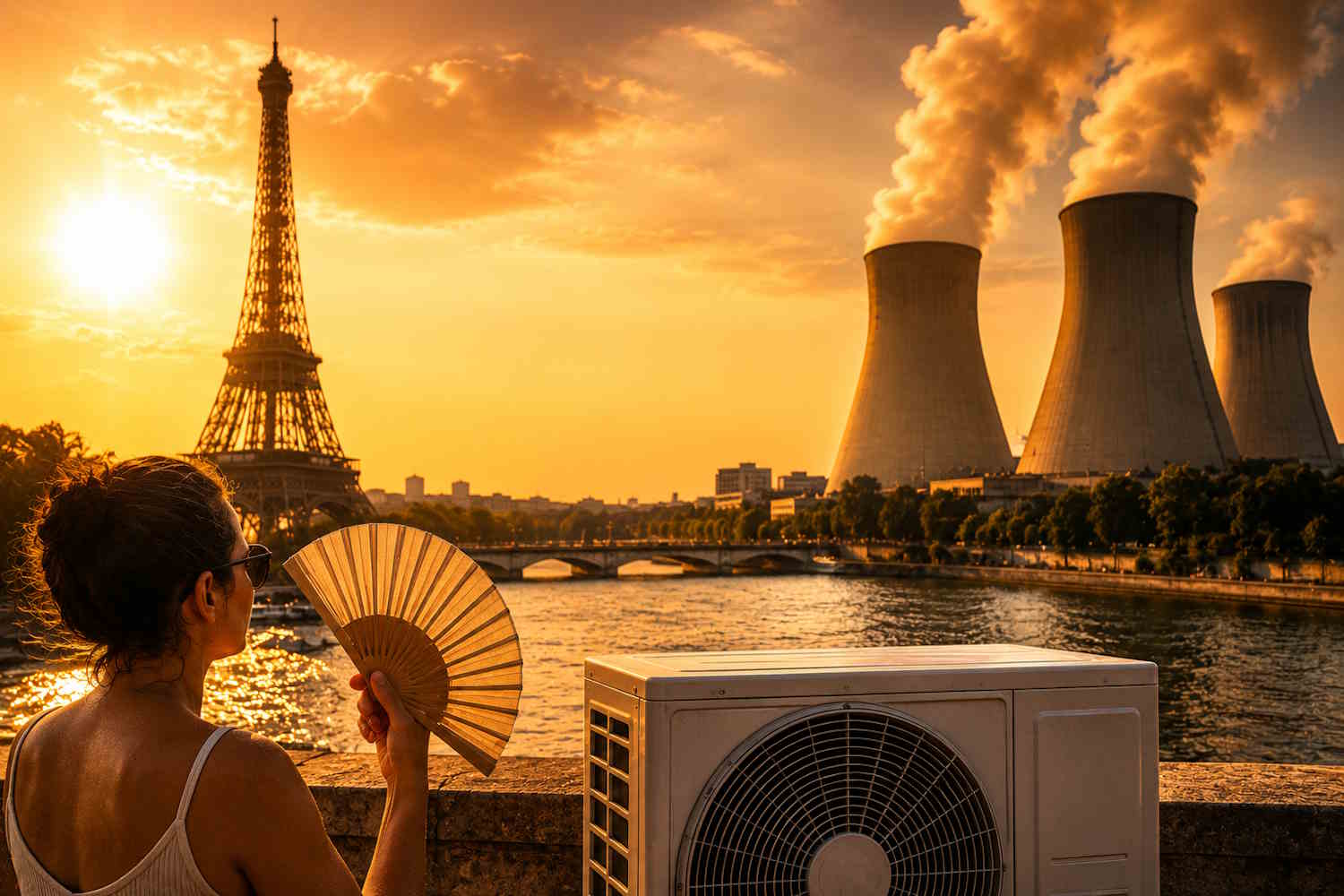
France is experiencing one of the most intense heat waves in its recent history. In many cities the thermometer has exceeded 40 degrees, tropical nights follow one another without respite and millions of people are desperately looking for a way to protect themselves from the caniculeas the French call great heat waves.
But what’s happening beyond the record temperatures tells an even more interesting story. Because while the race for air conditioners grows, the heat is putting pressure on the very energy system that should power them.
It’s the great paradox of the French summer.
France rushes to buy air conditioners
For decades, France has viewed air conditioning with a certain distrust. Unlike countries like Italy, Spain or the United States, the air conditioner has never really entered the daily life of most families.
This year, however, something seems to change.
Sales of fans and air conditioners are seeing significant increases as cities try to adapt to temperatures that just a few years ago would have been considered exceptional. The images arriving from Paris, Lyon and Marseille show people seeking refreshment in public fountains, parks and along waterways.
The debate is now open: have air conditioners become a health necessity or do they represent a solution that risks worsening the problem by increasing energy consumption?
Just when more energy is needed, nuclear power slows down
The question becomes even more delicate because the heat is creating difficulties for part of the French electricity system. In recent days, EDF has had to stop or reduce the production of some nuclear power plants due to excessively high temperatures recorded in the rivers used to cool the reactors.
When water from the Garonne, Rhone or other waterways reaches certain thresholds, plants cannot continue to discharge further heated water without risking damage to ecosystems. For this reason, limitations or temporary suspensions of production are applied.
The result is surprising. While millions of people turn on fans and air conditioners, increasing electricity needs, part of the infrastructure that should produce that energy is forced to slow down precisely because of the same climate phenomenon.
The heat increases the demand for electricity and at the same time reduces the availability of part of the supply.
A contradiction that many experts consider one of the most effective images of the contemporary climate crisis.
“The only air conditioners we should talk about are trees”
In this climate of tension and concern, the words of Thomas Brail, one of the best-known defenders of trees and forests in France, are also causing a lot of discussion.
During a television program dedicated to the heat wave, the activist expressed all his frustration:
I hold back so as not to explode. We have been sounding the alarm for seven years. The only air conditioners we should be talking about are trees.
Words that are finding widespread echo in the French media and on social media.
For Brail, the debate on air conditioning risks in fact focusing on the symptoms rather than the causes. Trees, he claims, represent the most effective natural cooling system available to us: they produce shade, absorb carbon dioxide, promote evapotranspiration and can lower urban temperatures by several degrees.
They cost us zero euros and do everything for free, he recalled.
The problem is not just how many trees we have
The activist also points the finger at the continuous artificialization of soils and against reforestation policies that favor monocultures. According to Brail, a forest is not a simple sum of trees. It is a complex ecosystem that functions thanks to biodiversity. Replacing natural forests with uniform plantations means losing much of the ability to adapt to extreme events.
His criticism comes at a time when many French cities are trying to increase green surfaces to counter so-called urban heat islands, those heavily concreted areas that during the summer can reach much higher temperatures than areas rich in vegetation.
View this post on Instagram
The true lesson of the canicule
Behind Thomas Brail’s anger there is a question that is crossing the whole of France. Is it possible to face increasingly extreme summers by simply installing more air conditioners?
Or do we need to rethink the way we build cities, protect forests and manage land?
This year’s heat seems to have transformed an environmental debate into a concrete issue of everyday life. Because the heat isn’t just making it harder to sleep at night. It is calling into question infrastructure, urban models and even the energy system of one of the most nuclear countries in the world.
And the fact that one of Europe’s main atomic powers finds itself having to slow down some reactors just as the need for electricity increases could be the most powerful symbol of this new climate reality.
