
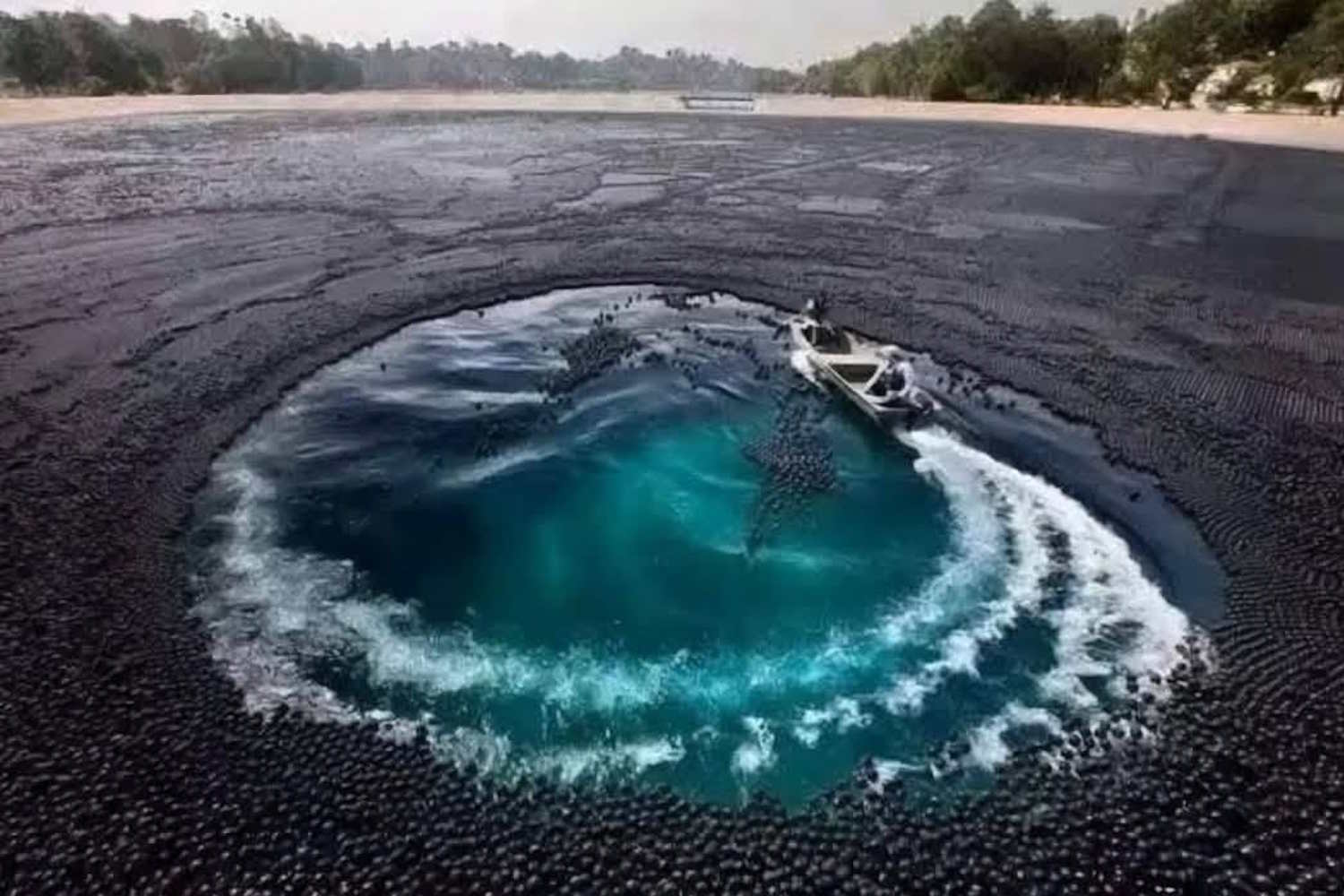
Seeing them from above is almost impressive. Millions of black spheres floating compactly on the surface of a huge reservoir, so much so that the water seems to have disappeared.
Yet, that day in 2015, when 96 million plastic pellets were poured into the Van Norman reservoir in Los Angeles, it was neither a crazy gesture nor an art installation: it was one of the largest environmental engineering experiments ever carried out to combat drought.
In those years, California was experiencing one of the worst water crises in its history. Precipitation had plummeted, temperatures continued to rise, and the city’s main drinking water basin was losing about 300 million gallons of water to evaporation each year. A huge quantity, enough to supply thousands of people.
The solution chosen by the authorities was as simple as it was surprising: cover the surface of the water with millions of “shade balls”, floating black spheres designed to block sunlight.
What are shade balls
Each ball measures approximately 10 centimeters in diameter and is made of high-density polyethylene, a UV-resistant plastic. Inside it contains a small amount of water which increases its weight and prevents the wind from carrying it away. The black color is not accidental. The spheres are added with carbon black, a substance that absorbs ultraviolet rays and slows down their degradation. Their main function is to create a mobile cover on the surface of the basin, limiting direct contact between water and sun.
According to estimates from the Los Angeles Department of Water and Power, this solution was able to reduce evaporation by up to 85-90%, saving hundreds of millions of gallons of water each year.
The shade balls were not only used to conserve water, another problem had also emerged in California basins: the formation of bromate, a substance classified as potentially carcinogenic. The compound is generated when the chlorine used to disinfect water reacts with the bromide naturally present in water resources, a process accelerated by exposure to ultraviolet rays.
By reducing the amount of light that reaches the surface, the balls also contribute to limiting these unwanted chemical reactions and containing the proliferation of algae and microorganisms.
An economical solution
The surgery cost approximately $34.5 million. An certainly important figure, but much lower than the approximately 300 million that would have been necessary to install a traditional floating cover over the entire basin. The size of the tank in fact made many of the hypothesized solutions impracticable. With its over 700 thousand square meters of surface area, the Van Norman Reservoir represented an enormous engineering challenge.
Shade balls therefore appeared as the best compromise between costs, effectiveness and speed of installation. Not everyone, however, welcomed this choice with enthusiasm.
Producing 96 million spheres required large amounts of plastic, energy and water. Some studies have shown that their manufacturing would have consumed over 700 million gallons of water, more than double the annual savings achieved by reducing evaporation.
Supporters of the project, however, point out that, having an estimated lifespan of about ten years, the balls end up compensating for their initial impact after a few years of use.
However, the question of microplastics remains open: although the spheres have been designed to withstand the most extreme environmental conditions, prolonged exposure to sun, wind and water can favor the deterioration of the materials over time and the release of increasingly smaller plastic particles. For this reason the project continues to be monitored and still represents a case study in the international debate on climate adaptation solutions.
More than ten years later, the image of the 96 million black balls remains one of the most iconic in the fight against the water crisis.
The Los Angeles experiment shows how adapting to climate change often requires creative and unconventional solutions. But also remember that every technological intervention brings with it new questions: how sustainable is it? What consequences can it have in the long term? And above all, can it really replace more responsible management of natural resources?
With increasingly frequent droughts and constantly rising temperatures, protecting water supplies will be one of the great challenges of the 21st century. The shade balls represent a possible answer. Not perfect, not without critical issues, but capable of opening an important reflection on how to live with a changing climate.
