
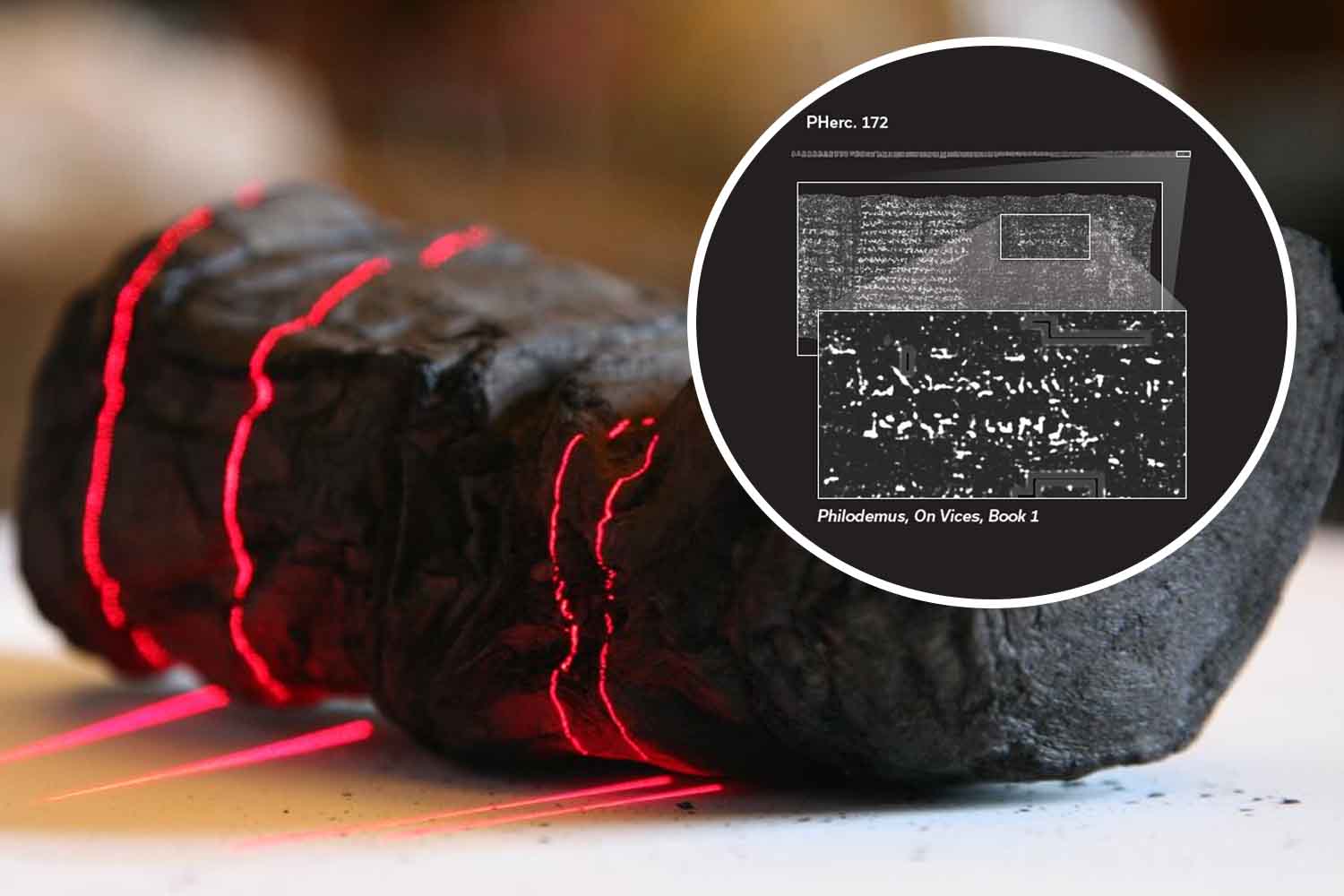
A small, crumpled, apparently silent black scroll. Looking at it like that, it looks more like a lump of coal than a book. And instead inside one of the papyri of Herculaneumsealed by the eruption of Vesuvius in 79 AD, there were still words. Not vague impressions, not signs read by dint of enthusiasm, but columns of Greek text reconstructed without physically touching the papyrus. The news comes from the Vesuvius Challenge, the international project born in 2023 to decipher the carbonized scrolls using X-ray imaging, machine learning and philological work.
The strongest result concerns the papyrus PHerc. 1667virtually unrolled and read along the entire preserved portion. We’re talking about almost one and a half meters of textdistributed over approximately twenty columns, without opening the scroll and without subjecting it to the risk of further destruction. It’s a technical breakthrough, sure. But also a quite concrete scene: after almost two thousand years, a burned and buried library begins to return sentences, ideas, philosophical discussions. With all the slowness and patience that this thing demands.
The book was closed, not lost
The Herculaneum papyri come from the Villa dei Papiri, one of the most incredible discoveries of Vesuvian archaeology. There, under the ash and volcanic material, remained the only ancient library that has come down to us with its scrolls still preserved. The point is cruel: Vesuvius charred them, making them very fragile, but that very trauma also protected them from time. They remained there, blackened, compressed, almost impossible to handle.
For centuries the problem was this: to read a papyrus you had to open it, and to open it you risked destroying it. Some attempts in the past have produced precious fragments, but also irreversible damage. The PHerc. 1667, for example, had already been partly manipulated between the nineteenth and twentieth centuries. The internal core of the scroll remained, a compact portion about eight centimeters high. That kind of dark lump has become the testing ground for a technology that works without scissors, without tweezers, without trembling fingers over ancient material.
The mechanism is complex, but the mental image is quite clear. The roll is scanned with very high resolution X-rays, then its internal geometry is digitally reconstructed. The rolled layers are followed, separated, laid out into a readable surface. At that point the models intervene artificial intelligencetrained to recognize tiny differences between carbonized papyrus and ink, which is often carbonaceous itself. In practice: black on black. A wickedness of matter.
What they read in the Herculaneum papyri
Inside the PHerc. 1667 a philosophical text from the Stoic area emerged, probably linked to the environment of Chrysippusone of the great names of ancient Stoicism, or to one of his students. In the final part the name of Aristocreon, nephew and disciple of Chrysippus, appears. The text addresses ethical issues, impulses, human behavior, practical wisdom. Stuff that said like this seems dusty, until you remember that these are the same questions we still carry with us today: how to act, how to control ourselves, how to distinguish a clear choice from an automatic reflex.
It’s not the only discovery. In the papyrus PHerc. 139 was identified Book 8 of the work On the gods Of Philodemus of GadaraEpicurean philosopher of the 1st century BC very present in the library of Herculaneum. The data is important because it shows that the work was broader than what could be reconstructed so far and forces scholars to revisit the map of the texts attributed to Philodemus. Not a footnote curiosity, then, but a piece that shifts the understanding of an entire philosophical corpus.
From the papyrus PHerc. 172preserved at the Bodleian Library in Oxford, over seventy columns of the On vicesBook 1, also attributed to Philodemus. Here we are talking about character flaws, arrogance, greed, flattery. After two thousand years, the old, very solid human defects also emerge from the burnt scrolls. Those have weathered eruptions, empires, destroyed libraries, and software upgrades just fine.
X-rays, synchrotrons and AI: reading passes through matter
The technological part revolves around enormous and very precise instruments, such as the European synchrotrons used to obtain internal scans of papyrus. The Diamond Light Source in the UK and the ESRF in Grenoble have played a central role in the imaging work. These machines allow you to observe the inside of the scrolls without opening them, following folds, layers and deformations accumulated over almost two thousand years.
AI, however, should not be imagined as an oracle that takes a charred papyrus and magically transforms it into a book page. Work on minimal signals. Research published in arXiv showed that the surface of written areas contains sufficient morphological differences to distinguish ink from papyrus, even when traditional X-ray contrast is almost useless. Translated: you don’t just read the color, you read the skin of the papyrus. Its reliefs, its irregularities, the traces left by writing.
Then comes human work, the least noisy and most decisive. Papyrologists, philologists, classicists and historians must verify, transcribe, compare and discuss every word. The machine helps you see. She doesn’t decide for herself what an ancient author says. This detail matters, because amidst the enthusiasm for artificial intelligence there is always the risk of transforming a tool into a character. Here the character remains the papyrus. The AI holds the lamp.
An entire library can start talking again
Second Reutersthe Vesuvius Challenge has already awarded over $1.8 million in prizes and is offering a new $1 million prize to push scroll reading even further. The point is not just the single papyrus read today. The point is the method. If it works on a scroll, it can be improved, repeated, checked, applied to other still closed papyri.
And there are many of them. Hundreds of scrolls still remain to be read. Some are preserved in Naples, others in international collections. Furthermore, parts of the Villa dei Papiri could contain other unexcavated material. Every step forward in virtual reading opens up an enormous possibility: recovering Greek and perhaps Latin texts that the modern world thought were lost forever.
Of course, caution is needed. Texts are damaged, columns have gaps, words can be difficult to reconstruct, attributions take time. Here the revelation proceeds inch by inch: it is not a curtain that opens wide, it rather resembles a torch pointed into a buried room, strong enough to make us understand that there is still a lot inside there.
