
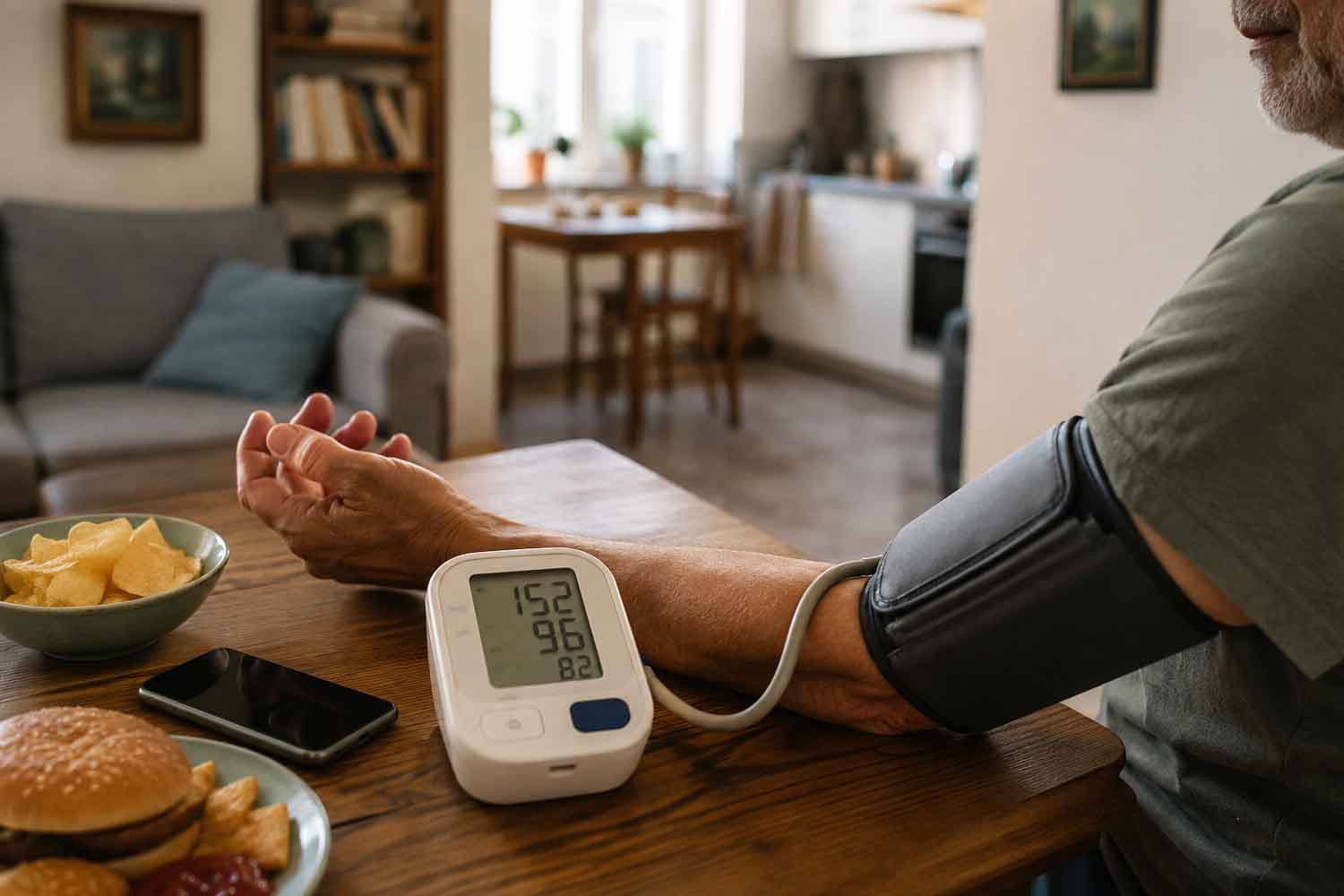
The bracelet that tightens the arm, the little silence before the number, the automatic look towards the maximum and minimum. Blood pressure is measured like this, in a few seconds, often in the pharmacy, at the doctor’s, at home, with that routine of a check-up. Yet an enormous part of Italians’ health passes inside those numbers.
According to ISTAT data, the share of people with hypertension went from 6.4% in 1980 to 10.2% in 1995, up to 18.9% estimated for 2025. In practice, almost three times as much. A leap that tells of both a conquest and a failure: we live longer, we control ourselves more, we intercept many conditions sooner, but the body also presents the toll of years spent sitting, of excess weight, of salt hidden in daily food, of movement postponed until the following Monday.
We live longer, we get sick longer
The ISTAT photograph starts from some good news, enormous news: between 1990 and 2024, life expectancy at birth grew by around 8 years for men and 6.5 years for women, reaching 81.5 and 85.6 years respectively. Increasing the years of life, however, also means encountering the chronic-degenerative pathologies typical of advanced age more often. Multimorbidity, i.e. the simultaneous presence of two or more chronic diseases in the same person, affects approximately 13 million people in 2025, compared to 10.3 million in 1993; among them, 39% are over 75 years old.
In this longer-lived Italy, hypertension finds its place easily. Part of the increase depends on the higher average age of the population. Another part comes from progress in diagnosis, earlier checks, and clinical thresholds updated over time. The most inconvenient fact, however, remains the other: ISTAT also links growth to the adoption of unhealthy lifestyles, capable of worsening risk factors such as excess weight among people who are still far from old age. Translated into everyday life: high blood pressure stops being just an “elderly” thing and also begins to talk about desks, long shifts, car rental for every trip, ready dinners, salty snacks, short sleep, stress chewed badly.
The sofa weighs as much as salt
The World Health Organization defines hypertension as too high blood pressure, generally equal to or higher than 140/90 mmHg, and reminds us of a fundamental detail: many people with high blood pressure are fine, at least apparently. The simplest way to find out is to measure it. Among the factors that increase the risk are age, family predisposition, overweight or obesity, physical inactivity, diet high in salt and excessive alcohol consumption. As of 2024, approximately 1.4 billion adults aged 30 to 79 were living with hypertension globally, representing one in three adults in that age group.
The Istituto Superiore di Sanità places salt among the most concrete daily actions to intervene on: reducing daily consumption by around 5 grams can lower blood pressure by around 5 mmHg. The same page of the Heart Project indicates that a diet with more fruit and vegetables, regular physical activity, weight control, stopping smoking and stress management are useful. 30 minutes of brisk walking a day is enough to help blood pressure remain at more favorable levels. It doesn’t seem like much on paper alone. In the real day, often, it is precisely that little that jumps first.
Body weight remains one of the most visible issues. In Italy, obesity in adults has gone from 5.9% in 1990 to 11.6% in 2025, with higher values among men in the last twenty years, among people with less education and in the South. ISTAT also highlights an Italian paradox: in adults the levels remain among the lowest in the European Union, while overweight and obesity among children and young people are much higher than in other EU countries. The problem, therefore, has already booked the future.
The good news concerns smoking, the uncomfortable news concerns the rest
Something has really improved in recent decades. In 1980, over half of men aged 14 and over smoked, 54.3%; in 2025 the share fell to 22.9%. Among women the decline was smaller, from 16.7% to 15.9%. Pathologies linked to smoking habits, such as chronic bronchitis, have also recorded a clear improvement: in 1980 they affected over 4 million people, in 2025 around 2 million. A sign that collective habits change, when campaigns, bans, awareness and cultural pressure push in the same direction.
With hypertension, however, the enemy smells less. A cigarette is seen, a missed walk disappears. Salt in packaged products hides well. The weight increases slowly, without making any noise. A sedentary lifestyle disguises itself as work, tiredness, lack of time, poorly built cities. And stress remains socially accepted as long as the body finds the driest way to make itself heard. High blood pressure lives very well in this gray area: a serious thing with the appearance of a nuisance.
The PASSI surveillance of the ISS reminds us that hypertension is one of the main risk factors for stroke, heart attack, heart failure and renal failure, and is associated with modifiable factors such as salt content in the diet, obesity and physical inactivity. The same indicators also point out an important limit: many findings are based on diagnoses reported by people, so a portion of hypertension remains hidden, because someone has high blood pressure and is still unaware of it. Pressure, in the end, has this unpleasant talent: it transforms habits into numbers. And the numbers, sooner or later, stop being discrete.
You might also be interested in:
