
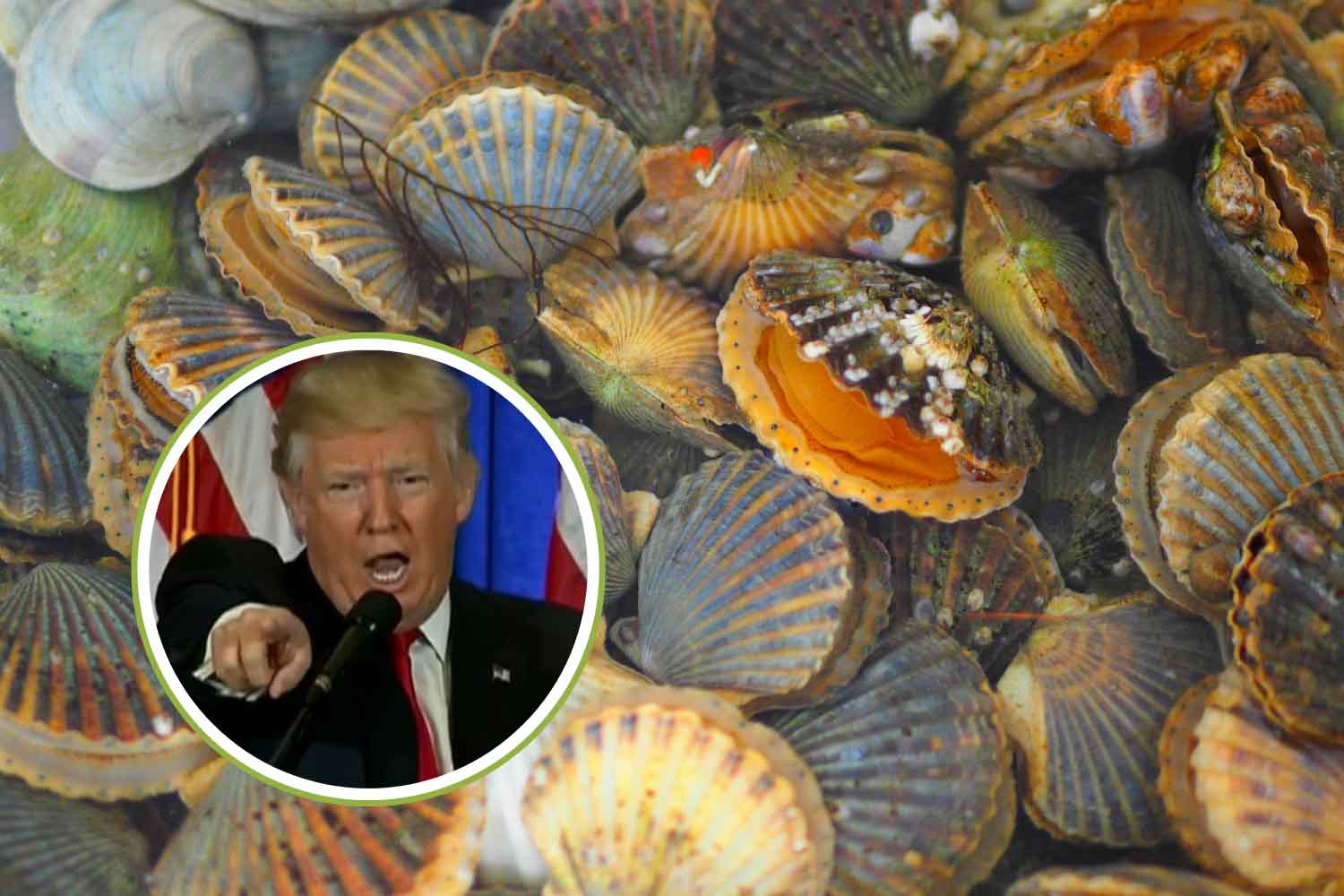
First the “communists” arrive, then the scallops. In Donald Trump’s story it works like this: a mollusc becomes proof of freedom, an environmental rule becomes sabotage, a seabed closed since 1994 becomes rallying material. The American president proclaimed National Scallop Day to celebrate the push to reopen fishing in the Northern Edge of Georges Bank, in New England, and invited people to vote Republican in the mid-term elections: he warned that if the “communists” win, fishermen will be able to forget about those scallops.
The sentence does its job. It takes the scene, covers everything else, reduces the sea to a stage joke. Yet, the serious part is right there, under the shell: Georges Bank is one of the great submerged banks of the Northwest Atlantic, historically very rich and historically exploited. In 1994, U.S. federal authorities closed areas of Georges Bank and Nantucket Shoals to bottom and scallop fishing. NOAA Fisheries recalls that in 1997 the Atlantic scallop was classified as overexploited. Thirty years later, that closure is treated as an ideological lock to be blown.
The mechanism is always the same: you take an environmental measure, stick a fairly noisy enemy on it and the rest disappears. Even the backdrop. The scallop, so far, is not registered with any party. It lives on the bottom, filters water, tries not to get scraped away. This alone is enough to end up in an ideological war.
The word “communists” covers the scraping of the dredgers
Atlantic scallop fishing occurs mainly with dredgers: metal frames towed along the seabed to collect the molluscs. NOAA explains that dredgers and bottom trawls can remove benthic organisms, damage living bottom structures, and alter habitats that serve as shelter and food for other species. Closures, rotations and tool limits exist for that. They are banks, not spite. The sea does not compile press releases to explain why it still needs them.
Fishing is harvesting. The one with dredgers is scraping. It can be regulated, limited, controlled, but physical pressure remains on an ecosystem. Opening a protected area for thirty years means putting heavy tools back on a seabed left out of commercial exploitation for a specific reason.
In June 2024, the New England Fishery Management Council stopped the Northern Edge from reopening. The area matters for Atlantic cod, American lobster, Atlantic herring, and future scallop productivity on Georges Bank. The technicians also reported an inconvenient fit: the best months for fishing scallops, June and July, overlap with delicate phases for young cod and lobsters with eggs. The access hypotheses evaluated also affected the cod spawning period, between March and May.
A biological tank passed off as a mine
The Northern Edge could be a kind of invisible nursery for other schools of scallops, from the Southern Flank of Georges to the Great South Channel to the Nantucket Lightship. And this is where the technical detail becomes political: that area not only contains shellfish ready to be harvested, it could help generate others elsewhere. Scraping there can fill the nets now and empty the future a little later. Politics lives on immediate harvests. The sea thinks over longer times, a bad habit for those who have to close an ad before the effect passes.
NOAA Fisheries, in the document dated July 2, 2026 on the administration’s priorities, talks about reducing burdens on national fisheries, landings decreasing since 2019, production to increase, markets to stabilize, American product to strengthen. Rotational access to the Northern Edge also appears in that package. Increasing production, at sea, means shifting pressure on living bodies, seabeds, reproductive seasons, target species and species dragged into the same gesture.
For 2026, meanwhile, Framework 40 on scallop fishing provides 36 days at sea for full-time permits and no new access areas. This makes the friction between the technical time of management and the political time of the announcement even more evident. On the one hand, limits, checks, seasons. On the other, a national holiday and the red enemy agitated in front of the fishing boats.
The sea transformed into a rally
Trump uses scallops as he uses everything else: he takes a concrete object, empties it, fills it with belonging. The fisherman becomes a symbol. The mollusk becomes identity. The environmental constraint becomes oppression. The word “communists” acts as a solvent: it dissolves the details, erases the complexity, leaves on the surface an easy-to-sell story.
The sea, however, retains traces. A dredge doesn’t pass as a post on Truth. It leaves signs where slow, small organisms live that are not very usable in an electoral campaign. Scallops have commercial value, sure. The seabed also has value, it’s just that it doesn’t count when we talk about landed kilos and American tables. It’s the usual accounting trick: you measure what reaches the market, you fade out what remains broken underneath.
Industrial fishing has already taken a lot from the oceans: any reopening should start from this premise. If an area has been closed since 1994, whoever wants to reopen it must demonstrate that the damage will be contained, measurable and reversible. It must do it with data, limits, controls. Scallops know nothing of Marx. They stay at the bottom, they filter water, they grow inside an ecosystem that is already squeezed enough. Trump put them on stage. The dredgers wait below, where the slogans stop making noise and start leaving marks.
You might also be interested in:
