
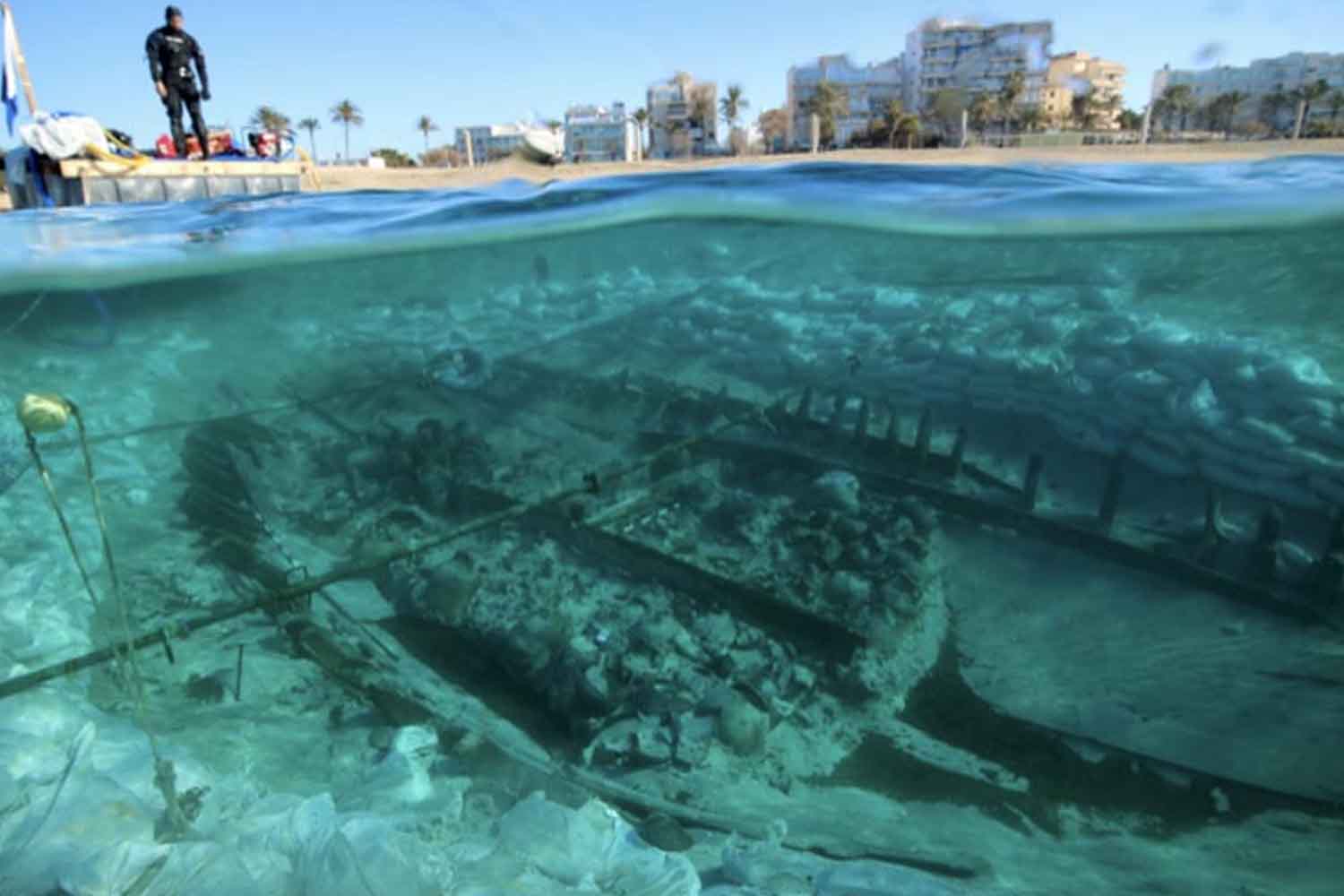
The sea in front of Playa de Palma revealed something that seemed to belong more to history books than to a beach frequented by swimmers. A few tens of meters from the coast of Mallorca, in shallow water, the recovery of the Roman wreck of Ses Fontanellesa 4th century AD merchant ship that remained under the sand for approximately 1,700 years and was discovered in 2019 after a storm.
The operation, coordinated by Council of Mallorca within the project Archeomallornautaclosed after four months of underwater work. The last portion of the hull was raised from the seabed on 29 June 2026, marking a rare milestone for Mediterranean archaeology: the complete recovery of a late ancient Roman ship, with much of the cargo and objects on board still legible.
©Universitat de Barcelona
A Roman ship under a few meters of water
The wreck lay about two meters deep, near the Les Meravelles area, in front of one of the most tourist areas of Mallorca. An almost paradoxical place: above, the ordinary life of the coast; below, a fragment of the Roman Mediterranean that remained stationary for centuries. The marine sediments themselves have protected the hull and many organic materials, creating favorable conditions for the conservation of wood, plant fibres, ropes and even parts of the sails.
©Universitat de Barcelona
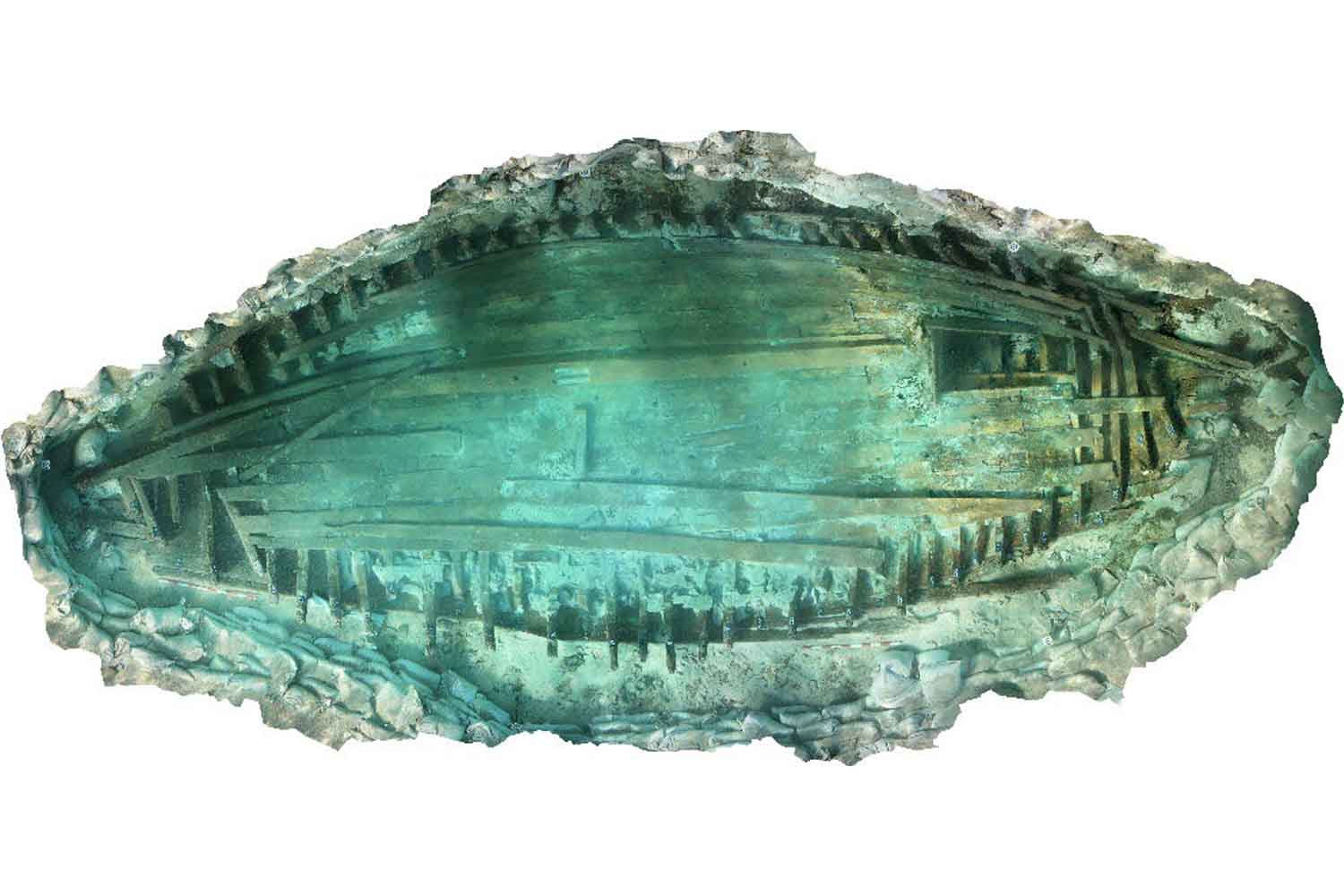
According to the Institute of Archeology ofUniversity of Barcelonathe site is also exceptional for its fragility: it was located very close to the shore, exposed to currents, human activities and possible damage. For this reason the recovery was treated as a patient race against time, with every element documented, mapped and raised following procedures designed not to compromise what the sea had preserved for so long.
The most delicate phase concerned the large wooden portions of the hull. The remains were secured with support structures, harnessed, lifted with flotation systems and transferred to the Club Marítimo San Antonio de la Playa. From there they were taken to the Castle of San Carlos, where their long stay in desalination tanks will begin. Once out of water, ancient wood becomes vulnerable: without specific treatments it can deform, crack and lose consistency. In practice, recovery from the sea is just the beginning of the slowest part.
Amphorae, shoes, baskets and an ancient drill
The Roman wreck of Ses Fontanelles it didn’t just return a naval facility. It brought to the surface a kind of inventory of life on board. Archaeologists have recovered hundreds of finds, including amphorae intended for the transport of food, ceramics, fragments of the hull, ropes, baskets, remains of linen sails, anchors and navigation tools.
©Universitat de Barcelona
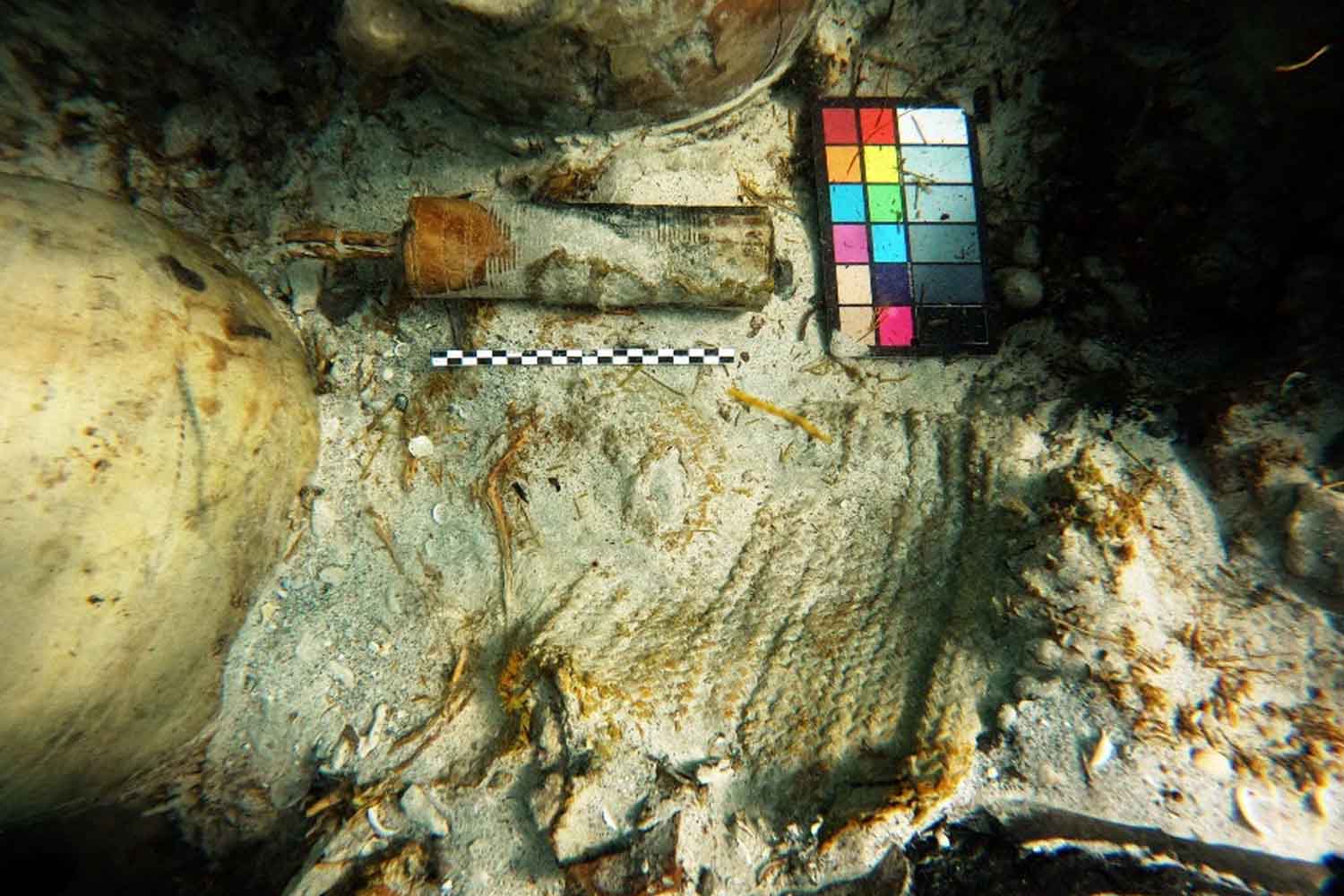
Among the more concrete objects there are shoes, coins, fishhooks, a lamp and a tool similar to a bow drill, probably linked to the work of ship carpenters. They are tiny details, and for this reason powerful. The amphorae tell of the routes and trades, of course. A shoe, a knotted rope, a tool left on board also tell the story of the material toil of those who steered that ship, repaired it, loaded it, perhaps feared it when the weather began to change.
Particularly important are the remains of the linen sails, found in very fragile conditions but still useful for understanding sewing techniques, reinforcements and assembly methods. In an ancient shipwreck, finding organic materials of this type is rare. Here the sea has preserved not only the “what” it travelled, but also part of the “how”: how a sail was built, how a ship was held together, how a crossing in the late ancient Mediterranean was undertaken.
The cargo left Roman Hispania
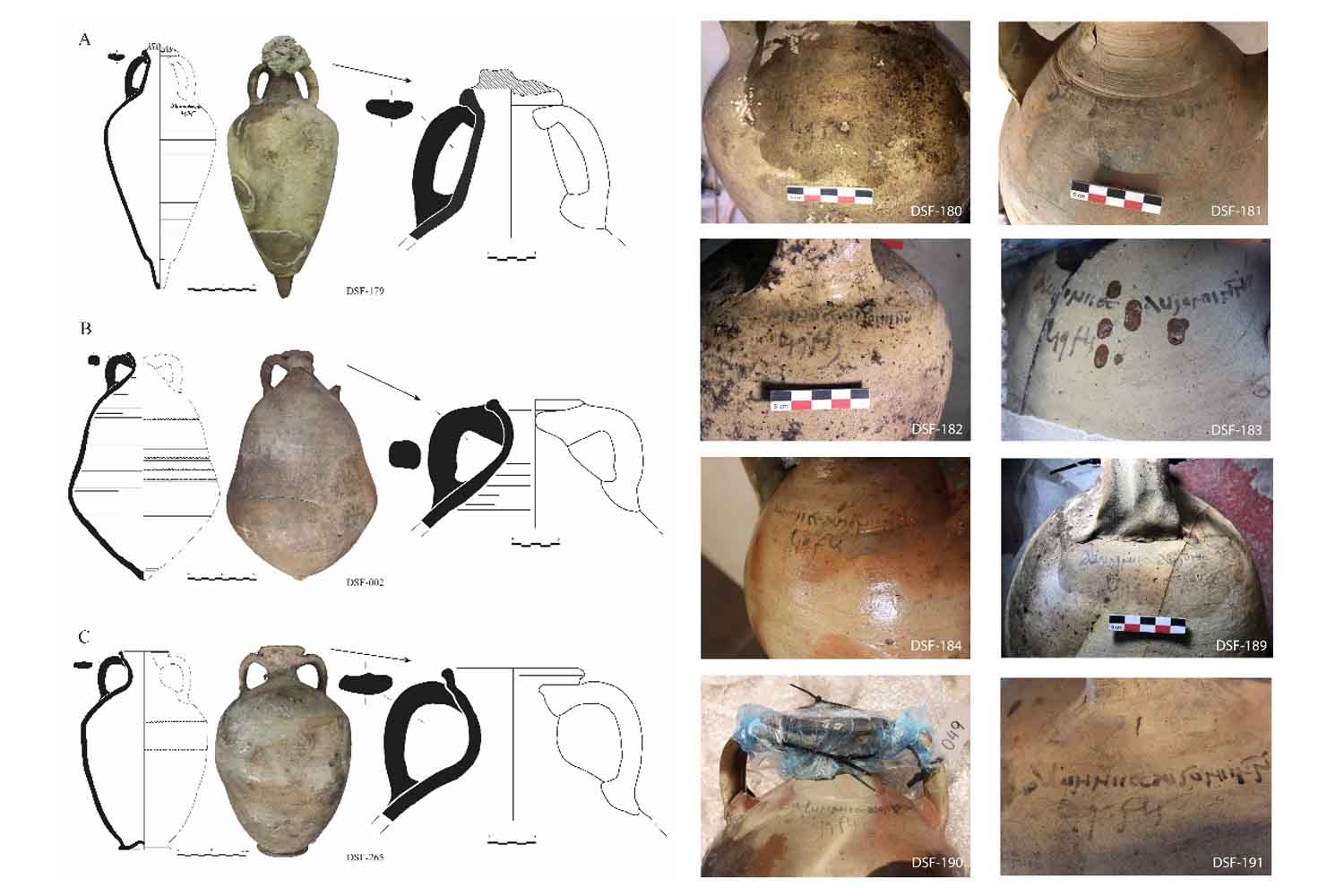
The amphorae are the commercial heart of the find. The project Archeomallornauta indicates that the wreck carried over 320 amphorae with oil, wine and fish sauces. The ship would have departed from the area of Carthago Spartaria, now Cartagena, on the south-eastern coast of Spain. In Roman times that port was an important hub in Hispania, connected to the trade routes of the western Mediterranean.
Making the cargo even more precious are the inscriptions painted on some amphorae, the so-called picti titles. They were a form of ancient label: they indicated contents, weight, origin, sometimes information related to merchants or the control of goods. A practical system, written directly on the containers, which today allows scholars to reconstruct the trade network, the organization of naval transport and the circulation of food products in the 4th century AD
©Universitat de Barcelona
Some amphorae caps also retained Christian symbols, such as the crismon. It is a detail that moves the wreck into an era of profound transformation of the Roman Empire, when Christianity was taking on an increasingly visible role even in public life and in everyday signs. A merchant ship, thus, becomes a compact page of economics, religion, navigation and imperial politics.
Why the Ses Fontanelles wreck is so important
The value of the wreck lies not only in its age. Several Roman ships are known, but few arrive in such a rich state of preservation, in such shallow waters and with such a legible load. Here scholars can observe together the hull, the stowage system, the amphorae, the inscriptions, the on-board instruments and the organic materials. It is a rare combination, almost an interrupted photograph of a journey that never ended.
The analyzes will be able to better clarify the construction techniques used by Roman shipyards, the type of wood used, the way in which the ship was assembled and the circumstances of the shipwreck. They will also be able to reconstruct with greater precision the route that the merchant ship was following when it sank in front of Mallorca. For now we know that it transported food goods, that it came from the south-eastern Iberian coast and that it was part of a late antique Mediterranean that was still very active, even as the Empire changed shape.
After desalination, the wooden remains will be subjected to more advanced restorations and conservative treatments. The work will move from the seabed to the laboratories, from cranes to analyses, from sand to microscopes. It is the least scenic part, but also the one that will really make the ship do the talking.
