
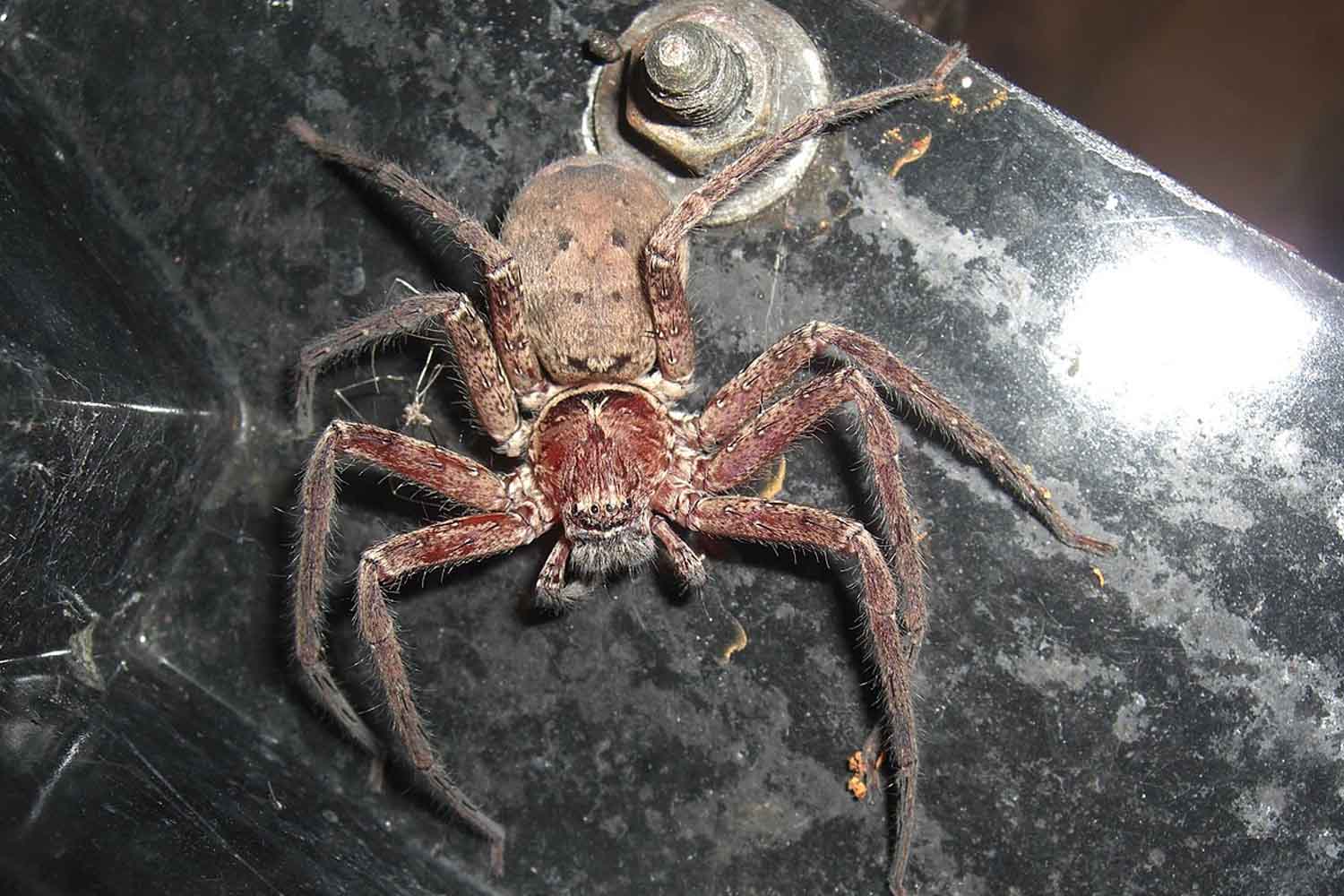
In the laboratory, a tiny scene can become almost comical: an A4 sheet of paper, a grid, a pointed camera and a spider that takes off as if it had just remembered that it had left the gas on. From this controlled race, much less spectacular than a documentary with anxiety-inducing music and much more useful for understanding how animals move, a new record emerged: the fastest spider in the world would be a Australian huntsmana “hunter spider” from Queensland, capable of reaching 3.59 meters per second, that is, almost 13 kilometers per hour.
For an animal that many of us would like to see still, far away and possibly out of the house, it is a remarkable performance. The study published as a preprint on bioRxivstill awaiting peer review, measured maximum sustained speed in 236 specimens from 162 species, then integrating previously published data to get a broader picture of 258 spider species.
A run on graph paper
The protagonist of the record belongs to the Heteropoda group, hunting spiders which are very widespread in eastern Australia and are often difficult to distinguish at a glance between very similar species, such as Heteropoda cervina and Heteropoda jugulans. Taxonomic confusion around these brown huntsmen has long existed, precisely because visible differences can be minimal and identification often requires specialist observations.
In the work, the maximum speed indicated for this spider reaches 3.59 m/s, a value much higher than that of the previous most famous candidate, the Moroccan “flic-flac” spider, known for its acrobatic movements in the desert. That case, however, left one question open: can his rapid movement, similar to a lateral somersault, really be considered running in the strict sense or does it belong to another form of locomotion.
To avoid mixing sprints, rolls and scenic escapes, the researchers chose a very concrete procedure. Each spider was weighed, then moved on A4 or A3 gridded sheets, fixed on a rigid plastic or metal base. The walls of the tray were treated with liquid paraffin, so the more adept climbing species stayed in the path instead of turning the experiment into a spider hunt around the lab.
The cameras recorded the movements to analyze the biomechanics of the run. Inside this almost domestic setup, between paper, body weight and filming, a surprising map of speed in arachnids emerged.
Big helps, too big slows it down
The first rule seems intuitive: in general, heavier spiders run faster. The comparison explains the scale of the phenomenon well. The tiny Maso sundevalli, a “money spider” of about 1 milligram, recorded just 0.018 meters per second. On the other hand, the approximately 3 gram Australian huntsman reached the record of 3.59 meters per second.
Between these two extremes lies a whole world of legs, abdomens, proportions and lifestyles. Body mass helps, at least as long as the body remains agile enough to support running. An abdomen that is too heavy can become a burden, as happens to those who want to sprint after a wedding dinner.
The mass, however, only tells part of the story. Two spiders with similar weight can move in completely different ways. The study cites the case of the spider Calommata signata and the tube-web spider Segestria florentina: both around 200 milligrams, yet with maximum speeds 28 times apart.
The body, therefore, weighs a lot, but its architecture also comes into play. After accounting for size and evolutionary parentage, the researchers found that better performance was associated with relatively longer legs, while the thinness of the legs mattered less. In practice, the lever seems to make the difference rather than the elegance of the frame.
Among the most curious exceptions also appears Oonops pulcher, a tiny orange goblin spider weighing just 0.1 milligrams, yet capable of exceeding 0.2 meters per second. On paper it seems like little, on the scale of its body it becomes an almost unreal escape. Certain spiders, seen at their scale, make movements so rapid that they disappear before the eye can even follow them.
The terrain changes everything
Speed, for a spider, only makes sense within the environment in which it lives. Hunting on the ground, moving through vegetation, running up a wall, hanging upside down or sprinting under bark requires different bodies and different solutions.
Huntsmen, for example, have long, sideways legs, flattened bodies, and a remarkable ability to change direction quickly. They are nocturnal spiders, often hidden under bark or in dark places during the day, ready to come out to look for prey. Some species even enter homes, much to the delight of those who already check the ceiling before sleeping.
The new study suggests just that: running in spiders arises from a cross between size, leg length, evolutionary history, environment and behavior. Pure speed is a headline, of course. The most interesting fact, however, lies in the way in which apparently similar species end up responding to different pressures.
A spider that hunts on the ground has different needs than one that moves between leaves and branches; someone who lives on vertical surfaces has to solve different problems than someone who runs on a flat surface. Natural selection also works on details like this: an extra millimeter of paw, a lighter abdomen, a more effective posture, a quicker escape at the right moment.
Then there is a necessary caution. The work is still a preprint, so it should be read as a promising scientific result, not as the last word set in stone. The peer review may confirm, correct or clarify some passages.
The record, at the moment, remains impressive: 3.59 meters per second for a spider means transforming an escape of a few centimeters into a flash disappearance. The next time a huntsman crosses an Australian wall, someone may call him an unwanted guest. He, in the meantime, will already be on the other side of the room.
You might also be interested in:
