
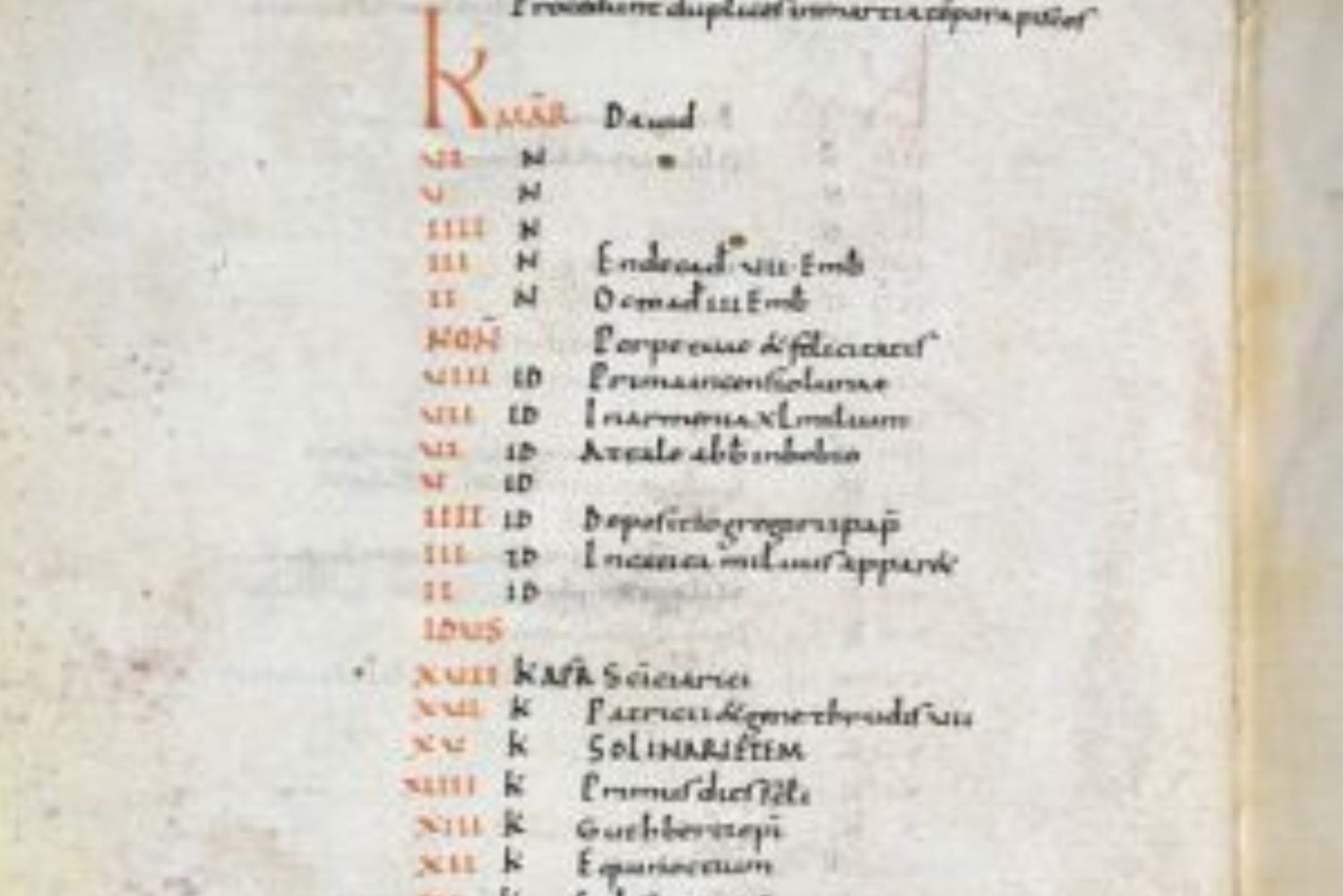
Sometimes time makes mistakes in silence. A day every now and then, a few minutes left behind, a season that slips just ahead of schedule. No one notices while it’s happening, because the calendar on the wall always seems to be right. And instead, in a manuscript kept in Florence, someone had already understood it more than twelve hundred years ago: the calendar used to count the days was falling behind the Sun.
The document, preserved in the Laurentian Library, contains a calendar of 813 which places alongside the conventional dates of the Julian calendar and those of real celestial phenomena. The result is surprising: already at the beginning of the 9th century a difference of approximately three days between the official calculation and the calendar year.
The discovery, which emerged from a study by the National Research Council, pushes back an awareness that is usually linked to subsequent centuries and, above all, to the great correction that arrived in 1582 with the Gregorian Reform. In between there are more than seven centuries, an enormous distance if we think about the history of the measurement of time.
The calendar that looked at the Sun
The Florentine manuscript was found in a Sacramentary from the Opera del Duomo. It had already been reported in the eighteenth century by the Jesuit astronomer Leonardo Ximenes, an important figure for science and hydraulics in grand-ducal Tuscany, yet its value for the history of astronomy had remained in the shadows.
The decisive point lies in a double registration. THE’spring equinox, according to the tradition established by the Council of Nicaea in 325, it remains indicated on March 21st. Alongside, however, another piece of data appears: on March 18, the entry of the Sun into Aries is noted, i.e. the real astronomical phenomenon. The same three-day advance also occurs for the other equinoxes and solstices.
To put it without turning the Middle Ages into a blackboard: whoever compiled that calendar knew that the official calendar told one thing and the sky showed another. And this difference was quantified with a precision compatible with what modern astronomy reconstructs today for the beginning of the 9th century.
Because the Julian calendar was wrong
The Julian calendarintroduced by Julius Caesar in 46 BC, had solved many problems of the previous Roman calendar. It established a year of 365 and a quarter days, with an additional day every four years. An effective, tidy system, robust enough to last for centuries.
The flaw was small, almost invisible: the Julian year was slightly longer than the actual solar year. A few minutes difference every year. Nonsense, one might think. Except that time has a ferocious patience: those minutes, accumulated over centuries, progressively moved equinoxes and solstices with respect to the dates written on the calendar.
By 1582 the discrepancy had become too obvious and Pope Gregory XIII introduced the Gregorian calendar, the one we still use today in much of the world. The reform deleted ten days from the civil calendar and changed the leap year rulemaking the calculation much closer to the actual cycle of the Earth around the Sun.
The 813 calendar tells something different and more subtle: the official correction would arrive much later, however problem had already been seen. Someone, in Carolingian Florence, had observed, compared, noted. He had left on the page a small fracture between the time of the Church and the time of heaven.
Florence within a network of knowledge
The manuscript precedes by about thirty years another calendar preserved in the Prüm area, Germany, dating back to 840. The similarities between the two documents suggest a broader cultural link: perhaps a common matrix, perhaps a network of exchanges between study centers of the Carolingian Empire, perhaps a knowledge that circulated more than we imagine when we think of the Middle Ages as a time that was still, closed, almost dark by definition.
Here, however, darkness has little to do with it. It involves a city, Florence, in an era long before its Renaissance splendor. Monks, copyists, scholars of ecclesiastical calculations, people accustomed to counting time to establish holidays, anniversaries and liturgical cycles have something to do with it. A practical culture has to do with it, where astronomy, religion and calendar were in the same mental notebook.
The calendar of 813 it doesn’t change the way we measure days today. Something changes in the history of how we learned to measure them. It shows that the Julian calendar error had been recognized long before its official correction. And it does so with an almost disarming concreteness: one date next to another, March 18 next to March 21, the Sun passing where it must pass and the man who finally notices it.
Time, every now and then, leaves evidence. You just need to know how to read the right margin.
