
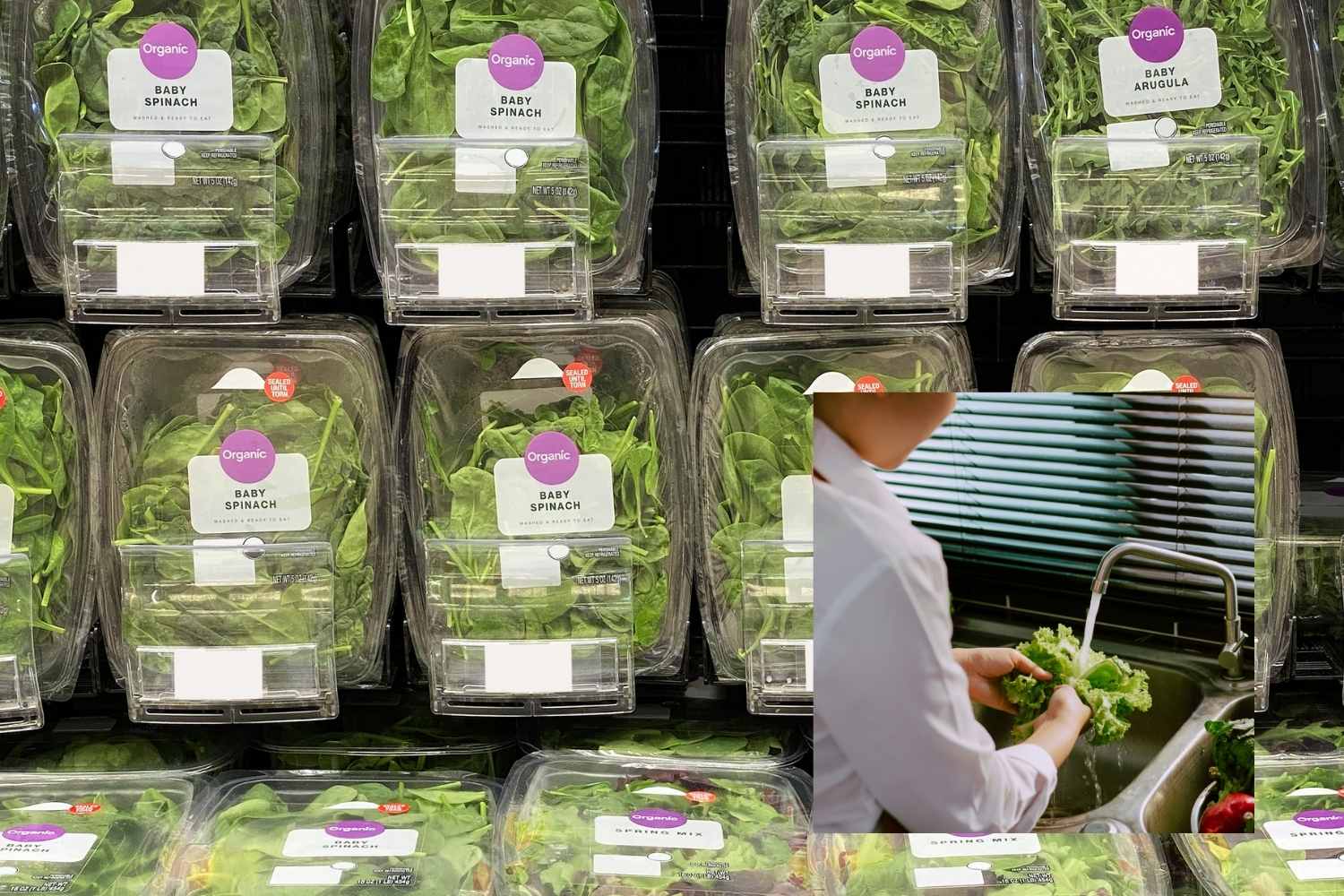
You buy the ready-made salad and, once you get home, pass it under the tap anyway “just to be safe”. It is an almost automatic gesture, one of those that are done without thinking, even if that extra rinse, in most cases, adds nothing to the safety of the product. In fact, in certain conditions it can even make it worse.
The starting point is the label
Not all packaged salads are the same, and the first thing to do, before even opening the bag, is to read what is written on it. Most of those found on the refrigerated counter belong to the so-called fourth range, which means fresh vegetables already washed, cut and packaged, ready to go directly into the bowl. If the label says “washed and ready for consumption”, that step in the company has already been completed. In the industrial process, the leaves are subjected to repeated washing with drinking water, generally at least two cycles, then dried and packaged in a protective atmosphere, a mixture of gases that slows down bacterial proliferation. The transport then takes place in refrigerated trucks, to maintain the cold chain from the producer to the shelf. It is a process also regulated by EC Regulation no. 2073/2005 on microbiological criteria, which imposes systematic controls along the entire supply chain.
Why washing it at home is useless (and sometimes harmful)
The crux is so-called domestic contamination, because our kitchens are comfortable environments, but certainly not sterile: the sink, the colander left in the cupboard for weeks, the hands that have just touched the refrigerator or cell phone, all of this hosts its own bacterial population. Subjecting an already sealed and treated product to a new wash means exposing it to precisely those microorganisms from which we wanted to protect it. Wanting to examine some concrete examples of what has been said, we can cite a research project by the Istituto Zooprofilattico Sperimentale delle Venezie which compared the effectiveness of domestic and industrial washing systems on 207 batches of salad (52 first range and 155 fourth range) through laboratory challenge tests and random checks. The census of home habits showed that half of consumers wash salad with water alone, a quarter with sodium bicarbonate and another quarter with chlorine-based disinfectants: none of these methods, when applied at home, replicate the effectiveness of industrial protocols with monitored peracids or chlorine.
Zero risk does not exist, but it is still low
We still remain in the field of fresh and raw food, so a margin of microbiological risk is never completely eliminated. In the IZSVe study, four positive cases emerged out of 207 lots analyzed (three per Listeria monocytogenes and one for Salmonella), a figure that the researchers themselves define as compatible with accidental contamination rather than with a structural problem, also considering the short commercial life of these products (five-seven days), which hardly leaves time for the pathogens to reach an infectious dose.
When is it better to rinse?
Common sense remains the best compass. Before opening the envelope it is worth checking three signs:
Then there are situations in which an additional rinse, followed by careful drying, makes sense, as in the case of packages expiring the same day, or for the presence of pregnant women or fragile people, for which the caution against toxoplasmosis remains valid. In these cases, however, it is better to rely on running water and thorough drying: vinegar and bicarbonate produce effervescence, not disinfection, and have almost no effect on real bacteria. For anyone who has the right to choose, a more sustainable alternative remains valid, namely loose salad to be washed leaf by leaf, which reduces the consumption of plastic linked to packaging.
