
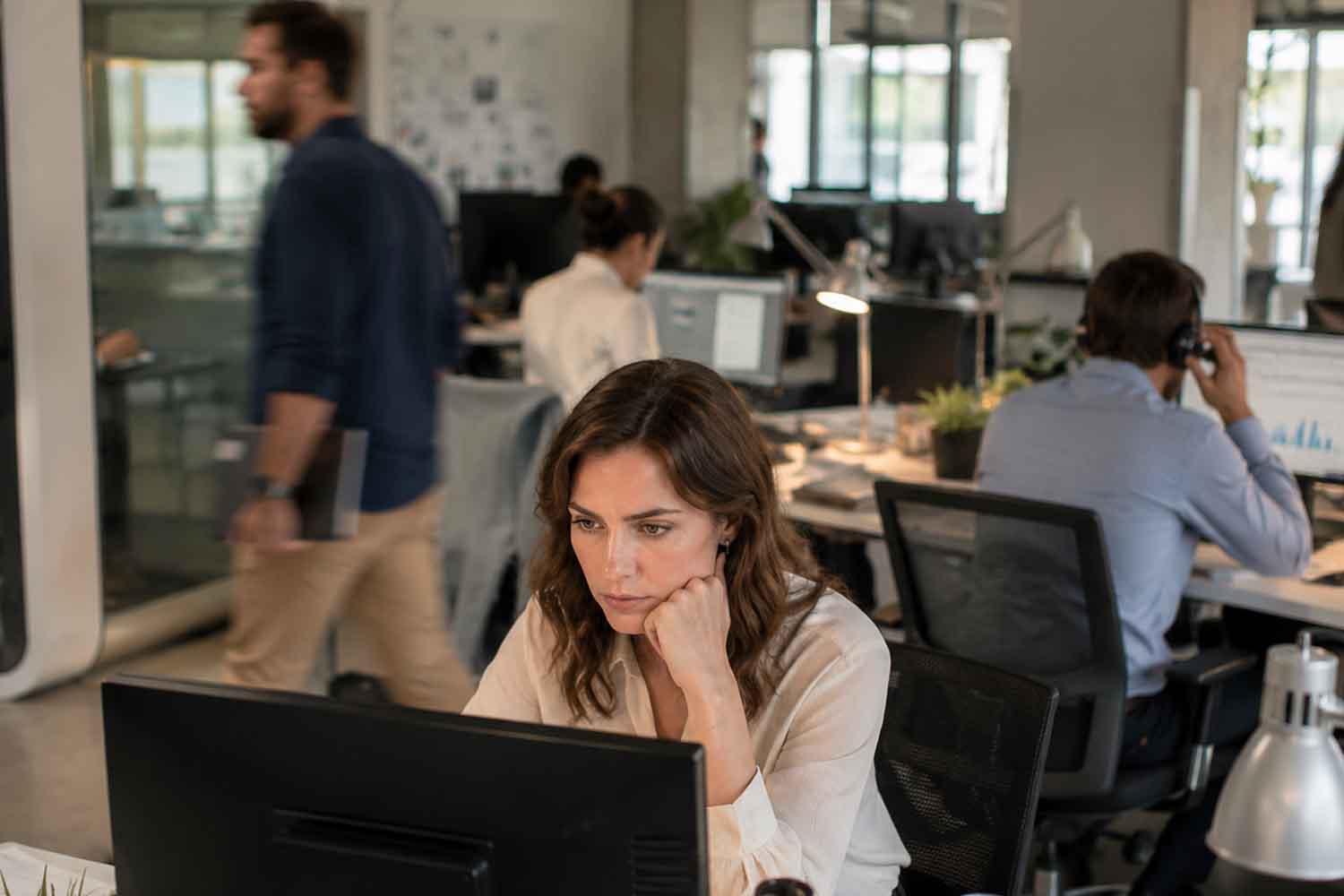
If at the end of the day you feel without energy after eight hours in the office, perhaps the problem also lies in the room. In the colleague talking on the phone two meters away from you. In the call I started without headphones. In the continuous passage behind the chair. In the monitor displayed like a shop window, while you just try to finish an email without feeling watched like a panda in the zoo.
For years we told ourselves that it was enough to be more organized, more motivated, more disciplined. Orderly agenda, headphones, short breaks, notifications turned off, breathing like a Zen monk while someone nearby comments on the lunch of the day before. Then studies on the brain arrive and put something very concrete back on the table: the work environment can change the mental load necessary to carry out the exact same tasks.
A neuroscientific study by the Universitat Politècnica de València monitored the brain activity of 26 people via EEG, i.e. electroencephalogram, while they carried out normal work activities: listening, reading, writing. No extreme tests, no laboratory exercises with mysterious buttons and white coats in the background. Just daily cognitive work, what many people do every day in front of a screen.
The difference was in space. The same participants carried out the same tasks in two different environments: an open space and a work pod, a small self-supporting, soundproofed and visually isolated cabin. A kind of bubble inside the office, designed to cut out noise and visual stimuli. Thus the comparison became direct: same brain, same activity, different environment.
The brain under noise
The findings tell something many workers already suspect, only with fewer scientific instruments and more headaches. In the open space, brain activity progressively increased during the session. In practice, the brain seemed to have to recruit more and more resources to stay focused, as if every minute added a small weight on the same effort.
In the work pod, however, cortical activation tended to decrease over time. The same tasks were carried out with a less “lit” brain profile, less busy keeping everything together. The work remained the same, the invisible cost of completing it changed.
A significant detail, given that the open office is often described as a dynamic, collaborative, modern space. All true, at least when you need to exchange ideas, talk to the team, solve something on the fly. The problem arises when in the same space we also ask the brain for deep concentration, careful reading, writing, analysis, memory, precision. A nearby phone call still comes into focus. A lateral movement draws the eye. A person behind you changes the way you inhabit the workstation. The body registers everything before you can even call it a nuisance.
The work pod does not transform the office into a corporate hermitage, but it reduces some of that dirty work that the brain constantly does: filtering, ignoring, checking, returning to the task. A tiny effort taken on its own, much less harmless when it accumulates for hours.
Getting used to it is not enough
The study also reports strong individual variability in brain responses observed in the open space. Some people seem to tolerate chaos better, others less so. This makes the question even more interesting, because it dismantles the idea of the standard worker, the one who should work well anywhere, as long as he has good will and a vaguely decent ergonomic chair.
There are those who can concentrate even with three conversations around them. There are those who feel their brain fraying after half an hour. There are those who think they’ve gotten used to it, then arrive in the evening with that nervous tiredness they can’t explain. He calls it laziness, stress, bad day. Maybe, instead, he spent hours defending his attention from small continuous stimuli.
The practical point is here: concentration doesn’t just live inside the head. It also lives in space. An exposed workstation, a noisy office, reduced privacy and the feeling of always being available can increase the mental energy required to do normal activities. The file is delivered, the email goes, the report closes. Meanwhile, that granular fatigue remains, difficult to measure in daily life, very easy to feel.
However, the authors urge caution. The sample is small and the study observes differences between two specific environmental configurations, so it would be incorrect to turn it into an outright condemnation of open spaces. But the indication is clear enough: designing offices as spaces that are always open, always passable, always visible can have a cognitive cost.
A door is still needed
The solution is not to cancel every shared desk or lock everyone in sad cubicles from a 90s American movie. Work also needs exchange, presence, discussion, words said without booking a meeting room three days in advance. However, a more adult balance is needed.
A well-designed office should have open areas for collaboration, collected spaces for concentration, rooms for calls, areas where you can talk without occupying the minds of others. It should recognize that writing, reading, proofreading, analyzing data or preparing a presentation requires protection. Even just for an hour. Even just to finish something without starting over ten times.
In this sense, work pods and isolated spaces are not a cool office quirk. They can become concrete tools for reducing the mental load, especially when the work requires sustained attention. Smart working, after all, has made precisely this clear: many people work better from home also because they control their environment more. They close a door, lower the noise, choose when to speak and when to disappear to concentrate.
Open space can work. But it can’t be the only answer to everything. The brain does not become more productive because it sees more colleagues in the same field of vision. He works better when he stops defending himself from what goes around him. In the office, sometimes, the effort isn’t in the task. It’s everything you have to ignore in order to finish it.
You might also be interested in:
