
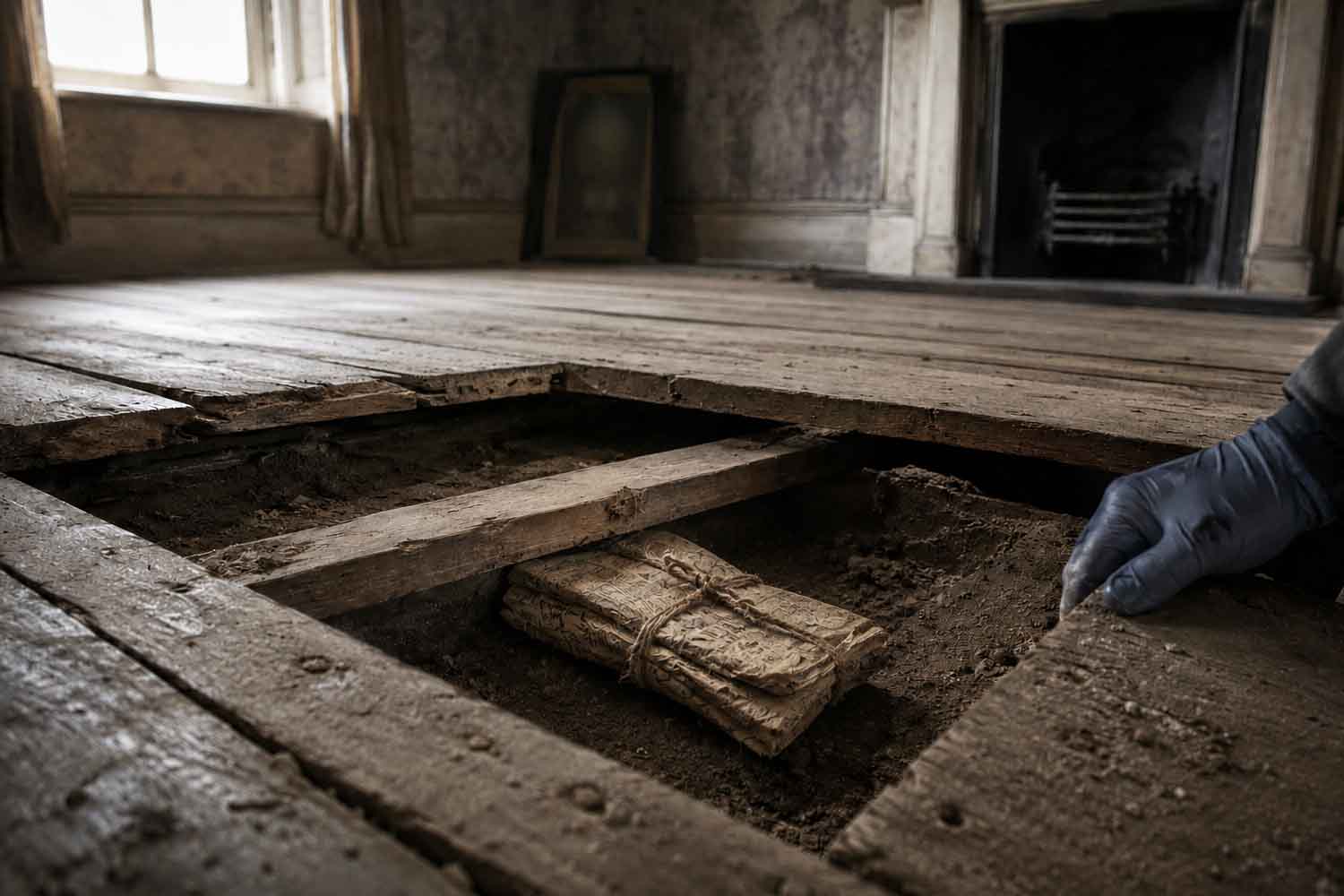
The date printed in the newspaper seemed to offer investigators a point of reference: June 19, 1910. That Sunday issue was still wrapped around the nearly complete skeleton of a newborn baby, hidden under the floor of an old English house. However, scientific analyzes have moved the story much further back, towards an era in which that newspaper did not even exist yet.
According to the radiocarbon datingthe child may have lived between 1726 and 1812. His remains would therefore be at least a century older than the pages in which they were found. It is this temporal distance, difficult to reconcile, that has transformed the discovery into the mystery of Baby Auckland.
The name was assigned to the little one by investigators after the discovery which took place in Bishop Auckland, a town in County Durham, in the north-east of England. His identity remains unknown. Even the cause of death and the path followed by the body before ending up under those boards still await a convincing reconstruction.
The newborn baby hidden under the floor
The discovery dates back to July 29, 2024. Some workers were renovating an apartment on the upper floor of a building in Fore Bondgate, a central street in Bishop Auckland, when they lifted part of the old floor.
The remains of a child appeared in the space below. The skeleton was wrapped in a copy of The Umpirea Sunday newspaper founded in Manchester in 1884 and dedicated mainly to sport, theater and news. The copy used to cover the body bore the date 19 June 1910. The story was reconstructed during the judicial inquiry and reported by the British broadcaster ITV News.
Investigators also found one around the child’s neck brown twine wrapped three times. A detail that pushed the County Durham police to approach the case as a suspicious death and to evaluate, among the possible explanations, that of infanticide.
The building dated back to the Victorian era and the newspaper seemed to place the death in the early decades of the twentieth century. The agents began to consult censuses, land registers and documents relating to the people who had lived in the house between 1900 and 1920.
The first reconstruction led to a birth that remained secret, perhaps linked to poverty, to a pregnancy out of wedlock or to the social shame that accompanied single mothers in England at the time. The dating of the bones completely shattered that chronology.
Tests take Baby Auckland back to the eighteenth century
The remains were transferred to the Royal Victoria Infirmary in Newcastle and entrusted to pathologist Louise Mulcahy and forensic anthropologist Micol Zuppello. The examination of the skeleton revealed that the child had reached approx 40 weeks of development. It was therefore a full-term fetus or a newborn baby who had just come into the world. The condition of the remains made it impossible to establish whether he was born alive or already dead.
The meaning of the string also remains uncertain. The triple twist around the neck may suggest strangulation, yet the preserved bones and tissues did not allow us to definitively link him to death. Twine may also have been used to tie the wrapping or added when the body was moved.
Attempts to extract DNA have provided only one certain piece of information: Baby Auckland was a boy. The genetic material was too deteriorated to reconstruct the child’s identity or identify any descendants and relatives.
An initial analysis of the carbon present in the bones ruled out that the child was born after 1945, the year in which nuclear tests began to alter the levels of carbon-14 in the atmosphere. Subsequent investigations have indicated the most probable interval is between 1726 and 1812.
Baby Auckland may therefore have lived during the reign of George II or George III, in the years when the Industrial Revolution was changing the face of British cities. The newspaper that covered him would have been printed at least a century after his birth.
How could a child of the eighteenth century have ended up in a newspaper of 1910
The difference between the age of the remains and that of the newspaper opens up the most complicated scenario. A copy printed in 1910 may have remained in the home for a few years, used to protect objects, fill cavities or insulate the floor. An interval of more than one hundred years requires at least one movement of the body.
One of the hypotheses taken into consideration predicts that the child was buried or hidden in another place shortly after death. The remains may have been discovered during works carried out at the beginning of the twentieth century, wrapped in the newspaper available at that time and subsequently placed under the boards.
The body may also have been kept for a long time inside an old structure of the building, then moved during a modification of the house. The police are searching the archives for information on the renovations, the previous owners and the inhabitants of the property.
However, the dates provided by radiocarbon require cautious reading. The technique measures the decay of the carbon-14 isotope and returns probabilistic ranges. Nutrition, contamination and storage conditions can affect the results. For this reason the coroner asked to hear from a dating specialist before closing the investigation.
The funeral and the investigation still open
The April 27, 2026almost two years after it was found, Baby Auckland received a burial in Bishop Auckland Municipal Cemetery.
During the ceremony, a small white coffin was accompanied by representatives of the police, local authorities and some citizens. County Durham Police said they wanted to give the child a dignified send-off after a time spent under the floor that may have lasted more than two centuries. The report of the ceremony is available on the official Durham Constabulary website.
The investigation was supposed to end in May 2026. However, the hearing was postponed to allow the intervention of three new witnesses: a representative of the investigative team, a specialist involved in the post-mortem examination and a radiocarbon expert.
The new hearing has been scheduled for September 17, 2026. The medical examiner will have to establish, as far as possible, who the child was, when and where he died and what circumstances accompanied his death. Under those boards, an unnamed baby, three turns of string and a Sunday from 1910 remained together. The date on the newspaper is still perfectly legible. The child’s continues to slide backwards.
