
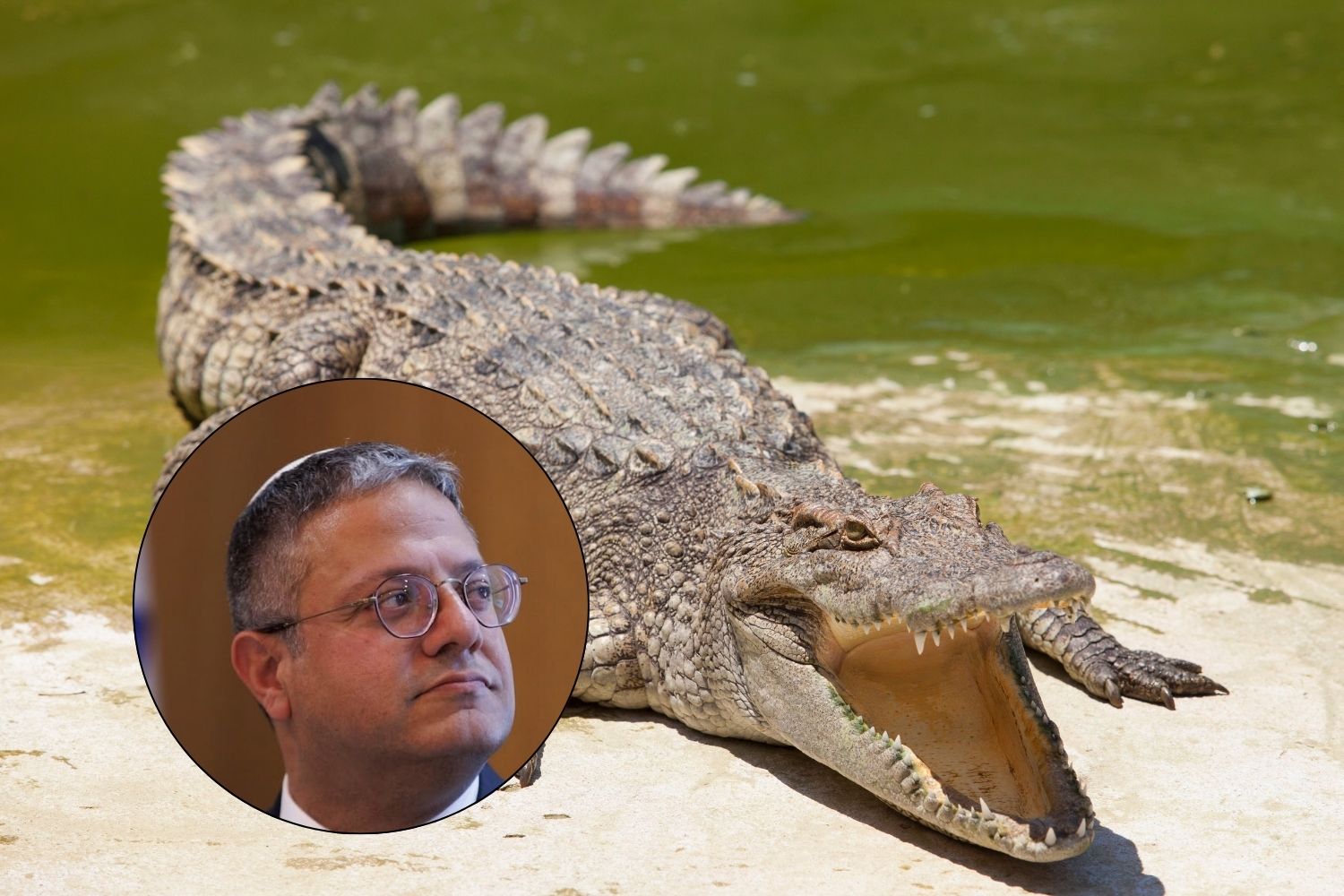
How medieval is the idea of placing crocodiles around the walls of a prison to discourage escapes? A mixture of disbelief and amazement will attack you the moment you realize that no, the idea that popped into the head of the Israeli Minister of Environmental Protection is not a fake, Idit Silman – in the pay of the well-known Ben GvirMinister of National Security.
The idea, that is, of classifying crocodiles from the category of wild animals to that of “captive-bred wildlife“, a modification that allows its use for security purposes, paving the way for the controversial plan nicknamed “Alligator Alcatraz“: using reptiles as a natural barrier around prisons housing Palestinian prisoners.
An initiative that would have been approved despite the contrary opinion of the legal advisor of the Ministry of the Environment itself and the experts of the Israel Nature and Parks Authority, the body responsible for the protection of wildlife.
For months the Ministry of National Security has been trying to obtain some crocodiles from the Hamat Gader park to place them around the Ketziot maximum security prison in southern Israel.
The name “Alligator Alcatraz” recalls a detention center for migrants inaugurated in July 2025 by the Florida authorities in a remote area of the Everglades, where alligators and swamps were presented as natural deterrents against escapes. That structure, however, has become one of the symbols of the Trump administration’s crackdown on immigration, attracting legal challenges and harsh criticism from environmental groups.
The Israel Nature and Parks Authority had rejected the proposal from the beginning, recalling that the legislation allows the keeping of wild animals of this type exclusively for educational, scientific or popular purposes. But, to get around this obstacle, the Government has decided to classify the Nile crocodile as a “wild animal under special management”.
This category had already been used in the past to allow the commercial breeding of crocodiles for the leather industry. An experience which, however, had generated numerous problems, including animal escapes, risk of settlement in nature and potential dangers for the population. For this reason, the then Environment Minister Gilad Erdan had put an end to the system, following the recommendations of the Authority’s council.
With the new decision, Silman effectively reactivates an unused provision of the law on the protection of wildlife, but creates a completely new situation: a special category intended not for commercial purposes, but for national security needs. The crocodiles would be entrusted directly to a safety body, subject to authorization from the Minister of the Environment.
And who thinks about the welfare of crocodiles?
It is not only the legitimacy of the measure that raises serious doubts. Also on the table is the fate of the animals which, if the project were to be successful, would be transformed into real “surveillance tools”.
In his opinion, the legal advisor of the Ministry of the Environment Neta Drori highlights how the Israeli Penitentiary Service does not have the necessary expertise to manage a dangerous wild species such as the Nile crocodile. The administration claims to be able to guarantee the welfare of the animals, recalling the experience gained with the dog units. A comparison which, however, according to Drori, does not hold up: raising and keeping dogs is very different from taking care of large predatory reptiles, with extremely complex biological and behavioral needs.
The jurist also points out that a change of this magnitude cannot be decided with a simple administrative act. In fact, the legislation provides for the involvement of the Israel Nature and Parks Authority, other competent bodies and even a public consultation, especially when activities are at stake that involve significant risks for animals, safety and the environment.
Despite the wall raised by technicians and experts, Minister Idit Silman seems intent on continuing and has in fact rejected the objections of her legal advisor. Now the proposal will return to the board of the Israel Nature and Parks Authority for consideration, while institutional conflict grows.
For the moment, Silman has not responded to the complaints. But a story like this, which intertwines safety, protection of wildlife and respect for the rule of law, should not be overshadowed.
