
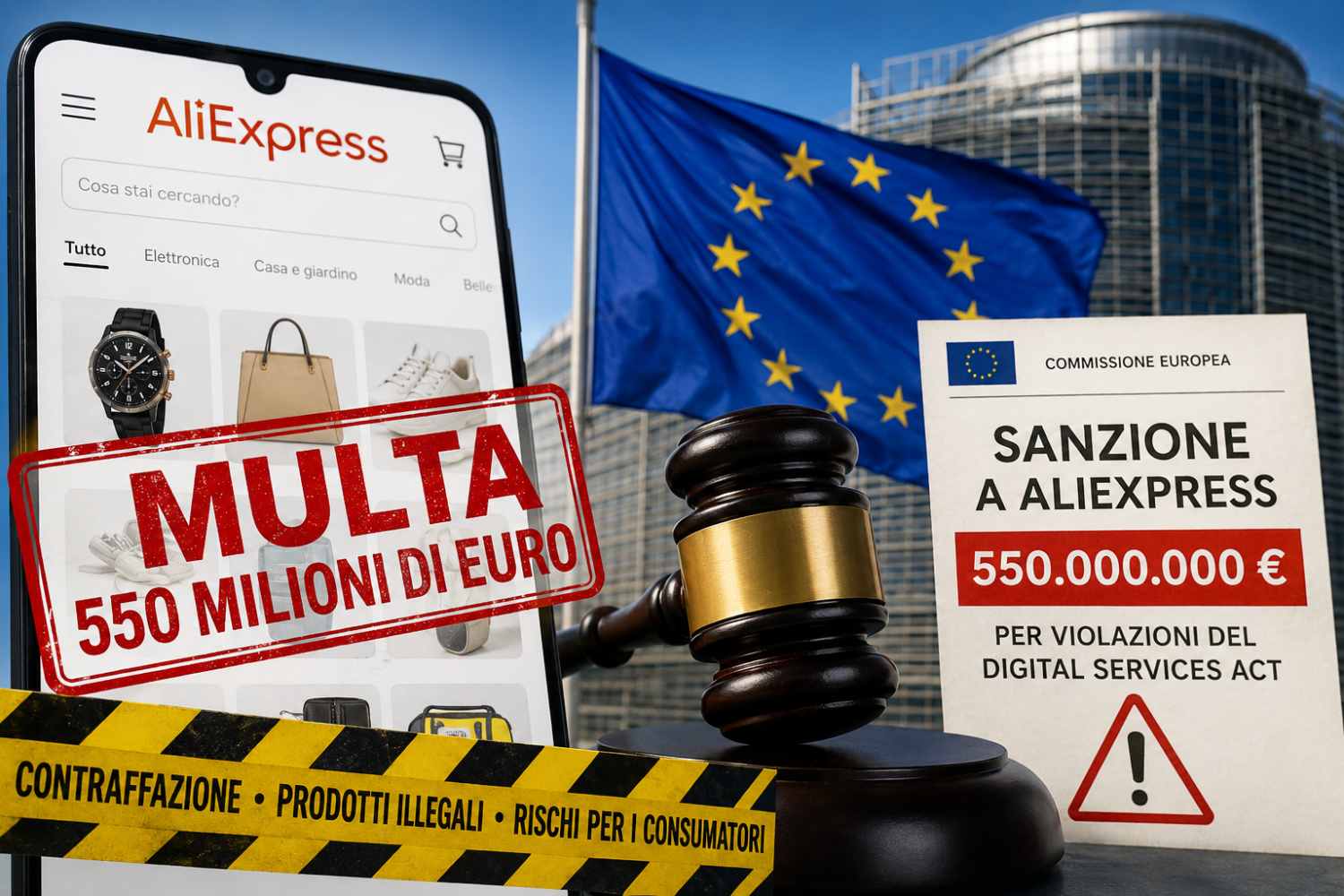
Five hundred and fifty million euros it is the amount with which Brussels has decided to punish AliExpress for failing to stem the circulation of illegal, dangerous or counterfeit products on its platform. This is the highest fine ever imposed by the European Commission under the Digital Services Act, the legislation which from 2023 imposes stringent obligations on large online platforms to evaluate and mitigate systemic risks.
A risk assessment deemed inadequate
According to the Commission’s decision, AliExpress overestimated the effectiveness of its detection systems, without realistically taking into account the imbalance between the number of human moderators and the volume of products to be verified. Tests conducted by the Commission’s offices also showed that numerous illegal items were still being recommended or advertised to consumers before they were actually removed, a sign that the problem was not just with detection, but also with the systems that decide what to show users.
The flaws in the controls
The judgment on the mitigation measures is no less severe, given that Brussels disputes the following points against AliExpress:
The trademark authorization system, designed specifically to block counterfeiting, was in turn rendered ineffective by insufficient staff and inadequate controls.
The words of the Commission
These are the statements of Henna VirkkunenExecutive Vice President of the European Commission for Technological Sovereignty, Security and Democracy:
The spread of counterfeit clothing, unsafe toys, dangerous cosmetics and other illegal and harmful products is not an inevitable price of online shopping, but rather the result of AliExpress’s failure to comply with its obligations under the Digital Services Act. The size of the business is not an excuse; risks must be identified and addressed systematically to ensure consumers can shop online safely. Today we ask AliExpress to adhere to this standard and act accordingly
An investigation opened in 2024
The proceeding has its roots in 14 March 2024, the date on which Brussels opened a formal investigation on multiple fronts: risk assessment, content moderation, advertising transparency, seller traceability, access to data for researchers. In June 2025, the Commission made binding a series of commitments offered by the platform on most of these points, while keeping open the area relating to the management of risks linked to illegal products. Today’s decision closes that chapter, based among other things on the 2023 and 2024 risk assessment reports provided by the company and on responses to formal requests for information sent by the Commission on 6 November 2023 and 18 January 2024.
What happens now
AliExpress will have until October 20 to present an action plan indicating corrective measures, then the European Digital Services Committee will have one month to express an opinion, and the Commission another month to adopt the final decision. Failure to comply with the non-compliance ruling may result in periodic penalties.
The AliExpress replica
The company’s response was not long in coming. “We disagree with today’s decision and the disproportionate fine, which does not adequately reflect our established regulatory framework and the proactive improvements we have made,” AliExpress said in a statement carried by Irish broadcaster RTÉ, adding that it was “evaluating all available options”.
The third blow of the Digital Services Act
The AliExpress case is part of a sequence of sanctions that is redefining the relationship between Brussels and the digital commerce giants. In December 2025 it was the turn of X, fined 120 million euros for the lack of transparency on the blue check and on access to data for researchers. Last May it was Temu’s turn, hit with a 200 million euro fine for not having correctly assessed the risks linked to illegal products on its platform.
