
Before becoming coal, certain landscapes were forests. Warm, dense swamps, full of very tall trunks and plants that today would seem almost out of scale, as if someone had tried to design a forest starting from the wrong idea of a tree. Among those Paleozoic giants were the arboreal lycophytes, distant relatives of the small plants we know today as lycopods and isoetes. Names like Sigillaria And Lepidodendron they belong to that world: organisms capable of reaching tens of meters of height in the late Carboniferous, when vast marshy areas would then have left the organic matter from which many coal deposits were formed.
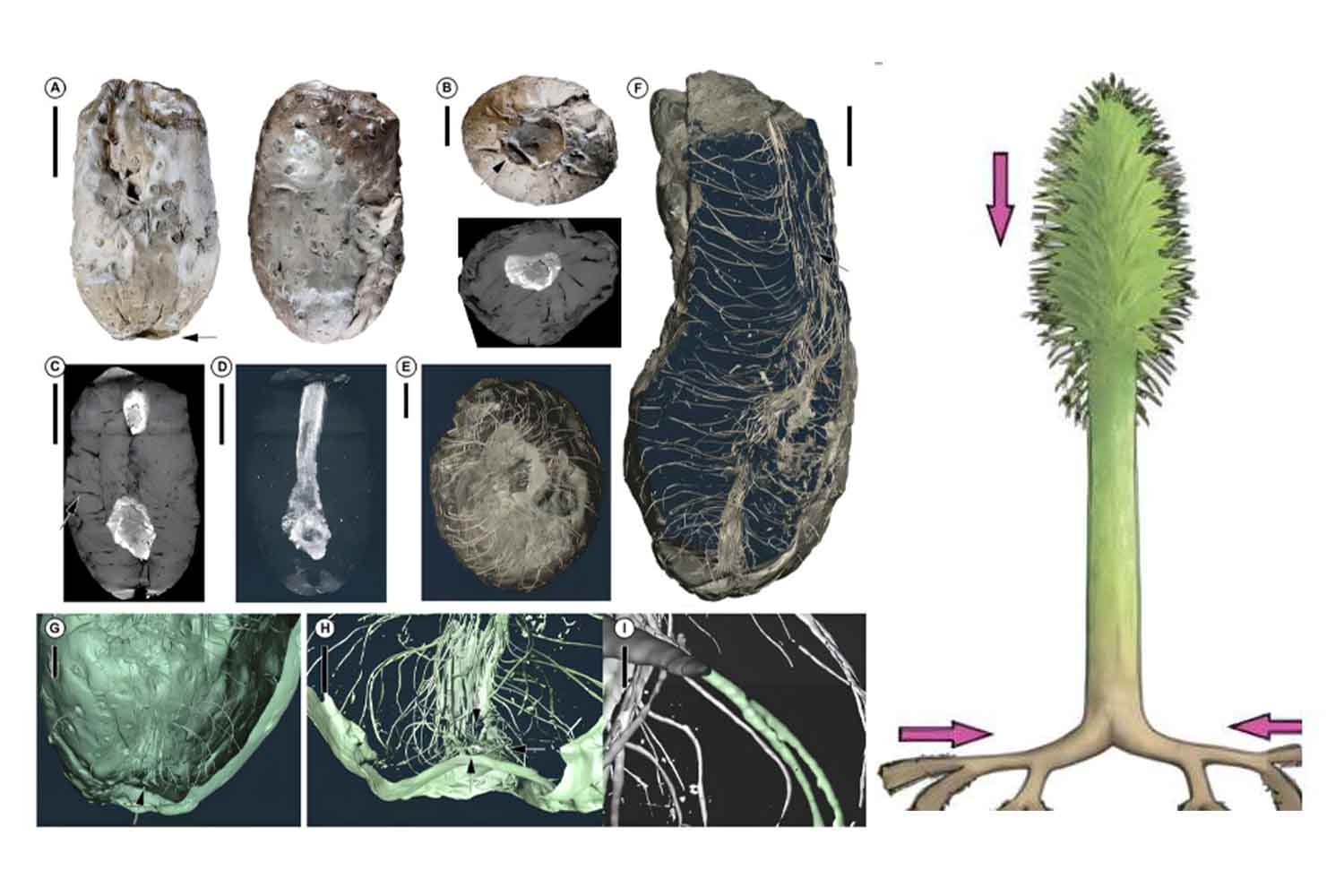
The surprise, this time, comes from below. From those fossil structures called Stigmariathe casts of the underground axes of these very ancient trees. Looking at them from the outside they seem almost tidy finds: surfaces marked by rows of small round or oval cavities, each left from the point where a thin radicle once started. For decades they have been instrumental in understanding that coal swamps were forests that grew in place, with trees rooted in the soil and not driftwood. However, a much more subtle question remained: did those roots really grow like the roots we know today?
Inside the stone
The answer came by looking into the fossils without breaking them. The researchers used the X-ray computed microtomographya technique similar to medical CT scanning, but pushed to a much finer scale. In practice, the fossil is crossed by X-rays from many angles; different materials absorb radiation differently; then a computer recomposes thousands of images and builds a three-dimensional model of the interior. Thus the stone becomes legible without being cut, filed or worn.
The study, published on Proceedings of the Royal Society B: Biological Sciencesanalyzed three particularly well-preserved Stigmaria fossils. From those scans, real ones were born virtual fossilsdigital models that allow you to “browse” the inside of the find and follow the canals connected to the small lateral roots. The decisive detail was right there, in the position where those underground branches took shape.
In modern plants we are used to thinking of roots as downward-pushing structures, driven by very recognizable growth mechanisms. One of the protagonists is theauxina plant hormone involved in development, which in the roots tends to flow towards the apex and helps direct growth. In the Stigmaria, however, the picture that emerged from the scans goes in another direction. The small lateral axes appeared near the growing tip of the main axle, in an arrangement much more similar to that of buds.
Branch-headed roots
Saying that these roots grew “in reverse” works, as long as you understand the meaning well. It doesn’t mean imagining them pointing towards the sky like rebellious roots straight out of a cartoon. The reversal concerns the way in which growth was organized. The tip of the Stigmaria produced new lateral axes with a logic close to that of shoots, rather than that of common roots. A root with branch-like behavior, stuck underground to do the work of a root. Pretty strange, yes. And much more interesting than the usual image of the ancient tree placed there just for show.
The same researchers speak of an apical meristem, i.e. the growth tissue at the end of the structure, with characteristics typical of the shoots of vascular plants. This calls into question the often taken-for-granted idea that root development must always follow the pattern of auxin directed towards the apex. In these Carboniferous arboreal lycophytes, the system seems to have experimented with another architecture: an underground structure probably born from a stem-like axis and then adapted to the root function.
The most delicate point is right here. The Stigmaria they could represent a particular type of root organ, different from the roots of living lycophytes. Current plants, even when they retain distant relatives with those giants of the Paleozoic, are not miniature copies of that world. Evolutionary history has taken other paths, lost certain solutions, refined others. These fossils show an ancient experiment: a way of being in the soil that we no longer see in living plants today.
However, caution is needed. The scans concern few fossils and, for now, only one species of arboreal lycophyte. To understand whether the same pattern applies to other trees in the coal marshes, new finds, new images and other comparisons will be needed. But the way is open: many fossil casts considered common may still retain internal details good enough to tell something new. Not only the external shape of the plant, but the way it grew, branched and occupied the soil.
This is the most beautiful part of paleobotany when it stops seeming like dusty showcase material. A seemingly simple fossil, a petrified root with little holes lined up, can change the way we imagine an entire forest. Those trees weren’t just huge. They were strange deep down, even beneath the surface. Literally.
