
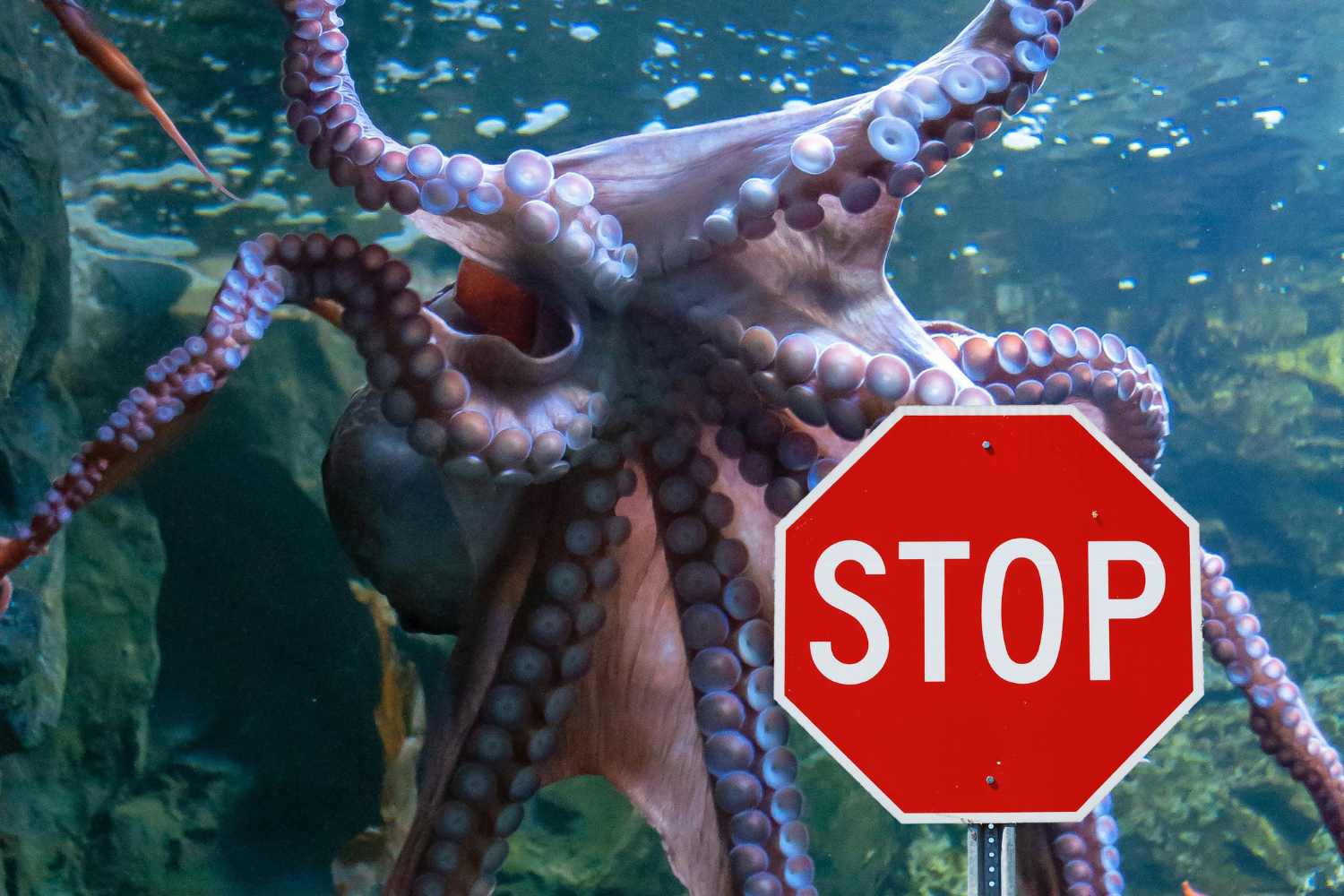
A victory for octopuses, for the oceans and for those who have been denouncing the risks of yet another frontier of intensive farming for years. After five years of international mobilisations, Nueva Pescanova has decided to abandon the project to build the first commercial octopus farm in the world in Gran Canaria.
The confirmation came today, July 23, from the Port Authority of Las Palmas, which announced the Spanish multinational’s renunciation of plans to build the plant in the port area of the island. A decision welcomed as a great victory by Compassion in World Farming (CIWF), the organization that more than any other carried out the campaign against the project.
Over the years, the protest has involved scientists, animal protection associations, activists and thousands of people around the world. In the last few weeks alone, over 43,000 emails had been sent to the Port Authority of Las Palmas asking to permanently block the authorization.
The Nueva Pescanova project
The idea of the Spanish multinational was to transform the octopus, until then caught in the sea, into a new species for industrial farming. The project involved the construction of a plant in Gran Canaria intended for the breeding of the common octopus (Octopus vulgaris), with the aim of producing thousands of tons of meat every year.
According to the company’s plans, the facilities would house approximately one million octopuses per year in controlled terrestrial tanks, replicating the model already used for other intensive aquaculture species. Nueva Pescanova argued that farming could reduce pressure on wild fisheries and meet growing global demand for this food.
But for many experts the project represented a dangerous path: bringing one of the most intelligent and complex marine creatures on the planet into an industrial production system designed to maximize economic returns.
Octopuses, intelligent animals
The central issue of the protest concerned animal welfare. Octopuses are not fish: they are molluscs with an extremely developed nervous system, capable of learning, solving problems, exploring the environment and displaying complex behaviors.
In nature they are solitary, territorial animals used to living in environments full of stimuli. Forcing them into bare, high-density tanks could have caused chronic stress, aggression and cannibalism, according to associations opposed to the project.
Octopuses are intelligent wild animals, not commodities to be locked up in intensive farming – explains Elena Lara, Senior Research and Policy Advisor at Compassion in World Farming. The decision to abandon this project sends a loud and clear message: the future of food cannot be built on animal suffering or unsustainable practices.
Now governments must go one step further, banning the farming of octopus and preventing the expansion of aquaculture of carnivorous species.
An unsustainable model even for the oceans
In addition to ethical questions, the project had raised serious environmental concerns. According to a report published by CIWF, the farm would have required approximately 28,000 tons of wild fish intended for feed production in the first year of operation, to obtain approximately 3,000 tons of octopus meat.
A paradox already seen in many carnivorous species farms: to produce animals in captivity, the pressure on marine ecosystems increases, taking resources away from the oceans and coastal communities that depend on fishing.
Octopus farming would therefore have risked transforming a wild species into a new product of the intensive food industry, without solving the root causes of the overexploitation of the seas.
Meanwhile, Nueva Pescanova’s resignation cannot fail to represent a significant precedent: for the first time a large industrial octopus breeding project was stopped before becoming reality. For CIWF, however, this is not enough. The organization is now calling on the governments of the Canary Islands, Spain and the European Union to introduce a specific ban on octopus farming and to stop the expansion of aquaculture based on carnivorous species.
The case of octopuses once again shows a clear limit: animals like these, precisely because of their intelligence and complexity, deserve to remain what they are, inhabitants of the oceans, not production goods.
