
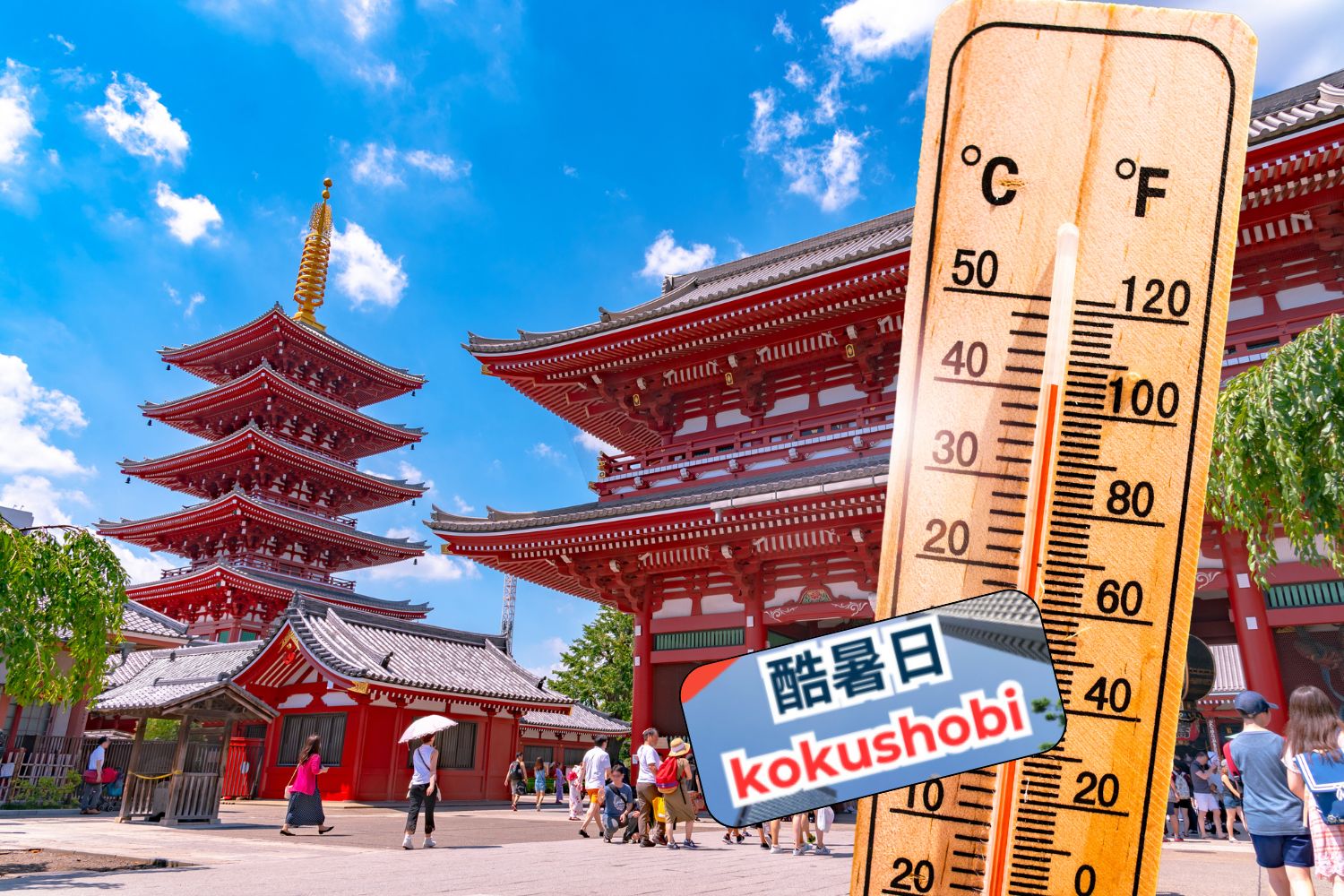
In Japan the heat has exceeded a new threshold. Not only that of the thermometer, but also that of language: the country had to invent a new word to describe days that until a few years ago seemed exceptional and which today are becoming more and more frequent.
Is called kokushobi (literally “cruelly hot day”, day of scorching heat) and is the new term coined by the Japan Meteorological Agency to indicate days in which the temperature exceeds 40 °C.
Just in recent days, Japan recorded its first real “kokushobi” since the official introduction of the definition in April (on Tuesday 21 July, on the same day, out of 914 meteorological stations distributed throughout the country, 278 recorded temperatures above 35 °C).
The cities of Gujo and Tajimi, in Gifu Prefecture, and Toyota, in Aichi Prefecture, reached or exceeded the 40-degree mark. In Gujo, 40 °C was recorded, while Toyota reached 40.1 °C: values never reached before in the respective weather stations.
A sign of how extreme heat is changing daily life in a country which, like many other parts of the world, is experiencing the effects of the climate crisis.
View this post on Instagram
From extreme heat to “normal” heat
Until recently, Japan already used a classification to describe hot days. Temperatures above 35°C were defined moshobior “extremely hot days”, while above 30 °C we spoke of manatsubithe “real days of summer”. The increasingly frequent exceeding of the 40 °C threshold has made it necessary to introduce a new alert level. And the heat is no longer just a problem of discomfort.
View this post on Instagram
Extreme heat already has dramatic consequences on public health. In 2024, heatstroke-related deaths exceeded 2,000 for the first time, while over 100,000 people were hospitalized between May and September due to high temperatures.
Just a few days ago, a man in his forties was found dead on the street in Niigata Prefecture, and another man in his seventies died in Kanagawa Prefecture. In both cases, a heat-related death is suspected. But climate change isn’t just changing the way people work or deal with summer. It is also transforming agriculture, sports and social habits.
One of the most evident effects concerns rice, a symbolic food of Japanese culture. Increasingly higher temperatures are affecting the quantity and quality of crops, pushing many farmers to experiment with more heat-resistant varieties. Some are even starting to grow crops that just a few years ago seemed foreign to the Japanese climate, like avocados.
Sport also has to deal with a summer that is increasingly difficult to bear. The famous national high school baseball tournament, the Koshien, always played in August under intense heat, has been reorganized from 2024 with games divided between morning and evening to reduce the risk of heatstroke for players and spectators.
View this post on Instagram
Goodbye jacket and tie: even offices surrender to the heat
Even the very rigid Japanese corporate culture is changing. To deal with the extreme temperatures, workers are advised to ditch suits and ties and wear lighter clothing: shorts, polo shirts, T-shirts and athletic shoes when possible. The governor of Tokyo, Yuriko Koike, has promoted new indications on office clothing as part of the “Cool Biz” measures, created to reduce energy consumption linked to air conditioning.
A small revolution for a country where the formal suit has been the symbol of the model worker for decades.
