
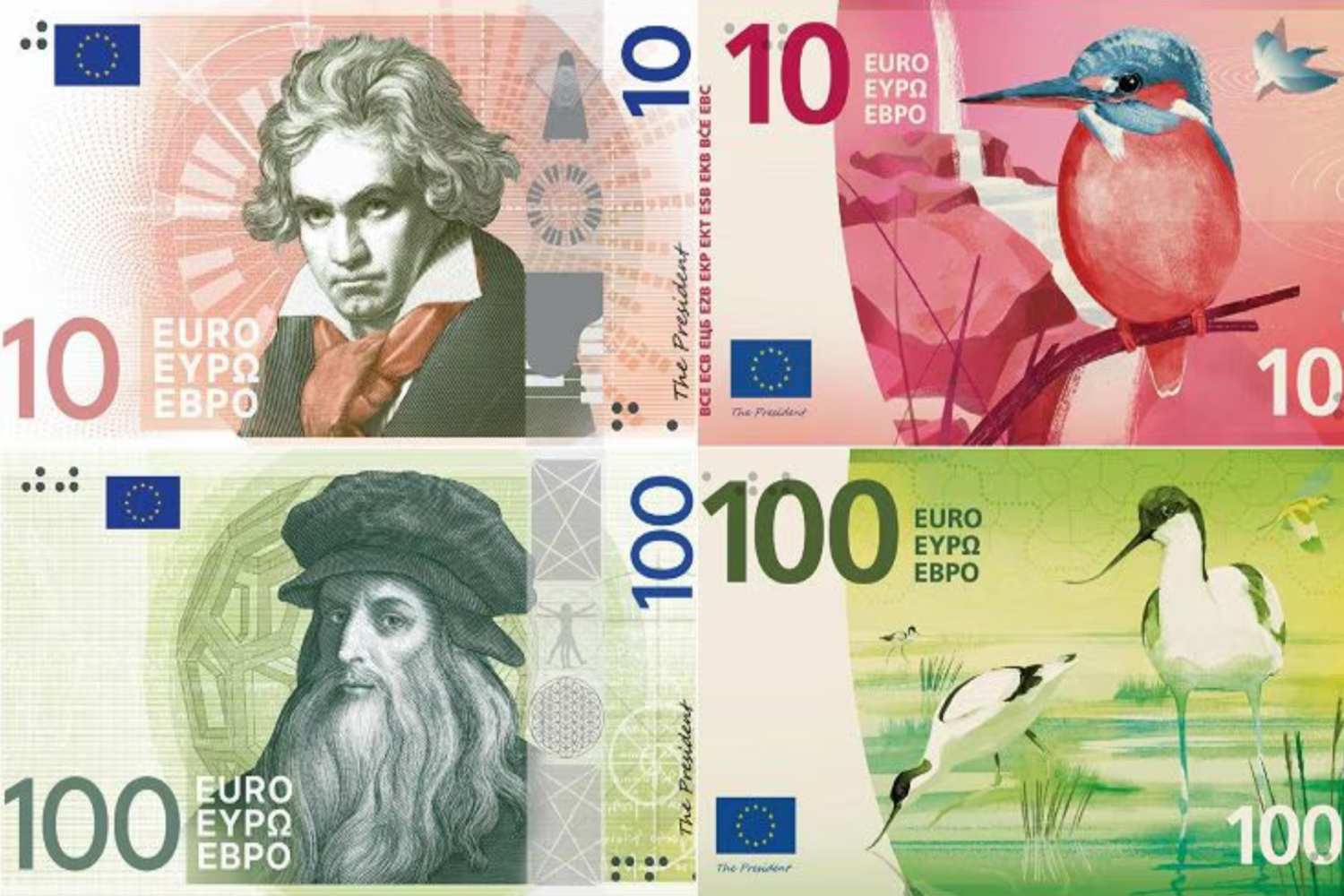
More than twenty years after the debut of single cash in 2002, the European Central Bank has launched the first complete redesign of euro banknotes. The monetary institution has revealed the ten finalist projects that emerged from a European public competition which collected over 1,200 graphic proposals. A jury made up of twenty-one experts in history, graphics, neuroscience and communication selected the ten final sketches, divided into two conceptual strands: European Culture and Rivers and Birds.
The two themes: European culture and Rivers and birds
Depiction of the new 5 Euro in 4 of the 10 finalist proposals that can be voted on
The first theme celebrates the great protagonists of the history and arts of the continent. If chosen, this series will depict Maria Callas on the 5 euro denomination, Ludwig van Beethoven on the 10 euro, Marie Curie on the 20 euro, Miguel de Cervantes on the 50 euro, Leonardo da Vinci on the 100 euro and Bertha von Suttner on the 200 euro, flanked on the reverse by squares, museums, libraries and youth choirs.
The second stylistic track proposes a symbolic and naturalistic journey through the different phases of the course of European rivers, accompanied by the bird species typical of the respective ecosystems. The back of this second group of banknotes hosts the architecture of the institutions of the European Union, including the European Parliament, the European Commission, the Court of Justice of the European Union, the European Council and the European Court of Auditors.
The public consultation: how to vote
For the first time in the history of the single currency, euro area residents are asked to express their preference directly. The public consultation will remain accessible on the institute’s official portal until 21 September 2026 at this link. In parallel, an independent polling agency will conduct a similar survey on a representative statistical sample of the population.
The Governing Council will adopt the final decision on the graphic imprint by the end of 2026, combining citizens’ votes with the technical analyzes of the jury. Subsequently, the development, testing and printing phase will begin. In addition to the visual value, the new paper tickets will introduce advanced anti-counterfeiting technologies, tactile elements for the visually impaired and blind, as well as materials with a reduced environmental impact. The current banknotes will remain legal tender and will continue to circulate regularly even after the introduction of the new notes.
