
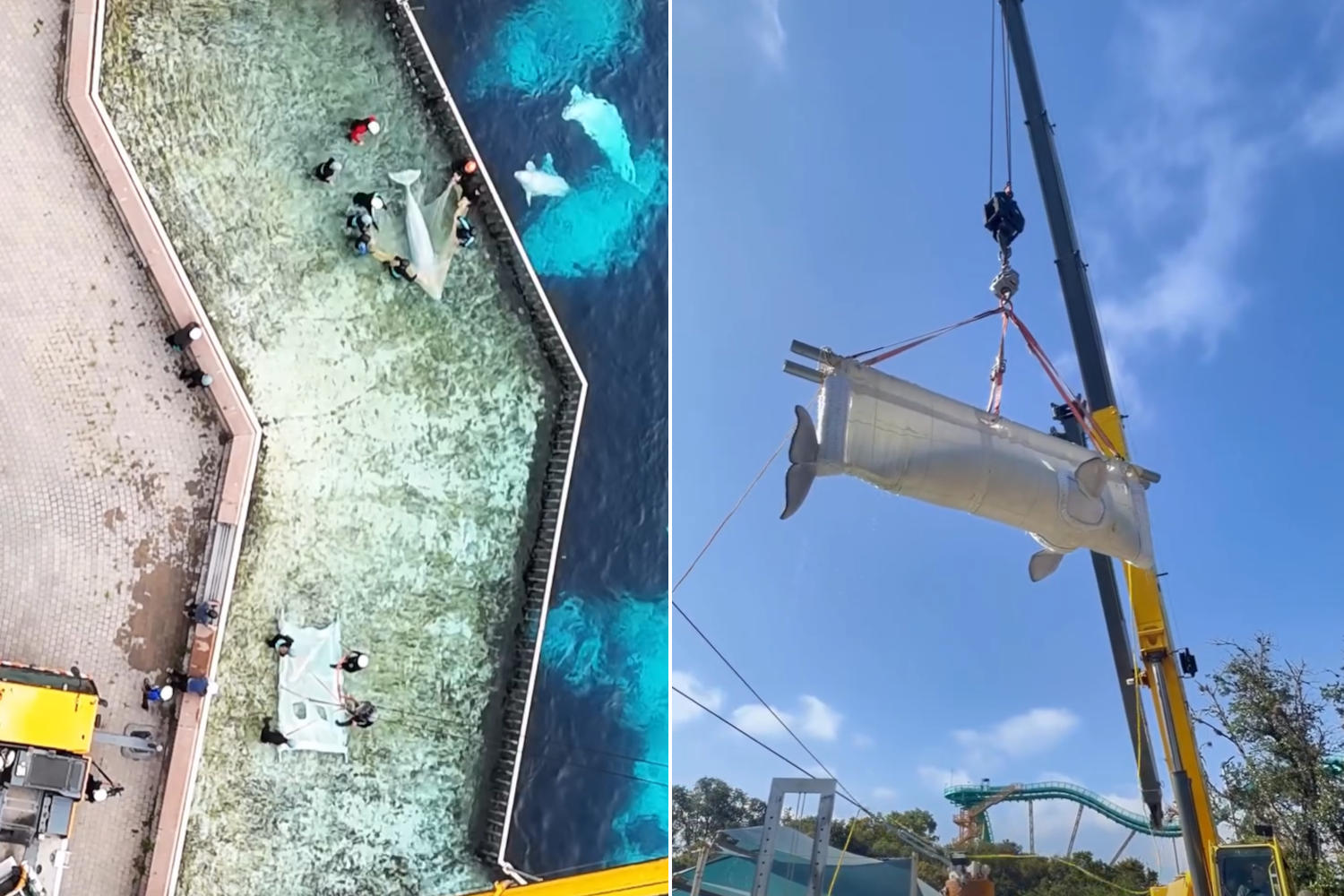
An imposing and delicate international rescue operation has sealed the fate of a colony of marine mammals in extreme danger. The Marineland water park, located in Niagara Falls, Ontario, has permanently closed its doors due to running out of management funds and frequent legal challenges related to animal welfare.
Without more resources to guarantee the nutrition and health subsistence of the creatures, the dramatic hypothesis of the suppression of around thirty specimens arose. Faced with the absence of suitable facilities on Canadian territory, the National Oceanic and Atmospheric Administration and the Ministry of Fisheries and Oceans of Canada have granted extraordinary permits for the emergency transfer of 28 belugas to four facilities in the United States and two specimens to Oceanogràfic València in Spain.
View this post on Instagram
The first phase: the collection of four females
Now new details emerge of how the transfer occurred. Dan Ashe, president and CEO of the Association of Zoos and Aquariums, coordinated the complex logistics chain. The first phase of the plan allowed the rescue of a group made up of four females: twenty-seven year old Acadia, twenty-six year old Osiris and Sierra, and twenty-one year old Lillooet. The four specimens, linked by a deep social bond that made them a close-knit sub-group, were taken from the tanks of the Canadian structure using special fabric harnesses and lifted by crane into thermal containers filled with cold water.
View this post on Instagram
The flight to Chicago and the beginning of the rehabilitation process
The giants of the sea were transported by road to Toronto-Pearson International Airport and then loaded stable inside a Boeing 777 cargo plane of the Qatar Airways company. During the entire flight to Chicago-O’Hare International Airport, the whales were cared for by a team of veterinarians and marine mammal medicine experts. Having landed at their destination just before 2 am, the belugas finally entered the Abbott Oceanarium at the Shedd Aquarium in Chicago.
View this post on Instagram
Dr. Karisa Tang, principal veterinarian and vice president of animal health at the Illinois Hub, and Charlie Jacobsma, director of animal behavior and training, confirmed the initiation of rigorous isolation and monitoring procedures to evaluate the adaptation, nutrition and social interactions of the new arrivals. To facilitate the acclimatization process and avoid sources of stress, several sections of the structure have been temporarily closed to the public. In the next few days, the Chicago water park could welcome another six specimens, while the rest of the group will be located between the Georgia Aquarium in Atlanta and the SeaWorld parks in San Diego and San Antonio.
A tragedy avoided, but no more dolphinariums!
The massive logistical operation avoided the worst-case scenario for the animals involved who risked being euthanized. However, the issue of captivity remains: since these are specimens that have always been born or raised under human care, a reintroduction into wild life in the ocean waters would have been completely impossible for their very survival. The transfer by air to equipped facilities therefore represents a fundamental intervention that made it possible to save the specimens and guarantee them a future and adequate veterinary care.
However, if the outcome of the operation deserves to be celebrated, the Marineland case has shown how complex the management of structures of this size can become when financial difficulties or regulatory changes arise and how vulnerable they are. The creation and maintenance of these dolphinariums require immense resources and very long-term planning; when these complexes enter into crisis or reach closure, extremely delicate emergency situations arise for the placement of the inhabitants of the tanks. So how sustainable are these facilities in the long term and what guarantees of protection do they really give to the animals they house? This story with a bittersweet ending represents a clear warning about the need to rethink our relationship with large cetaceans and to definitively overcome the model of traditional dolphinariums.
View this post on Instagram
