
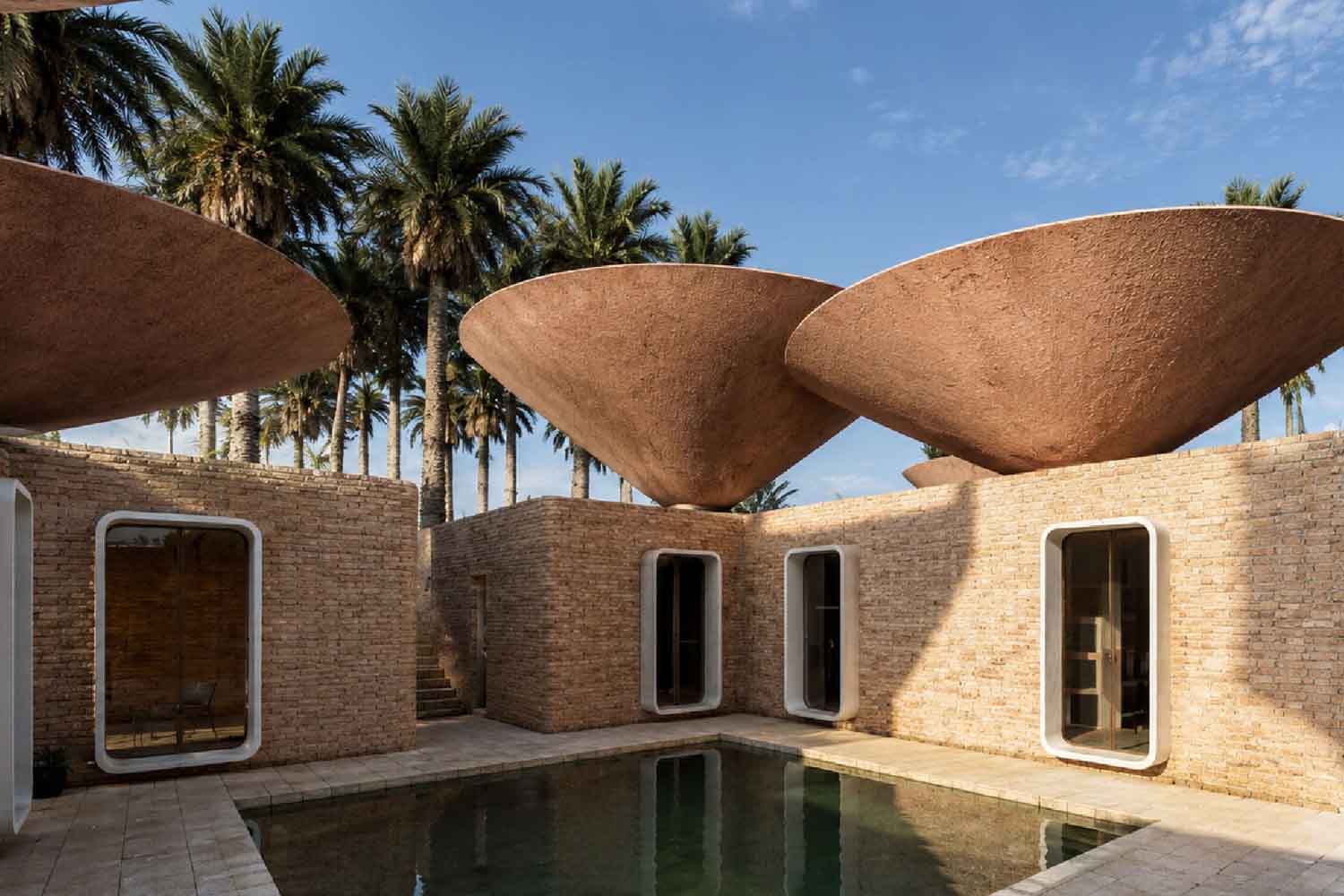
From afar they look like huge bowls resting on top of a school. In the project they serve to collect the little rain available, intercept the morning dew and protect the rooms from the sun. The concave roof designed by BMDesign Studios thus tries to solve two problems with the same structure: water scarcity and high temperatures.
The Concave Roof System was designed for a public school in southern Iran, one of the areas where the desert climate meets the more humid air coming from the Persian Gulf.
The large bowls collect even the lightest rain
In traditional roofs, water is quickly run down gutters and drains. Here the upper surface takes the shape of a sloping basin: the drops are brought together and guided towards a collection point, including those of light rains which, in a hot climate, risk evaporating before forming a real flow.
According to calculations published by BMDesign Studios, a collection surface of 923 square meters, with 193 millimeters of annual rainfall and an estimated yield of 60%, could recover approximately 106 cubic meters of water per year, equivalent to 106 thousand litres. This is a forecast obtained by multiplying surface area, rainfall and collection coefficient.
The model comes from a small desert beetle
Rain is only part of the system. During the night the roofing membranes should cool by radiation towards the sky. When their temperature drops enough, part of the vapor present in the air can condense on the surface, forming dew droplets that the concave shape accompanies towards the collection points.
The declared inspiration comes from the fog beetle of the Namib desert, often cited in biomimicry projects for its ability to exploit atmospheric humidity. In the concave roof, the bowls inserted one inside the other would increase the exposed surface area by almost six times compared to a flat roof of the same size. More surface area means more chance of condensation. At least in theory: the study does not publish experimental data on the amount of dew that the system would actually be able to obtain in different seasons.
A second roof keeps the sun out of the classrooms
The basins do not rest directly on the building. Below them remains a more traditional roof, separated by an open space. The upper cover intercepts solar radiation and creates shade; the air can circulate between the two layers and disperse some of the heat before it reaches the internal environments.
The rest of the school was also designed following passive cooling principles. Classrooms, offices and library overlook partially underground courtyards, inspired by the architecture of Iranian desert cities such as Yazd and Nain. The lowered areas retain cooler air during the night, while the recessed openings receive less direct sun. Date palms complete the system by providing shade and, a not very futuristic but rather useful detail, also fruit.
The idea was born in a country where water scarcity is already a concrete condition. The United Nations Development Program reports high temperatures, reduced rainfall and a trend towards further decline in rainfall for Iran, with increasing pressure on water resources, ecosystems and agriculture.
The collected water must still be treated
BMDesign Studios presents the system as a tool capable of contributing to the production of drinking water. Collecting water from the sky, however, is not enough to automatically make it safe to drink.
The World Health Organization reminds us that rain can become contaminated by coming into contact with covers, dust, animals, pipes and tanks. For human consumption, maintenance, systems to eliminate the first run-off water, protected storage and adequate treatment or disinfection are therefore required. The shape of the roof collects drips; the rest continue to require far less photogenic filters, controls and plumbing.
The most difficult step remains to build it
For now, the project, renderings and estimates exist. The school groups under the large bowls will have to wait. The study also recognizes several barriers that remain to be resolved. Large membranes must be lightweight, waterproof, windproof and accessible enough to clean. The support structure must keep the basins suspended above the building without closing the space necessary for ventilation. Added to all this are the initial costs, which are predictably higher than those of ordinary coverage.
The concave roof brings together ancient techniques and unusual shapes: underground courtyards, shade, ventilation, rain collection and night condensation. The idea is solid enough to deserve attention, still too young to be described as an already available solution. What is missing is a prototype, temperatures recorded in the classrooms, liters actually collected and maintenance costs.
For now those large bowls hold one thing well: the gaze. To know how much water they will be able to hold, you will first need to build the roof.
