
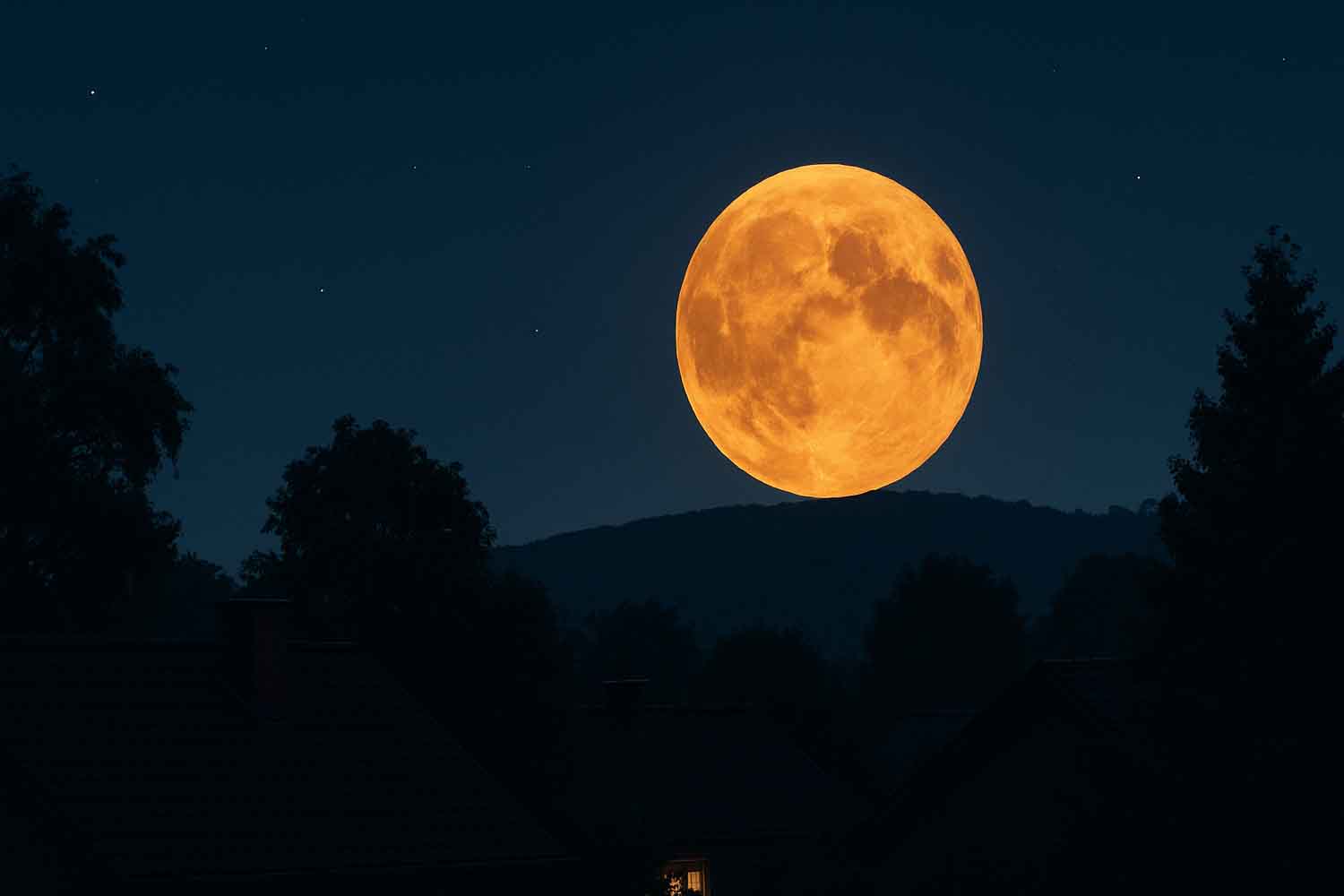
The end of July brings with it one of the most fascinating astronomical events of the summer. Between the July 29 and August 2, 2026 the Italian sky will in fact offer several events not to be missed: the Full Deer Moonthe peak of two showers of shooting stars and the return of Mercurywhich will return to show itself shortly before dawn.
Here’s what to watch for and when to roll your eyes.
The Deer Moon illuminates the evening of July 29th
Wednesday July 29th the Moon will reach the full moon phase at 4.37pm (Italian time). As always, however, the most evocative moment to admire it will be at its rising, in the hours of sunset, when it appears low on the south-east horizon.
In this phase the Moon may take on orange or golden tones, an effect due to the diffusion of light in the Earth’s atmosphere and not to a real change in color of our satellite.
The full moon in July is known as Deer Moona name that comes from Native American tradition and recalls the time of year when male deer develop new antlers.
This year the full Moon also falls two weeks after the spectacular total solar eclipse of August 12, 2026. From Italy the eclipse will only be observable in form partialwhile the band of totality will cross eastern Greenland, western Iceland and northern Spain.
The peak of the Delta Aquarids and the Alpha Capricorns
In the night between on July 31st and August 1st two summer meteor showers will reach maximum activity.
The Southern Delta Aquaridsgenerated by the debris left by the comet 96P/Machholzthey will be able to give away up to 20-25 meteors per hour in the darkest locations, far from city lights. These are generally dim meteors, but quite numerous.
In the same period the Alpha Capricornidsa less rich swarm, with approx 5 meteors per hourbut known for the presence of spectacular fireballs, particularly bright and easily observable even when the sky is not perfectly dark.
The full Moon will make it more difficult to spot the faintest meteors, but the brightest ones will still be clearly visible. To increase the chances of observation, it is best to choose a place away from light pollution, let your eyes get used to the darkness for about twenty minutes and observe a portion of the sky opposite the Moon. As always, no telescopes or binoculars are needed: shooting stars are best observed with the naked eye.
The Perseids are already active
Even the famous ones Perseidsknown as Tears of San Lorenzoare already active, although their maximum is expected in the night between 12 and 13 August.
This year the conditions will be particularly favorable because the peak will arrive near the new Moon. In the darkest skies it will therefore be possible to observe up to fifty meteors per hour, making the Perseids one of the most anticipated astronomical shows of the summer.
Mercury becomes visible again before dawn
Sunday August 2 Mercury will reach the maximum western elongationthe best time of year to attempt to observe the planet in the morning sky.
From Italy it will be visible just before dawn, very low on the eastern horizon. To locate it it will be necessary to have a horizon completely free of obstacles and to start observation about an hour before sunrise.
The next astronomical events
The astronomical summer will continue with other events of great interest. The August 12th it will be the big day solar eclipsewhich from Italy will appear as a partial eclipse, while the August 27 there Full Sturgeon Moon it will be the protagonist of a profound partial lunar eclipse, during which a large part of the lunar disk will enter the Earth’s shadow cone taking on a suggestive reddish color.
For those who love observing the sky, the next few weeks will therefore offer numerous opportunities to witness some of the most spectacular astronomical phenomena of the year, also from Italy.
