
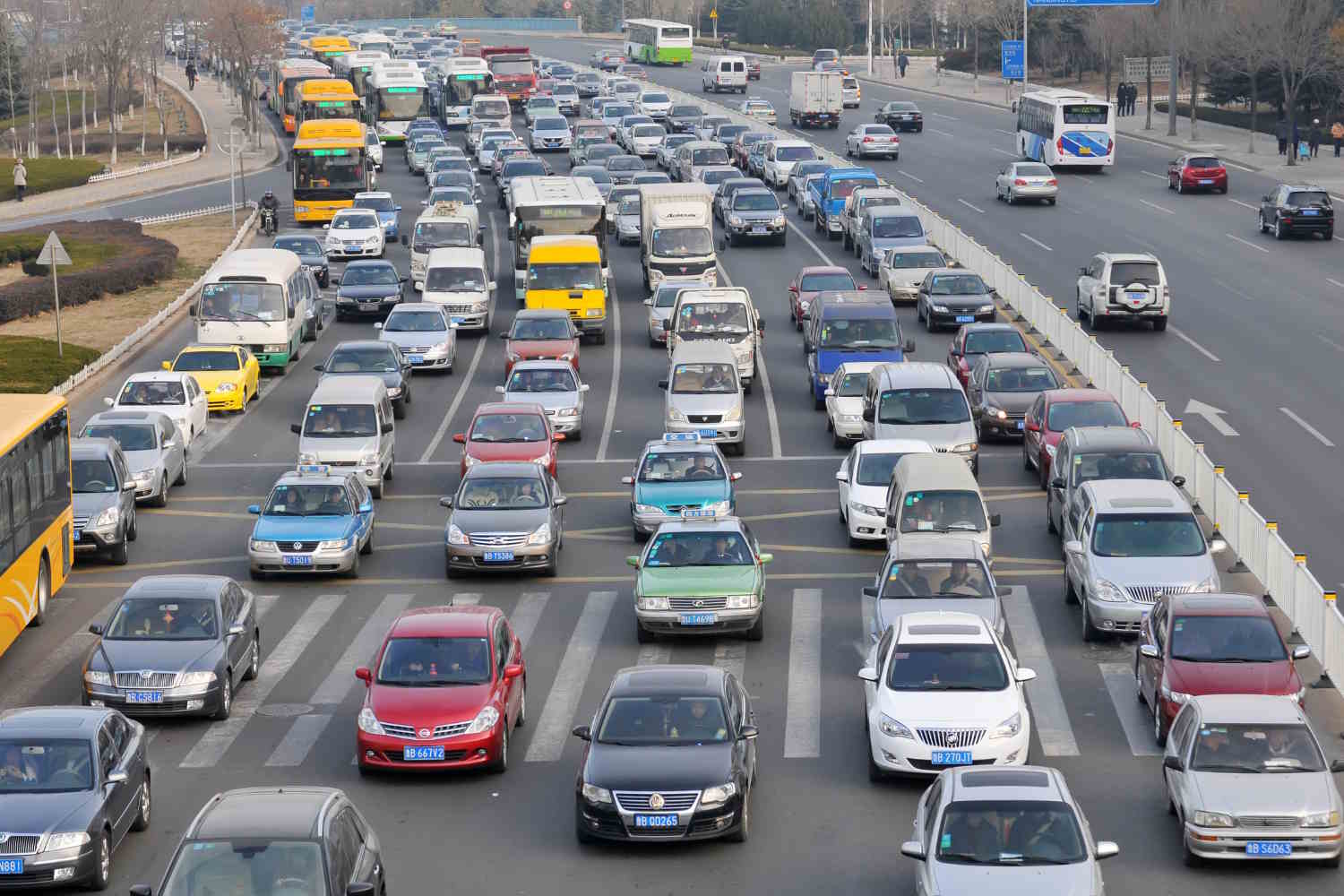
In this period, Viabilità Italia reports the usual increase in traffic linked to departures towards tourist locations. The flows tend to intensify from Friday afternoon, remain strong on Saturday and resume on Sunday with returns to the cities. The scene is the usual one on the main Italian routes: loaded cars, heat, crowded toll booths and a lane next door that always seems to restart at the exact moment ours stops.
Changing lanes can gain some positions. Continuing to jump from one row to another, however, usually offers modest advantages and adds new brakes to an already unstable flow. The queue, meanwhile, gets longer even without the need for an accident.
The queue that arises without accident
Concrete causes abound on Italian motorways: construction sites, restrictions, tunnels, entrances, climbs, toll booths and broken down vehicles. However, there are also ghost queues, capable of forming on a stretch free of obstacles when the number of vehicles approaches the capacity of the road.
In 2008, Japanese researchers placed 22 cars on a 230-meter-long circular track. The vehicles were distributed evenly and the drivers had to proceed maintaining regular speed and distance. After a few laps, a small variation turned into a sequence of stops and starts. About five cars ended up in a traffic jam moving backwards at 20 kilometers per hour, while the cars continued to travel forward.
The experiment published on New Journal of Physics showed how minimal braking can grow along the line. The first driver barely slows down; the one behind reacts with a small delay and brakes a little harder; the next one amplifies the correction even more. Several cars behind, the foot grazed on the brake became a complete stop.
With few vehicles, the disruption tends to run out. In the compact traffic of Friday evening on the Autosole or Saturday morning along the Adriatica, spaces are reduced and each change reaches the next car before the previous one has been absorbed. The queue behaves like an accordion, with less harmony and many more horns.
Because the “smart” lane doesn’t last long
The fundamental relationship used in traffic models is q = ρv: the flow of vehicles depends on their density on the road and the average speed. At the beginning, the arrival of other cars increases the number of vehicles that manage to pass. Once a critical threshold is exceeded, the interactions become so frequent that the speed collapses and, with it, the effective capacity of the road.
A crowded motorway can therefore allow fewer vehicles to pass than one with a few more free meters.
The lane change fits right into that space. The incoming car causes those coming behind to slow down, while the following vehicle must adapt as well. With already unstable traffic, the maneuver can generate a new braking wave.
A study published in Communications in Transportation Research analyzed vehicle trajectories on Sydney’s M1 motorway. In most speed ranges, those who changed lanes did not obtain significant benefits. The only exception observed was speeds between 45 and 50 kilometers per hour.
The researchers also identified a bidirectional statistical relationship: congestion pushed drivers to change lanes and a greater frequency of changes further disturbed the flow, especially during rush hours. The result concerns a specific Australian motorway, but reduces a very familiar temptation also between Bologna and Florence, on the Grande Raccordo Anulare or approaching the Milan barrier.
The maneuvers necessary to enter, exit, overtake a slow vehicle or follow a narrowing belong to another category. Here we are talking about the opportunistic zig-zag between two lines that both proceed in fits and starts.
Only one regular car calmed the other 21
In 2018, a research team repeated the circular experiment with 22 vehicles. One was equipped with an automated driving system programmed to maintain a smooth pace, avoiding chasing every acceleration and braking of the car in front. When all the cars were driven normally, the usual stop-and-start waves appeared. By activating control on just one car, equal to less than 5% of the traffic present, the oscillations attenuated.
In the three experiments described in the study, overall fuel consumption decreased by up to 40 percent and flow increased by up to 15 percent compared to phases dominated by traffic waves. In one of the tests, the strategy was also entrusted to a specially trained human driver.
The percentages concern a controlled circuit, free of toll booths, entrances, construction sites and motorists determined to reach Calabria in one go. However, the experiment shows a concrete mechanism: proceeding without jerks allows you to absorb part of the slowdown, while accelerating to close each space transfers braking to the following cars.
What should be done on Italian motorways
The first rule concerns position. Article 143 of the Highway Code establishes that, on carriageways with multiple lanes, the free lane furthest to the right must be used, leaving the left lanes for overtaking. Driving regularly, therefore, does not authorize you to pitch your tents in the central lane.
Once you have chosen the correct lane, it is best to maintain a sufficient distance, accelerate gradually and let small slowdowns be absorbed. Article 149 imposes a distance that ensures timely stopping and avoids collisions with the vehicle in front. That space also serves to prevent any slowdown from becoming a collective slowdown.
During the exodus, moving the departure time offers a more concrete advantage than zig-zagging. The updated conditions can be checked through the CCISS and the toll-free number 1518, Rai Isoradio, the Anas Vai app and the Autostrade per l’Italia forecasts. On those days the best margin is achieved before the toll booth. Once you enter the queue, physics has already started to do the math.
