
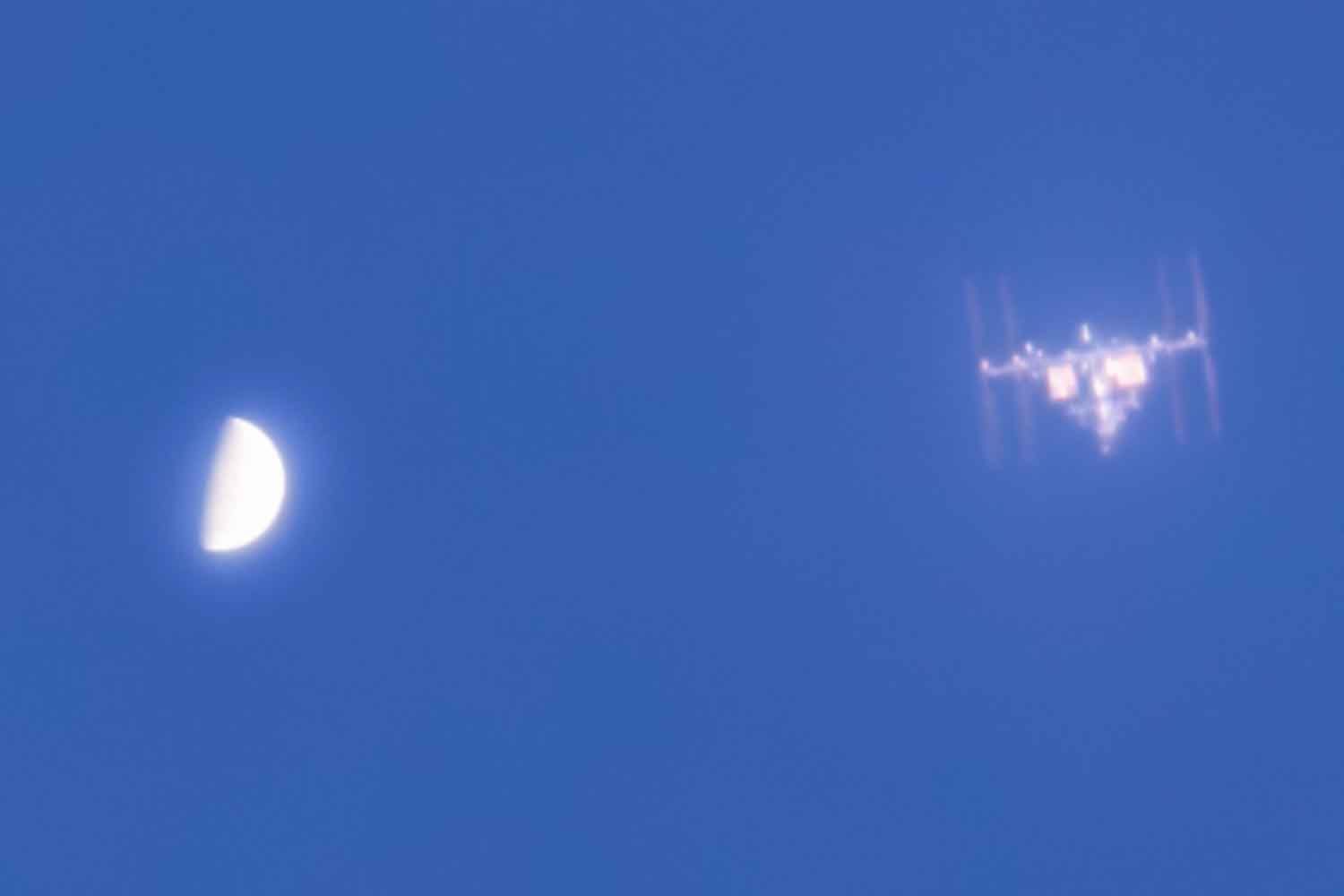
At 18:38:05 on 18 July 2026 the International Space Station enters the telescope’s range. Venus is already there, suspended in the blue sky and 62% illuminated. The hard part travels at around 28,000 kilometers per hour and gives AJ Smadi a few moments to take the image away.
The astrophotographer took the alignment from a park in Edmonds, Washington, after calculating the exact location and time of the passage. He called photography Worlds Apartdistant worlds. An almost necessary clarification: the ISS and Venus appear close only in the frame. In space, each quietly continued to mind their own business. The original video can be seen in the post published by Smadi.
View this post on Instagram
A passage prepared for the second
Smadi used a Celestron C9.25 Schmidt-Cassegrain telescope, with an aperture of approximately 23.5 centimeters, a ZWO ASI662MC astronomical camera and a UV/IR cut filter. The latter blocks some of the ultraviolet and infrared radiation recorded by the sensor, helping to achieve sharper outlines in a daytime sky that tends to swallow almost everything.
The ISS orbits at an altitude ranging between approximately 370 and 460 kilometers and completes a circuit of the Earth in about ninety minutes. Within the narrow field of a telescope it then crosses the scene in a flash. You can have the right equipment, a good atmosphere and a lot of patience; being wrong by a few seconds is still a very effective method for photographing only the blue sky.
The alignment taken up by Smadi is real. The final image, however, does not correspond to a single raw frame: the astrophotographer superimposed multiple images of the station to recover details and also processed Venus separately. In the technical description it indicates 18 frames for the ISS and a two-minute sequence for the planet, selecting the best images. It is a common practice in astrophotography, called stacking: reduces noise and makes what the sensor actually recorded more readable. The video shows the passage from which it all started.
The closeness ends within the frame
The International Space Station measures approximately 109 meters from one end of the solar panels to the other and 51 meters along the modules. Venus has a diameter of 12,104 kilometers, slightly smaller than Earth. In the image they occupy a similar space because the angular size matters: a small and close object can appear as large as a huge one and much further away.
The shape of Venus helps to read the photograph. The planet shows phases just like the Moon, because the illuminated portion we see changes with its position with respect to the Earth and the Sun. On July 18th it appeared just over halfway, while the geometric shape of the ISS passed nearby with its clearly recognizable solar panels.
Smadi presents Worlds Apart as the second photograph ever taken capable of showing the ISS and Venus together in this detail. Such a birthright is complicated to certify among archives, observatories and thousands of astrophotographers around the world. The first image by the same author, however, has rather solid documentation: it ended up directly in the NASA archives.
The first time there was also an umbrella
On April 5, 2025, Smadi had already imaged the ISS next to the crescent of Venus from Shoreline, also in Washington State. To shield the telescope from the intense light of the Sun he had used an umbrella, a very earthly detail in an image that seemed to come from much further away. NASA chose that frame as Astronomy Picture of the Day of 11 April 2025.
Then the station appeared next to a Venus as thin as a scythe. In the new work the planet is more illuminated, the details of the ISS emerge better and the blue of the sky makes the difficulty of the shot even more evident. The image lasts much longer than its subject: to obtain it, a precise point on Earth, a ready-made telescope and a clock capable of reaching the seconds are needed.
