
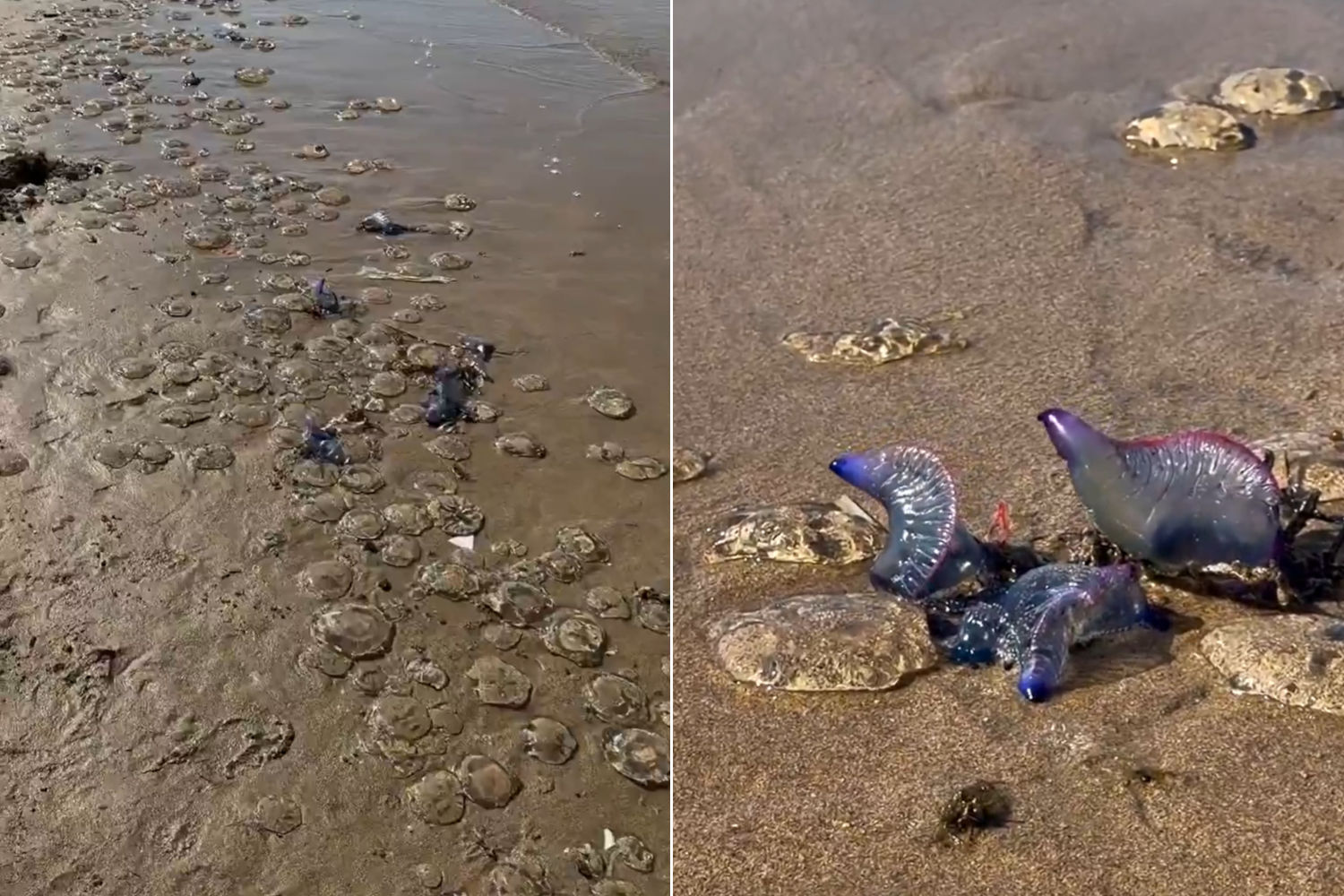
A purple-tinged threat has transformed a quiet start to August into a nightmare for thousands of swimmers crowded on the northern coasts of Spain. The famous beaches of Ondarreta, La Concha and Zurriola, tourist pearls of the city of San Sebastian, suddenly found themselves invaded by a floating fleet of Portuguese Caravels.
The massive presence of these organisms, pushed ashore by powerful sea currents and anomalous winds, forced lifeguards to raise the red flag and temporarily close access to the sea. In just one day, over 120 painful stings were recorded, causing hundreds of rescue interventions to skyrocket along the entire Cantabrian coast, also involving the nearby Basque municipalities of Zarautz, Getaria and Mutriku.
Portuguese man-of-war invasion on Zurriola Beach, San Sebastián pic.twitter.com/Kom1csOaf9
— DARRY (@darry_aX) August 6, 2026
Anatomy of Physalia physalis: the lethal floating colony
Although in the common imagination it is mistaken for a giant jellyfish, Physalia physalis is actually a siphonophore, that is, a colonial hydrozoan complex made up of four different individuals that cooperate for survival. The part visible on the surface is the pneumatophore, a floating bag filled with gas that acts as a real natural sail.
However, the real danger slips under water: the dactylozoids, or hunting tentacles, can extend up to 30 meters in length and are impregnated with powerful neurotoxic and cardiotoxic poison. A recent study published in November 2024 in the scientific journal Drosophila Model confirmed that the toxicity of this stinging liquid is potentially deadly for humans, placing the species among the most poisonous beings on the entire marine planet.
What to do in case of contact and first aid rules
Suffering an attack from this organism causes immediate burning pain, violent skin reactions and, in severe cases, systemic symptoms such as nausea, dizziness or anaphylactic shock. Health service experts remind us that poisonous traps remain active even when the animal is stranded and dead. In case of accidental contact, the emergency protocol requires getting out of the water without shaking and rinsing the affected area exclusively with sea water, absolutely avoiding fresh water which would activate residual toxins. The tentacle fragments must be removed using sterile tweezers and never with bare hands, subsequently applying protected ice to lower the skin temperature before running to the medical emergency station.
A recurring phenomenon driven by changing currents
The invasions of Portuguese Caravels in the Cantabrian Sea do not represent a completely unknown event, but the frequency and intensity of their summer appearances are constantly increasing compared to the seasons of 2024 and 2025. Although the ideal habitat of these animals is represented by the tropical waters and expanses of the Atlantic Ocean, numerous sightings are also reported every year within the Mediterranean Sea, including the basins that bathe the Italian coasts. As long as the trade winds and temperature variations continue to push the shoals towards the shore, surveillance of the beaches will have to remain maximum to prevent a day of holiday from turning into a trip to the hospital.
View this post on Instagram
