
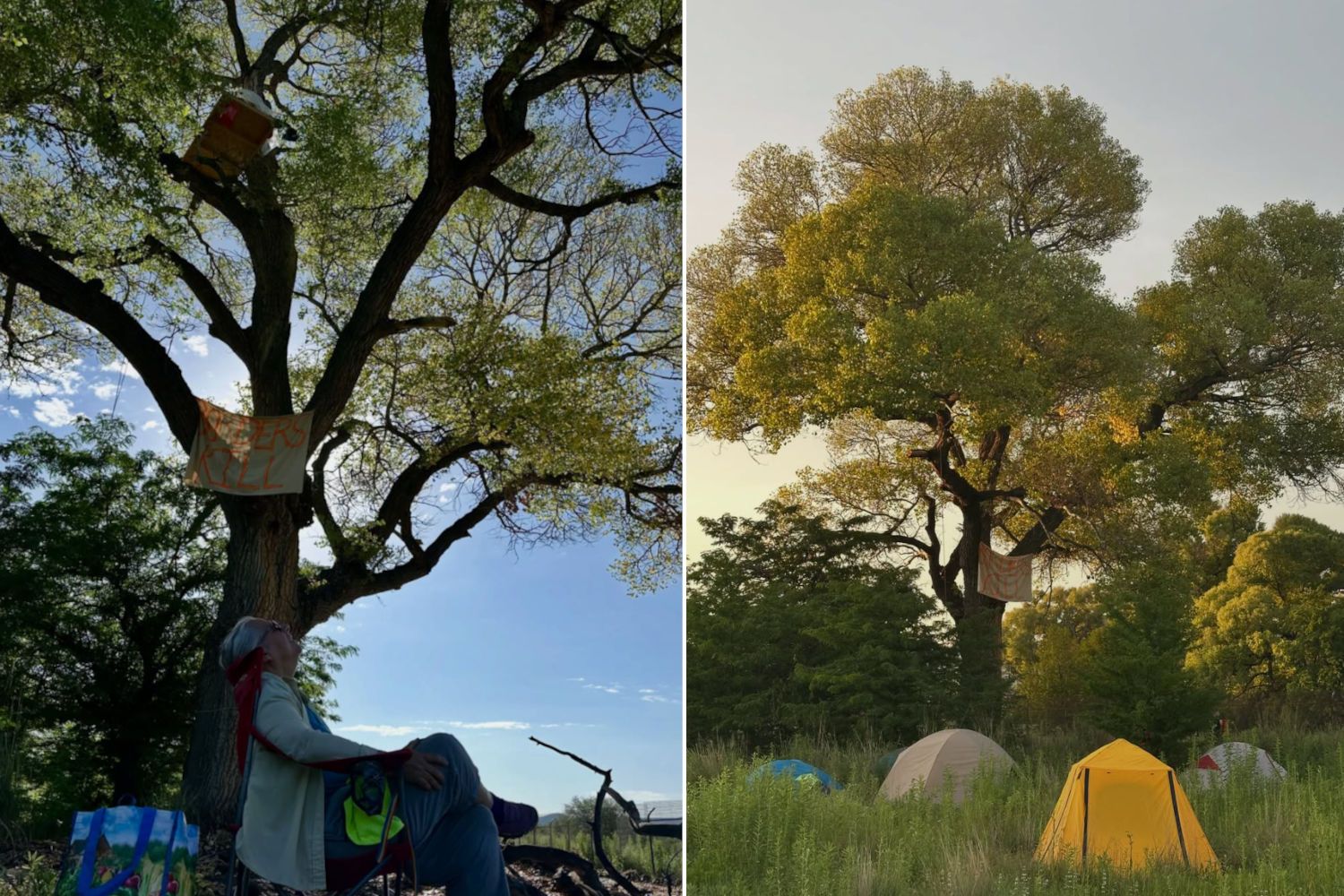
In the arid heart of the San Rafael Valley, in Lochiel, a remote location in southern Arizona on the border with Mexico, a towering cottonwood tree more than two centuries old has become the last bastion of environmental resistance. Among its branches, more than six meters above the ground, activists alternate day and night engaged in a peaceful tree sit, an all-out occupation to prevent the excavators of Fisher Sand and Gravel, a federal contractor, from cutting down the tree to make room for the new border barrier. The bulldozers have already razed to the ground three centuries-old giants belonging to the same grove, affectionately nicknamed the Grandmothers by local communities and indigenous tribes. Now, for environmentalists, this surviving giant represents a true ecological Statue of Liberty to be defended at all costs.
View this post on Instagram
An oasis of biodiversity overwhelmed by the concrete of the barrier
The dramatic protest arises from the decision of the Department of Homeland Security and Customs and Border Protection to create a double steel barrier system, with two parallel walls nine meters high and spaced between them by a twenty-meter wide service strip. The work devastates a fundamental ecological corridor where the sources of the Santa Cruz River originate, a rare riparian oasis in a state that has already lost ninety percent of its river environments. The valley is home to endangered species such as the yellow-billed cuckoo and is a vital transit route for black bears, porcupines, pumas and jaguars. Despite the sightings of active nests sent to federal offices by Erick Meza, coordinator of the Sierra Club, construction sites continue at a rapid pace thanks to the Real ID Act, a rule that grants special exemptions from environmental laws.
View this post on Instagram
The push of the organizations and the case of Santa Cruz County
Coordinating the protests in the field is Kate Scott, co-founder of the Madrean Archipelago Wildlife Center, flanked by dozens of protesters camped on nearby private land with the consent of the owners. The protest crossed state borders, gaining the support of Julia Butterfly Hill, the famous activist who lived in a redwood tree in California for two years in the late 1990s.
Making the demolition of the territory even more controversial is the clear opposition of the Santa Cruz County Sheriff, David Hathaway, who has publicly reiterated that illegal crossings in this stretch of prairie are practically non-existent. Intensive drilling to extract underground water and dynamite explosions risk irreparably drying up the local ecosystem and the aquifers shared with Mexico.
View this post on Instagram
An all-out defense against federal bulldozers
Despite the intimidation of security personnel and the threat of forced eviction, the human chain defending the last poplar tree shows no signs of breaking up. Activists are calling for structural changes to the project, such as widening the space between the steel pillars or targeted deviations of the route to spare the tree heritage. While the construction company’s trucks continue to whiz by, raising dust along the federal easement of the Roosevelt Reservation, the lookout perched on the branches reiterates its desire not to give in. Saving that bicentennial tree means opposing the systematic destruction of a unique natural landscape and protecting the last fragile thread of life that unites two nations.
View this post on Instagram
