
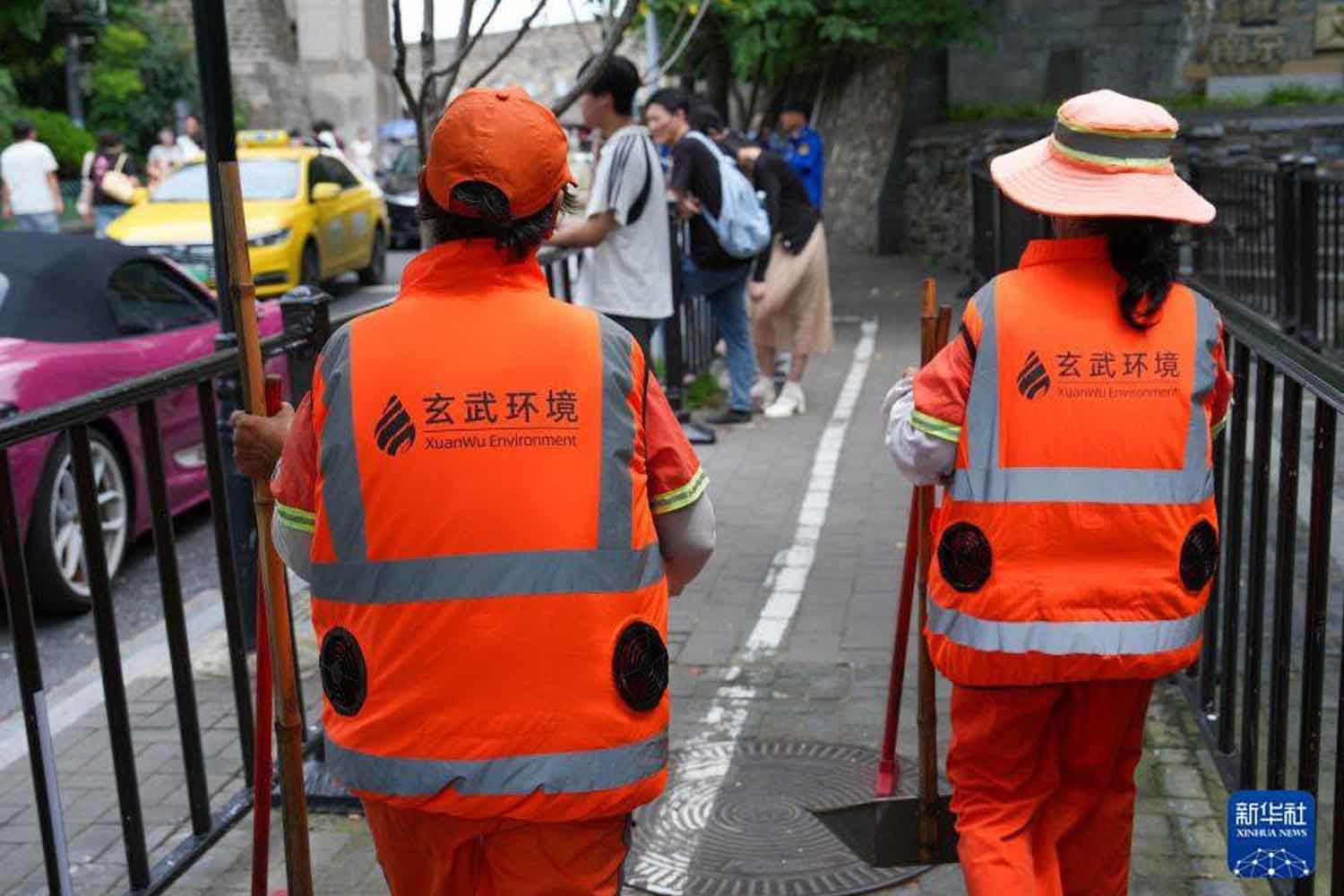
At nine in the morning, along the road alongside the ancient Jiming Temple in Nanjing, China, Zhu Wenxian’s yellow vest emits a soft hum. The 57-year-old continues to rake leaves, while two small fans push air from his waist towards his back and neck. Before, he says, after a few hours the uniform was already soaked and at the end of the shift the sweat left white layers of salt on the fabric.
The novelty entered service in the Xuanwu district of the eastern Chinese province of Jiangsu, where more than twenty ecological operators are experimenting with what local authorities call “air-conditioned vests”. The name promises air conditioning; inside, more soberly, there are two fans powered by a power bank.
How fan vests work
The fans are inserted on the sides of the waist and suck in air from the outside, circulating it under the fabric. The flow accelerates the evaporation of sweat and carries away some of the body heat. It does not produce cold air and does not directly lower the temperature like an air conditioner would: above all it helps to keep the skin and clothes drier.
With a full charge the system stays on for three or four hours. During the experimentation, the vests are distributed already charged, collected at the end of the shift and connected to the electricity again during the lunch break, so that they can also work in the afternoon. The uniform retains the yellow color and reflective bands provided for those who work on the road.
The first evaluations come from the workers themselves. Zhu Wenxian reports less sweat on his neck and arms and a feeling of greater comfort. The company that manages the service in the district defines the initial feedback as positive and is thinking of wider distribution. However, the Municipality of Nanjing still talks about a pilot projectpossibly intended for companies that have suitable needs and conditions.
Independent measurements on body temperature, heart rate or actual reduction of thermal stress are lacking, at least in published documents. For now we know that vests make the wearer feel better. That’s helpful, especially when the alternative is a t-shirt glued to your back, but it’s still different from demonstrating clinical protection against heatstroke.
Two fans can’t handle extreme heat alone
Nanjing didn’t entrust all its worker safety to a pocket battery. Before the vests, timetables had already been changed, mechanized cleaning increased, air-conditioned refreshment points opened and the allowances for working at high temperatures were recognised.
In another area of the city, Jiangbei, the heaviest outdoor manual activities are suspended during central hours. Sweepers, sprayers and washing vehicles continue their service while the operators rest. Eleven fixed structures with water, fans and refrigerators are also available, flanked by 45 mobile points.
Chinese national health indications also ask to reduce the time spent in the heat, organize shifts, provide shaded or air-conditioned areas and guarantee water and checks on workers’ conditions. Wearable devices appear among the possible tools, together with organizational measures: the guide of the National Health Commission insists above all on overall prevention.
The Nanjing vests therefore have a very concrete advantage: they follow the operators when they have to leave the shade and return to the road. As long as those fans remain an addition to breaks, water, reduced hours and mechanical means. A power bank can move air for four hours. Extreme heat requires something more.
In Nanjing, east China’s Jiangsu Province, sanitation workers were seen equipped with "air conditioning vests" recently to cope with the sweltering summer heat.
The high-tech vest, fitted with a small, low-noise fan with three speeds on both sides and powered by a portable power… pic.twitter.com/LZRSZsBs5u— Beautiful China (@PDChinaLife) July 30, 2026
