
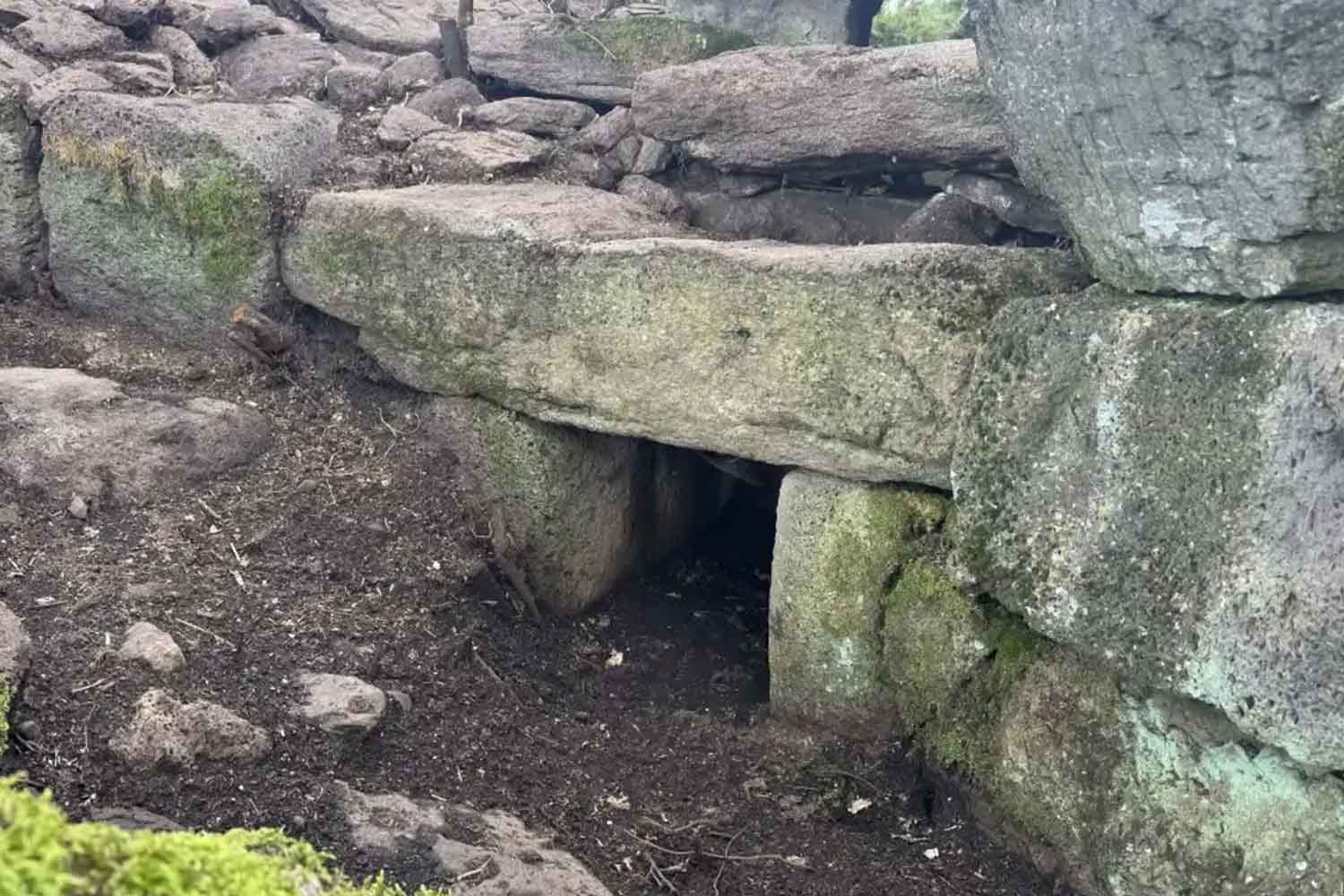
Clearance of earth, brambles and vegetation on the southern slope of Crastu Littu, in Sardiniaa structure appeared that still had a lot to show. At around 740 meters above sea level, in the archaeological complex of Carrarzu Iddia, in Bortigali, archaeologists have brought to light a giants’ tomb preserved together with the burial chamber and the large semicircular exedra in front of the entrance. Inside, then, the least common detail emerged: a part of the room is organized on two levels. There Supervision calls this solution rarely documented and has already announced further investigations.
The name promises giants, giants can sit outside. The so-called giants’ graves were large collective burials of the Nuragic agebuilt to accommodate the deceased of a community over time. What was most impressive must have been the size and monumentality of the façade, enough to leave a lot of work to the popular imagination in the following millennia.
The surprise is in the burial chamber
The Carrarzu Iddia monument is built with trachyte blocks. In front of the chamber there is the exedra, the semicircular space that characterizes many giants’ tombs and which is connected to the carrying out of ceremonies and practices dedicated to the deceased and ancestors.
However, conservation allows you to read something less usual. Near the entrance the internal space is divided into two levelsa solution that the Superintendence considers particularly interesting precisely because it is little attested in this type of funerary architecture. Excavations will be needed to understand how it worked, when it was built and what relationship it had with the different phases of use of the tomb.
Ceramic fragments have also emerged, albeit in an area that shows traces of previous clandestine excavations. The finds are important because they can help reconstruct the chronology of the monument and its attendance. Here it is best to keep the temptation of the perfect number at bay: already attributing the tomb precisely to 1800 BC, and therefore defining it without caution as “3,800 years old”, goes beyond what is currently documented by the available institutional sources.
The National Archaeological Museum of Cagliari in fact, it places the known materials of the Carrarzu Iddia complex in the Middle Bronze Age, approximately between 1770 and 1370 BC. It is an interval of four centuries, decidedly less convenient to put in a title, but it is the one supported by the current state of research.
Carrarzu Iddia was already a small concentration of prehistory
The tomb comes to a place where almost every handful of earth has a few millennia on it. The complex of Carrarzu Iddiain the Marghine, was already known for a corridor nuraghe, a second building probably a tholosa small settlement, a city wall, a well-cistern and a dolmen. Ministry sources also reported funerary remains in the area.
The dolmen tells of an occupation even before the full affirmation of the Nuragic civilisation. The new survey therefore allows us to read better how the same space was occupied, transformed and used to inhabit, bury and probably celebrate the dead during different phases of Sardinian prehistory.
The landscape also helps to understand why here. From the heights of Crastu Littu the view reaches the Macomer plain, the Abbasanta and Paulilatino plateaus and, further away, the Gulf of Oristano. The nearby Orolo nuraghe occupies the same relief system and dominates a vast territory: the ministerial documentation describes it at around 785 meters above sea level, in a position with an immediately legible strategic function.
The discovery comes during an already funded archaeological site
The grave did not pop up during a lucky walk. Carrarzu Iddia is part of the ministerial program “Marghine archaeological site system”dedicated to the excavation, restoration, consolidation and valorisation of six complexes between Bortigali, Silanus, Borore, Dualchi and Birori. They are allocated for the entire program 3,867,920 euros.
And this is also what makes the discovery interesting. The site was known, studied and even described in institutional archaeological guides. Yet vegetation and deposits continued to hide enough parts of the complex to today yield a legible tomb in conditions considered exceptional.
Now it will be stratigraphy, ceramics and the continuation of the excavation that will tell us how ancient it is with greater precision and above all how it was used. For the moment, the trachyte blocks, the resurfaced exedra and those two levels inside the chamber are enough. After more than three thousand years, Carrarzu Iddia still has a few rooms to explain.
