
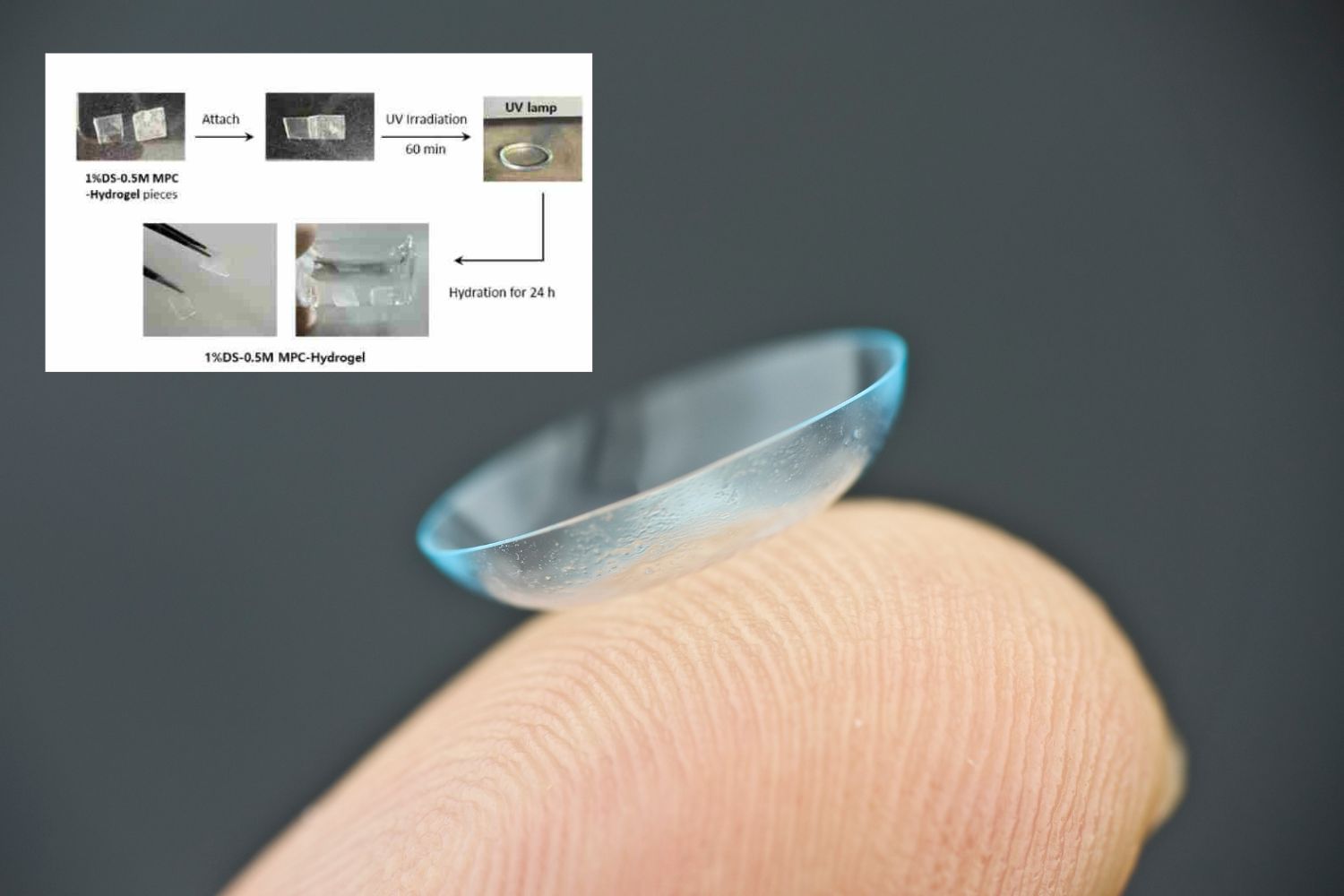
The lens gets a scratch, spend an hour under a UV lamp and the scar is reduced to an almost invisible line. It is the result obtained by a group of South Korean researchers, who developed a new self-healing material intended for soft contact lenses. Still an experimental prototype, of course, but capable of solving one of the most banal and irritating problems for those who use them: once damaged, today the lenses can only end up in the bin.
The material developed by Jung-Hyun Choi and Byoung-Ki Cho manages to mend scratches thanks to ultraviolet light, maintaining transparency, flexibility and a good capacity to retain water. The study, also funded by the National Research Foundation of South Korea, was published in ACS Applied Polymer Materials.
The scratch closes thanks to the sulfur bonds
Common soft lenses are made of hydrogels, porous, water-rich polymer networks that are flexible enough to adapt to the eye. However, this structure can become scratched during handling or in contact with dust and small debris.
The researchers modified the hydrogel by inserting dynamic disulfide bonds into its structure. When the lens is exposed to UV light with a wavelength of 365 nanometers for an hour, some bonds between the sulfur atoms temporarily break and form new ones with neighboring ones.
The network of material is thus able to reorganize itself in the damaged point, progressively closing the groove. In microscope images released by the American Chemical Society, the deep scratch visible before treatment transforms into a much thinner line after exposure to the lamp. A kind of molecular mending, with sulfur instead of a needle.
The team had already developed a hydrogel capable of repairing itself with heat, but the treatment took several hours and risked drying out such a thin lens. UV light, on the other hand, allows the reaction to be started at room temperature and in shorter times.
According to Cho, the process could be repeated and, in the future, also performed with small household UV light devices, similar to those used to clean objects or harden gel polish. This is still an application hypothesis: the prototype will have to be further studied before arriving in home bathrooms, between the lens fluid and the nail file.
More resistant to scratches and deposits
Self-healing is just one of the characteristics of the new material. A second polymer designed to limit scratching, the accumulation of biological material and bacterial growth was applied to the surface of the hydrogel.
The coating forms a very hydrated and slippery surface, to which proteins and microorganisms are able to adhere with greater difficulty. An important detail for a device that remains in direct contact with tears, eyelids and fingers and which, during daily use, can easily collect deposits.
To test its resistance, the researchers rubbed the surface with fine-grit sandpaper. After treatment, the transparency of the lens decreased by only approximately 2%. The coating therefore protected the material even when subjected to significantly more aggressive stress than expected during normal use.
The experimental lenses also retained mechanical properties and water retention capabilities similar to those required of normal soft lenses. In short, the material manages to repair itself without becoming rigid, opaque or dry: a balance that is anything but obvious when working with such thin and delicate structures.
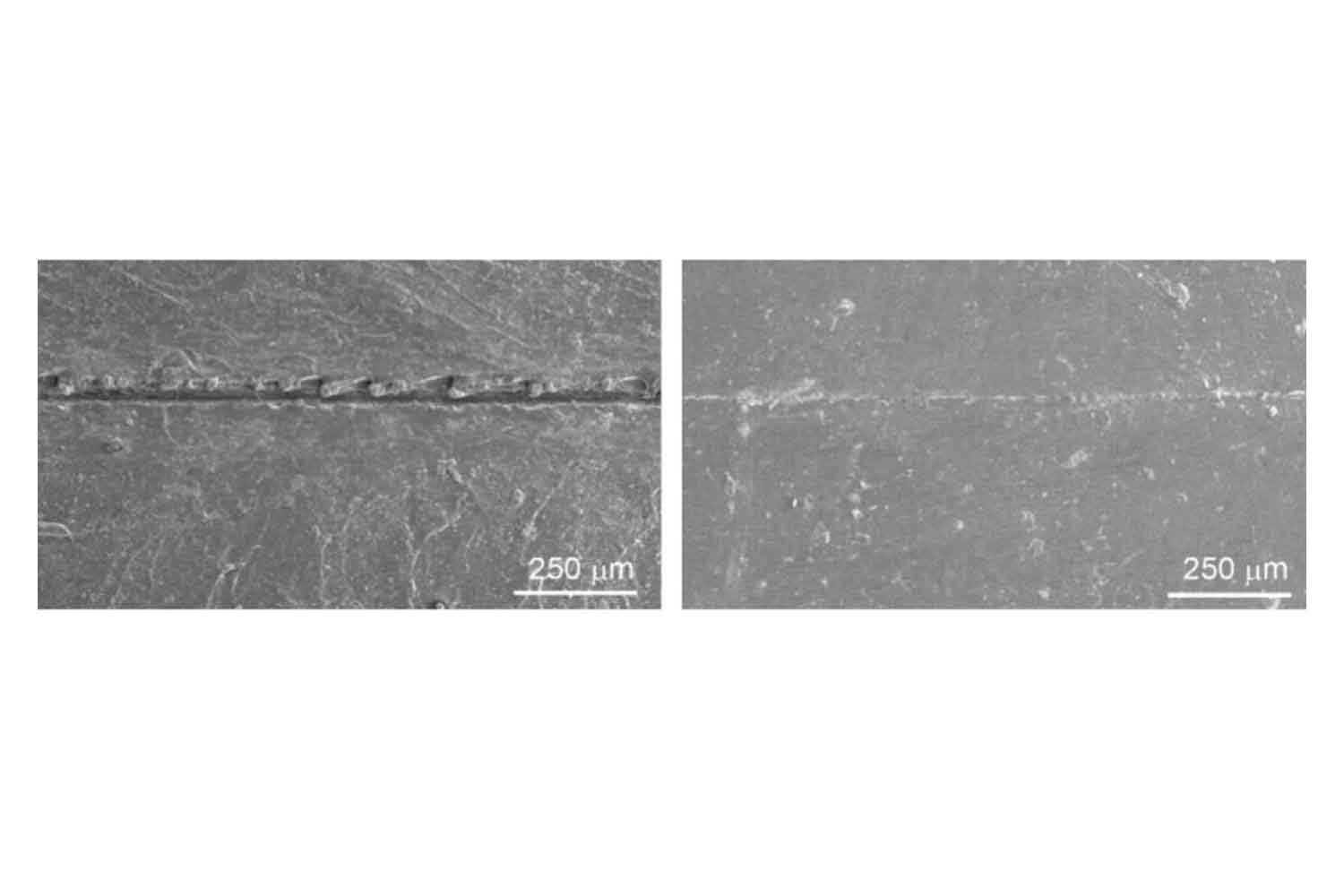
©ACS
Longer-lasting lenses and less waste
A lens that can better resist abrasion and recover from minor damage could last longer, reducing both the cost of replacements and the amount of devices thrown away. The advantage would be particularly interesting for lenses designed for prolonged use, as long as the possibility of repairing them is accompanied by safe cleaning and storage systems.
Before arriving on the market, further stability tests and approval from the South Korean regulatory authorities will be needed. Researchers will have to verify that the material retains its characteristics after multiple repair cycles and in real conditions of use. However, the technology starts from a very concrete result: a scratch engraved on an experimental lens almost disappeared after sixty minutes of UV light.
