
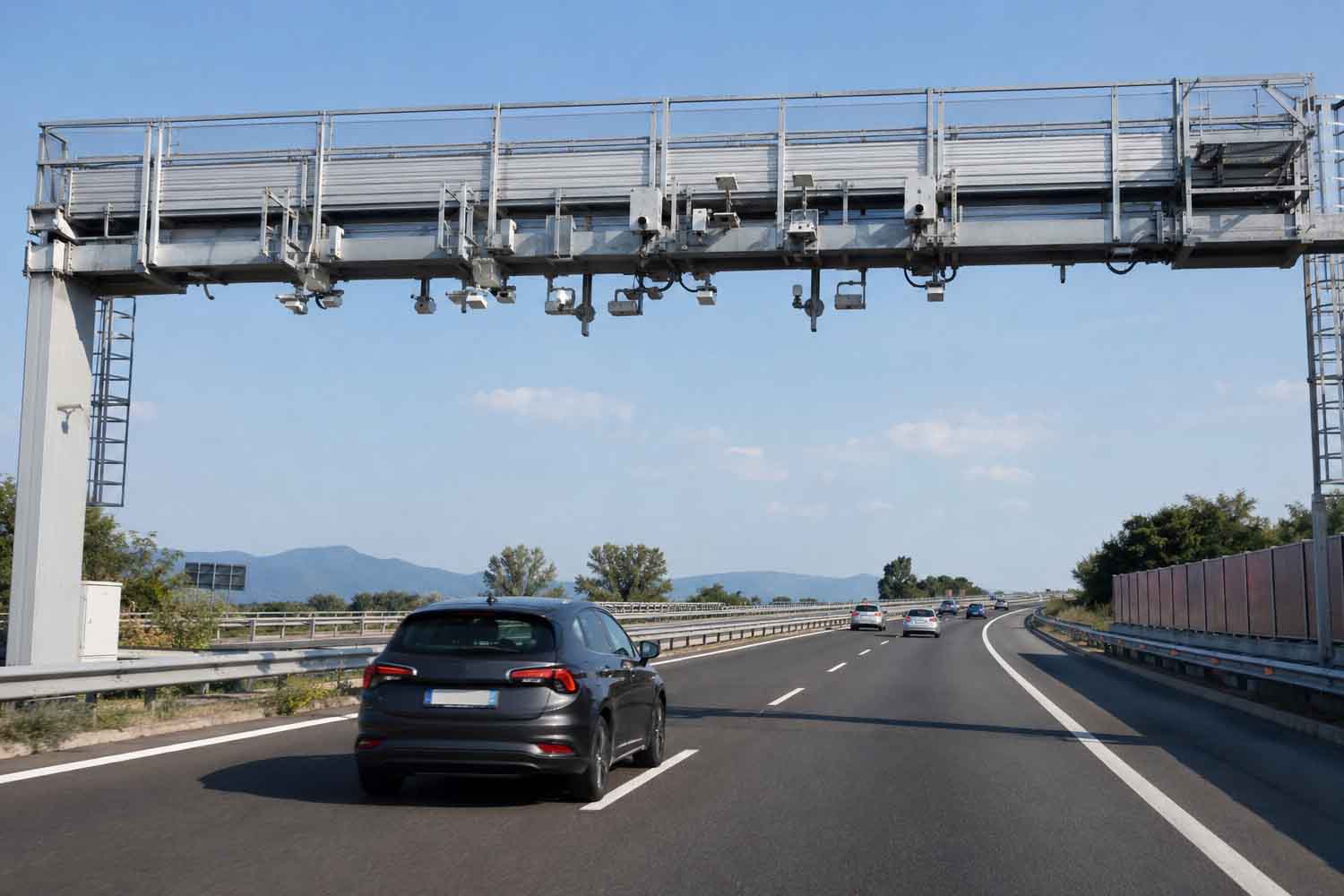
The toll booth disappears, as does the barrier. The car continues at its speed and above the road a portal reads the license plate, vehicle dimensions and any electronic toll device. A few kilometers further on, no one arrives with the POS, but the toll remains to be paid. It is Free Flow, the barrier-free collection system that has already existed in Italy for over ten years and in 2026 it gained a new route, the Ospitaletto-Montichiari connection, the so-called Corda Molle in the Brescia area.
The clarification is needed because Free Flow is not about to suddenly replace the toll booths on all Italian motorways. The first to use it was Autostrada Pedemontana Lombarda in 2015; in the meantime the system has arrived on a part of the A33 Asti-Cuneo and, from 1 March 2026, on the Ospitaletto-Montichiari connection managed by Autovia Padana. These are limited experiences, even if technology continues to gain space.
How Free Flow really works
The scene is a lot less complicated than it seems. Instead of toll stations there are portals that cross the entire roadway. Cameras and sensors identify the vehicle, read its license plate, recognize the class and record the points crossed. The central system can thus reconstruct the route and determine how much must be paid. There is no need to take a particular lane and, in the sections designed for Free Flow, you do not have to slow down to allow reading.
On the Corda Molle, for example, Autovia Padana explains that the toll is calculated on the stretch actually travelled. The same principle is used on the Free Flow sections of the A33. On the Pedemontana Lombarda the equipment can instead directly recognize the on-board device or, in its absence, use the vehicle’s license plate and class.
The most immediate advantage can be seen even before talking about technology: the queues created by toll collection disappear. Managers also indicate among the effects a reduction in fuel consumed and emissions associated with stopping, braking and subsequent acceleration. It is an evaluation of the dealers, not a promise of traffic magically disappearing: if there is a queue ahead, the portal does not yet have the superpower to dissolve it.
Free Flow and Telepass are not the same thing
This is where much of the confusion arises. Free Flow is the system with which the motorway detects transit and calculates the toll. Telepass is one of the services with which that toll can be paid.
Anyone who owns a compatible electronic toll device passes under the portal and is automatically recognized; the amount is then charged according to the contract signed with your supplier. On the Corda Molle and on the A33, in addition to Telepass, various electronic toll operators are authorized.
Those who don’t have any devices continue to travel in exactly the same way. Change what he has to do next. On the Corda Molle you can use the FreeFlow A21 app or the online platform, as an occasional user or through a Targa Account; transits are made available within 24 hours. There is also an Info Point at the Brescia Sud toll booth.
On the A33 the mechanism is very similar: FreeFlow A33 app, online platform, Targa account or physical points. On the Pedemontana Lombarda the possibilities are even more numerous and include the website, app, Conto Targa, Rechargeable Pedemontana, some banking services, Poste Italiane and assistance points. In short, the absence of the toll booth takes an operation off the road and leaves one to remember once you get out of the car.
How long do you have to pay
On the main Italian routes currently managed with this system the same number returns: 15 days from transit. It is the term indicated by Pedemontana Lombarda, Asti-Cuneo and Autovia Padana for those who do not use a form of automatic payment.
And it is precisely here that the Free Flow requires a little more attention than the traditional toll booth. The portal does not ask for anything at the time of passage and therefore it is possible to travel along a toll road without having the material sensation of having left something unfinished. The plaque, however, was read.
After 15 days, the procedures vary in detail between managers. On the A33 a reminder is sent, normally increased by the collection, inspection and mailing costs and the administrative sanctions provided for by the Highway Code may be applied. On the Corda Molle the concessionaire similarly indicates the sending of the reminder, the additional charges and the application of the sanctions provided for by article 176.
The fine can reach 344 euros, but it is not a fixed rate
That number that is circulating these days therefore deserves to be placed in the right place. There is no “344 euro fine” that starts automatically at the stroke of the fifteenth day. For failure to pay the toll, article 176 of the Highway Code provides for an administrative fine from 87 to 344 euros and the deduction of 2 points from the driving licence. The costs related to the assessment and recovery of the credit may be added to the money.
Pedemontana Lombarda is particularly explicit: once the deadline has passed, it initiates the recovery of the credit and sends the owner of the vehicle with an Italian license plate a reminder containing the toll and administrative costs. The company also specifies that the subsequent payment of the reminder does not in itself exclude any administrative sanction.
It is therefore better not to interpret “Free Flow” as “free”. The flow is free, the toll significantly less.
Where there are already motorways without toll booths in Italy
The veteran remains Lombardy. Since November 2015, Free Flow has been operational on the Autostrada Pedemontana Lombarda network, which includes the operating sections of the A36 and the A59 Como and A60 Varese ring roads. It was the first Italian motorway infrastructure to adopt the barrier-free system.
On the A33 Asti-Cuneo the system instead concerns the second section: the manager today indicates the section between Asti-Castagnito and Bra Marene-Cherasco as covered by Free Flow, while the first section towards Cuneo maintains traditional collection methods.
The most recent innovation is the Corda Molle, the Ospitaletto-Montichiari connection: the portals became operational for collection on 1 March 2026. Here the barrier disappeared a few months ago, enough to make something that has been circulating on the Lombardy Pedemontana since 2015 seem futuristic.
The change, therefore, exists and is spreading, but toll booths, traditional electronic tolls and Free Flow portals still coexist on Italian roads. Before entering a barrier-free section, it is best to look carefully at the signs. Because crossing the portal takes a few seconds. Forgetting to have gone through it can be costly.
