
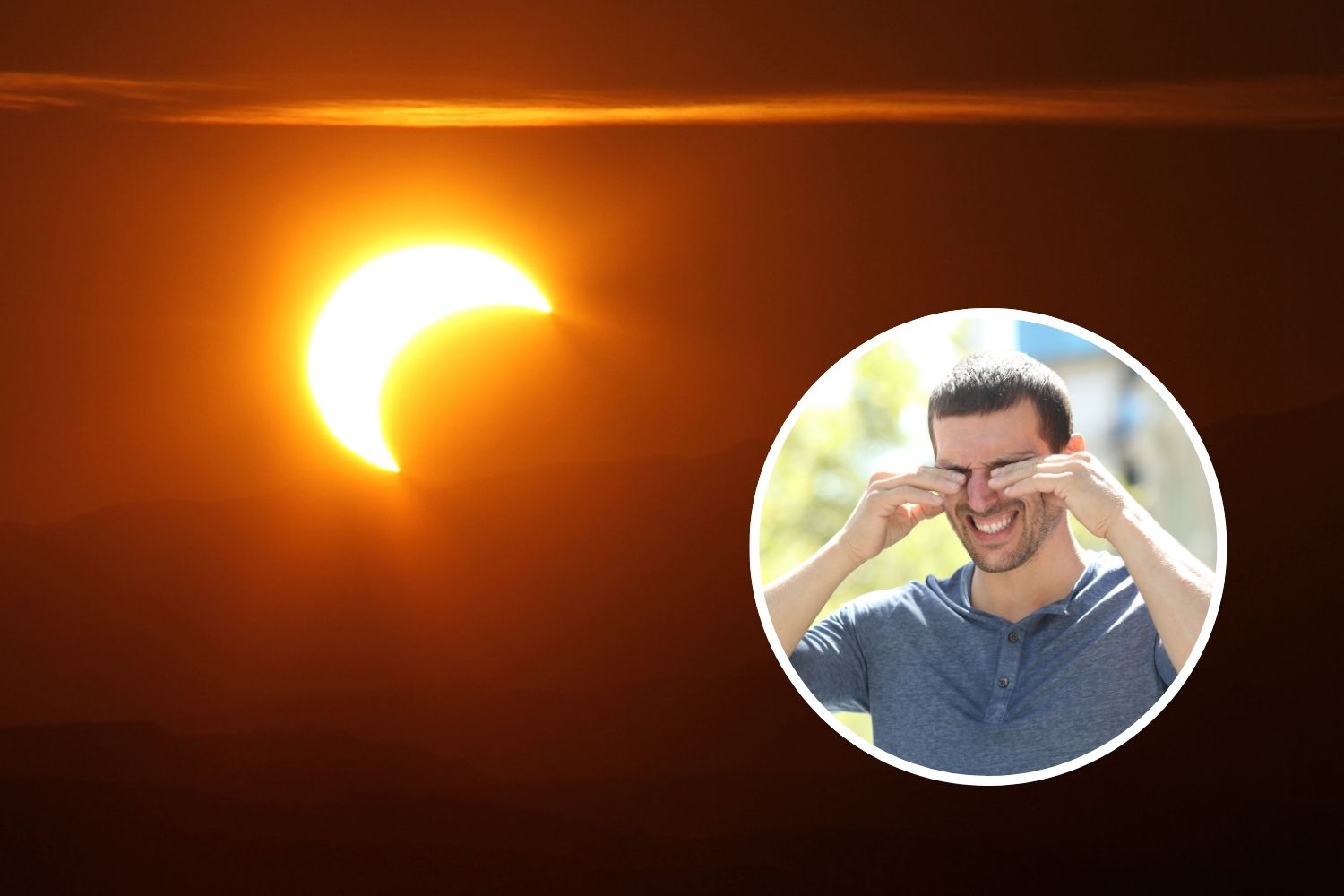
The warnings of scientists, creators and specialists not to observe the eclipse without adequate protection were not enough to avoid risky behavior. In the hours following the astronomical phenomenon, seven visits to the emergency room of the Ophthalmic hospital in Rome were recorded by people who had watched the eclipse without using ISO 12312-2 certified protective goggles.
“In recent hours we have had 7 cases attributable to the risk of ‘solar eclipse maculopathy’”. – Francesco Corasaniti, director of the eye emergency room of the Ophthalmic hospital in Rome, explains to Adnkronos Salute. – “Three people had no symptoms and showed up solely out of fear, because they had witnessed the eclipse unprotected. Two had dry eye syndrome, noticed immediately after exposure to the sun. And two others instead had blurred vision which, however, is now improving”. All patients had observed the eclipse from the capital or the province. Even the presence of clouds, which in some moments made it more difficult to see the phenomenon, may have given a false feeling of security and pushed someone to expose themselves without the necessary precautions.
Damage to the retina
The attention of the experts is directed above all to the retina. In fact, there is a risk that damage has occurred. “These are alterations that are not seen immediately. This is why we plan specific tests such as OCT (Optical Coherent Tomography) which is carried out in the following days to see if a maculopathy can arise” explains Dr. Corasaniti.
The seven patients will then have to undergo the necessary tests to check for any lesions. “They will have to do this type of test to get a diagnosis, to understand if there is a burn, with an eclipse maculopathy. In practice, a ‘black hole’ is created in the visual field”, highlights Corasaniti. Solar maculopathy can in fact affect the central area of the retina, which is fundamental for seeing details. The problem is that the damage does not always manifest itself immediately and can appear even hours after exposure. For this reason, the absence of pain or evident disturbances immediately after observing the Sun does not allow us to exclude any consequences with certainty.
Many patients spontaneously recover most or all of their vision within weeks or months. However, in the most severe forms, a permanent defect of central vision may remain, such as a persistent central scotoma or a reduction in visual acuity.
What should those who observed the eclipse without protection do?
Anyone who has watched the eclipse directly without using adequate filters should contact an eye emergency room or their ophthalmologist, even if they do not experience any particular discomfort. Any alterations can in fact manifest themselves in the following 24-48 hours and are not necessarily accompanied by pain.
Exposure to the Sun, however, does not automatically cause an injury. Some people may feel severe discomfort immediately after observing the eclipse and then test negative, while in other cases initially mild symptoms may be associated with damage only detected through specialist tests.
