
Nine passengers, two pilots, batteries inserted in the wings and a recharge expected in less than forty minutes. The Microliner from the German company Væridion promises to travel about 400 kilometers, including the reserves required for commercial operations, without burning a drop of kerosene. The declared objective is to bring it into service in 2030. For the first European regional routes, four years could therefore be enough. At least on the company calendar. The aircraft’s technical data sheet also indicates a charging power of up to 800 kilowatts: more industrial socket than camping extension cord.
The aircraft, however, still has to pass tests, validations and certification. In July 2026 Væridion concluded the second with the European Aviation Safety Agency Pre-Application Contracta step that is used to agree in advance how to evaluate batteries, high voltage wiring and energy distribution. It is a concrete advance, without yet being the stamp that authorizes passengers to board: the company itself specifies that compliance will have to be demonstrated in the subsequent phases.
The detail downsizes a promise that risks widening as it passes from title to title. By 2030 we could see the first scheduled electric flights on small aircraft and selected routes. Replacing the commercial planes that currently connect European capitals, carrying over one hundred people along with their trolleys, will require a lot of more work.
The 2030 comes in the cabin with nine seats
Væridion says it has secured commercial commitments for over one hundred Microliners and has passed preliminary design review. The commitments show interest from operators, even if they do not automatically equate to one hundred aircraft certified, built and delivered. The first version will be intended for passenger transport, cargo, charter flights and semi-scheduled connections between regional airports.
Even the figure according to which electric planes could cover “a quarter of European routes” needs a few centimeters less. The report published by Transport & Environment in June 2026 talks about the routes subject to Public Service Obligationthe connections supported by public authorities to serve peripheral, isolated or unattractive areas for the market. 77% of these routes were less than 500 kilometers and around a quarter averaged no more than 19 passengers. An interesting and very specific basin, far from representing a quarter of all continental traffic.
The first aircraft therefore find their natural space between islands, remote regions and secondary airports, where a fast train simply cannot reach. Some routes such as London-Dublin, Barcelona-Ibiza or Rome-Olbia easily fit within the announced kilometer range. The nine seats remain nine: the geography matches, the capacity of a normal commercial flight is decidedly less.
A busy route could be served by many small aircraft, increasing takeoffs and landings, or wait for larger aircraft. The first generation seems to have been built above all for those thin lines that today employ small turboprops, guarantee territorial continuity or are abandoned because they carry too few people to be profitable.
From nine to ninety seats, the calendar gets longer
An intermediate solution comes from the French Aura Aero. Its ERA should carry 19 passengers for a declared maximum distance of 1,500 kilometers and enter the market around 2030. However, it is a hybrid-electric plane: eight electric motors receive energy from batteries and two turbogenerators, also compatible with sustainable aviation fuels. The company estimates a reduction in CO₂ emissions of up to 80% compared to traditional aircraft of the same class. These are performances and savings declared by the manufacturer, to be verified during testing, certification and real use.
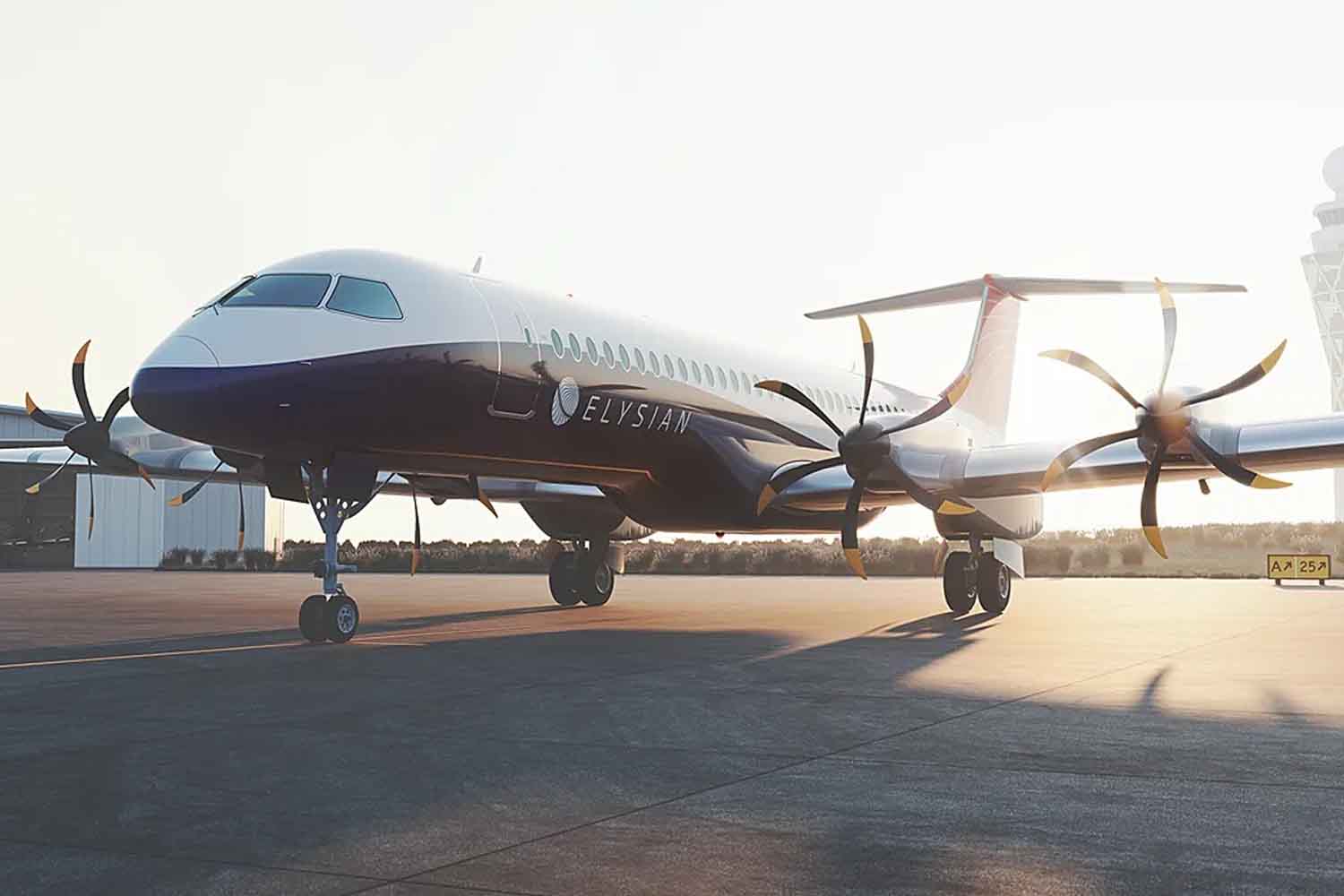
The leap towards a cabin similar to that of current regional aircraft is represented by the E9X from the Dutch company Elysian Aircraft. The project envisages between 88 and 100 seats, 750 kilometers of fully electric autonomy and the possibility of reaching a thousand through a reserve energy system. Elysian collaborates with KLM and Transavia to study maintenance, airport infrastructure, route organization and passenger experience. For now it’s all about industrial design and research: KLM has not announced commercial flights nor a date to put them on sale.
Putting together ninety people, batteries, safety reserves and sufficient autonomy produces a very different aircraft from the Microliner. The E9X studied by Elysian would have a wingspan of 52 meters and a maximum take-off mass of 82.5 tonnes. Batteries would enable the nominal route, while a fuel-powered system would come into play for reserves and occasionally to extend range. Mass electric flight therefore remains a goal of the middle of the next decade, not the ready product for the summer of 2030.
Batteries, airports and an 800 kilowatt outlet
The weight of the batteries continues to dictate how many passengers can board and how far they can go. Unlike fuel, which is consumed and lightens the plane during the journey, a discharged battery weighs exactly as much as a charged one. It must also conserve sufficient energy for diversions, waits, adverse weather conditions and alternative landings. In aviation, the reassuring percentages on the display have slightly stricter rules than those on the smartphone.
Then there is wear and tear. Deep charging and discharging cycles repeated several times a day can rapidly degrade batteries; the Transport & Environment report also considers very frequent replacements, in some scenarios even annual. Actual duration and costs will depend on the chemistry used, thermal management, routes and safety margins imposed during certification.
Regional airports will have to handle high power without turning every recharge into a lunch break. European standards already provide for electrical power for parked conventional aircraft, useful for avoiding the ignition of auxiliary engines. Charging the propulsion batteries is another matter: more robust grid connections, megawatt systems, common standards and adequate operating areas are needed. Small airports, chosen because they are suitable for the first electric flights, risk being those with the least prepared network.
Meanwhile, the European Union is preparing the regulatory ground. The European Alliance for Zero-Emission Aviation published a roadmap for electric, hybrid and hydrogen aircraft in April 2026. On 17 July, the Commission also proposed a review of the ETS that strengthens support for cleaner propulsion technologies and investments through the Innovation Fund. The regulatory track is getting longer; a large part of the hangar is still missing.
Emissions do not disappear with kerosene
An all-electric aircraft does not emit CO₂ during flight, reduces noise and does not produce pollutants linked to fuel combustion. Its overall impact depends on the electricity used, battery construction and replacement, materials and infrastructure. The term “zero emissions” therefore describes what comes out of the plane as it flies, not its entire life cycle.
This is also recognized by technical research published by Elysian and its scientific partners. The comparison includes electricity and battery production and assumes a European grid of 114 grams of CO₂ per kilowatt hour by 2030, corresponding to approximately 75% renewable sources. In that scenario the E9X would have a much lower climate impact than a modern narrow-body aircraft deployed over short distances. However, the train has significantly lower emissions.
The same analysis also shows the environmental price of the additional autonomy: using the fuel system to go from 750 to a thousand kilometers would triple the estimated emissions compared to operating on batteries alone. Hybrid mode would make sense as an occasional reserve, not as a daily habit disguised as electrification.
The first ticket could therefore arrive in 2030 on a nine-seater aircraft and a very selected route. The ninety passengers, the thousand kilometers and the mass connections have a longer timetable. For now, the battery must also line up ahead of certification.
