
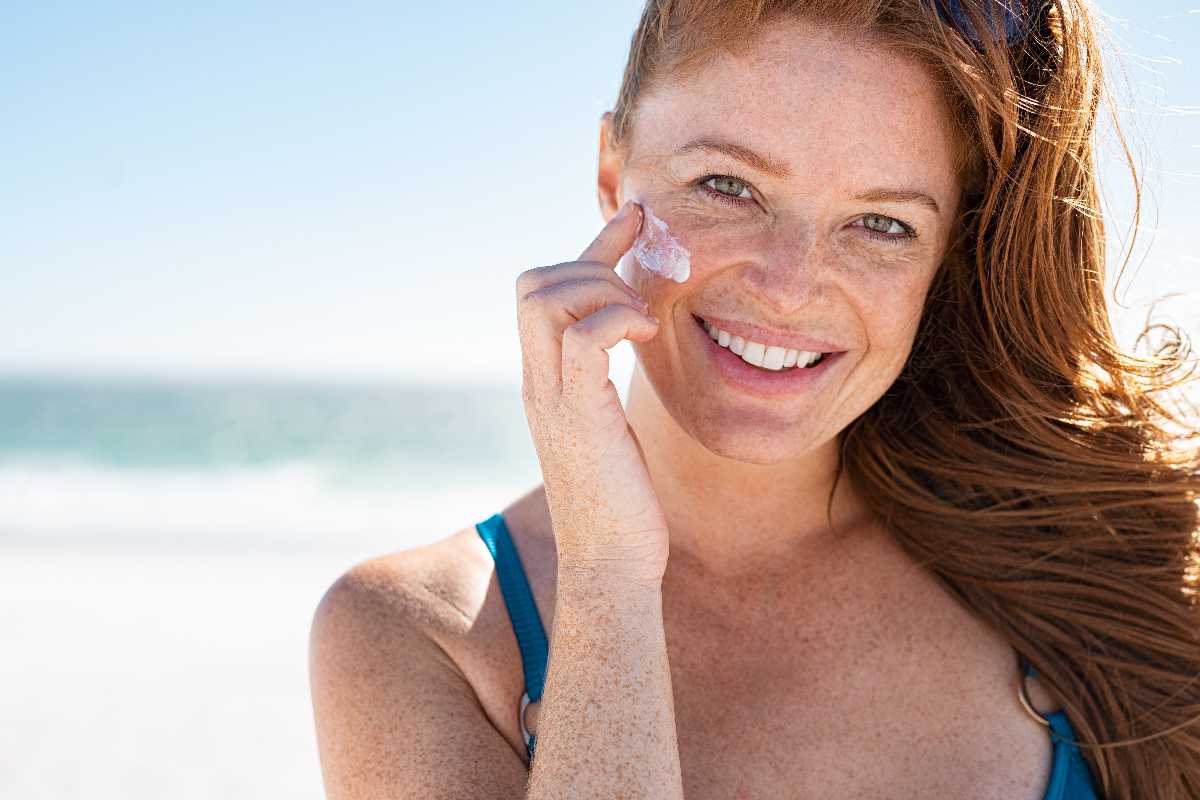
When sunscreen and makeup are part of the same routine, the sequence matters. Sunscreen should be applied after normal facial care products and before foundation, concealer and other cosmetics. In this way it can be distributed evenly on the skin and correctly carry out its protective function.
In the morning, therefore, you can start with cleansing and continue with any tonic, serum and moisturizing cream. Once these products have been absorbed, we move on to sun protection. Make-up only comes afterwards, when the sun has stabilized on the skin.
It is helpful to avoid wearing makeup immediately after applying SPF. Leaving a few minutes to pass reduces the risk of the foundation dragging or removing part of the product, creating less protected areas. Texture can also make a difference: light, non-greasy formulas tend to integrate better with makeup and can make the base more uniform.
Make-up with SPF does not necessarily replace sunscreen
Foundations, BB creams, concealers and powders may contain a protection factor, but this does not mean that they automatically guarantee the same coverage as a correctly used sunscreen product.
To achieve the declared level of protection it would in fact be necessary to apply a quantity of cosmetic often higher than that normally used for make-up. Furthermore, make-up is not always distributed evenly on every area of the face.
For this reason, a cosmetic with SPF can represent additional protection, but it is preferable to consider it a complement and not a substitute for sun protection, especially when you spend a lot of time outdoors.
Moisturizer with SPF or sunscreen?
Many day creams also contain UV filters. Their adequacy depends above all on the protection factor, the quantity applied and the type of exposure.
During a day spent mainly indoors, the needs may be different than those of those who walk outdoors for a long time, drive for many hours or spend time under the sun. When exposure is significant, it is generally best to use a broad-spectrum sunscreen with an adequate SPF.
It should also be remembered that the face is not the only exposed area, the neck, ears and décolleté may also need protection, especially during periods in which they remain uncovered.
Can tinted sunscreens replace foundation?
Colored sunscreens are a practical solution for those who want to combine protection and a light smoothing effect. They can therefore be used in place of a traditional base when the desired coverage is reduced.
The important thing is not to reduce the quantity applied just to avoid an overly pigmented result. In fact, to obtain the declared protection, the product must be distributed in a sufficiently generous and uniform way. If some imperfections require greater coverage, it is possible to intervene subsequently with a concealer or other make-up products.
How to behave during the day
The protection applied in the morning may decrease as the hours pass, especially in the presence of sweat, friction, water or prolonged exposure. The need to reapply the product therefore depends on the conditions of the day and the indications given on the sunscreen used.
With your face made up, reapplication may be less immediate. There are formulations designed to make touch-ups easier, but it’s important to remember that sprays, powders and other products with SPF must still be used in sufficient quantities to offer significant protection. A simple, very light mist does not necessarily guarantee the SPF level indicated on the package.
When exposure is intense, it may be preferable to favor correct reapplication of sunscreen even at the cost of touching up the make-up later.
How to combine sunscreen and makeup
To limit problems such as shine, lump formation or foundation shifting, it is best to choose formulas compatible with your skin type and let each product absorb before applying the next one.
Even the way in which the make-up is applied can affect the result: light pressure and non-aggressive movements help not to excessively disturb the underlying layer of protection. Furthermore, if the routine includes a lot of cosmetics, simplifying some steps can make it easier to obtain a stable and comfortable base.
Sun protection even when you don’t wear make-up
The usefulness of SPF does not depend on the presence of make-up. Protection from ultraviolet rays mainly concerns the prevention of damage caused by sun exposure, including photoaging, pigmentation changes and increased risk of some skin diseases.
UVA rays can partially pass through glass and are present throughout the year, even when temperatures are low or the sky does not appear particularly bright. The need for protection must therefore be assessed based on actual exposure and not just the season.
