
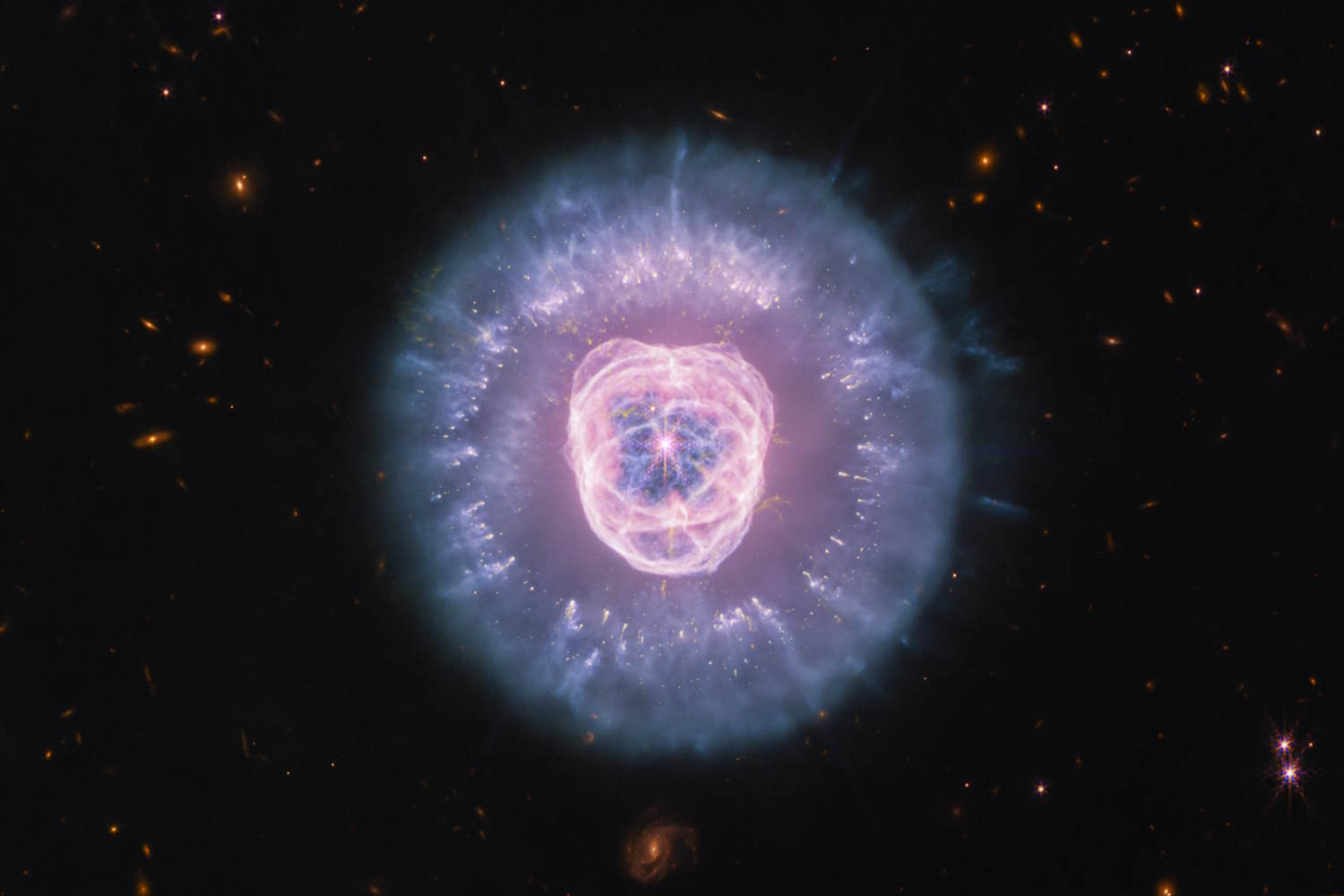
There Leo Nebula (NGC 2392) was again “captured” before its disappearance: the images, this time obtained with the Webb Space Telescopeare incredibly sharper than those captured in 2020 by the Hubble telescope, thanks to a resolution never had before.
View this post on Instagram
The Leo Nebula
As NASA explainsNGC 2392 is a planetary nebula that began forming around 10,000 years agowhen the dying star began to eject matter into space, and is composed of two elliptical lobes of matter that flow above and below the dying star.
Scientists believe that a ring of dense material around the star’s equator, ejected during its red giant phase, created the shape of the nebula, and that this dense mass of material slowly moves to approximately 115,000 kilometers per hourpreventing high-speed stellar winds from pushing matter along the equator. On the other hand, winds at 1.5 million kilometers per hour would instead sweep away material above and below the star, creating the elongated bubbles.
NGC 2392 is called Leo Nebula due to its shape, which resembles the snout of the king of the forest, and is located approximately 5,000 light years from Earthin the constellation Gemini. The first resolved image of the cosmic object was taken on January 10 and 11, 2000 with the Wide Field and Planetary Camera 2 of Hubble Space Telescopeobtained in visible light and which revealed for the first time features such as the “mane” of comet-shaped nebulous objects.
Images obtained by the James Webb Space Telescope
NASA’s James Webb Space Telescope has now captured new images of NGC 2392, much clearer and more detailed thanks to its high resolution: the nebula is located in the center, has a circular shape and resembles the head of a male lion. In the center of the structure is a small pinkish-white circle with eight diffraction tips, one dwarf white, while around the star there are cavernous bubbles of pink-purple color and rings similar to shells.
The bubbles and shells collectively form an oval with two small sweeping arcs near the top, resembling a lion’s snout and ears. What appears to extend from the lion’s face instead is a thick ring of blue-purple material, resembling a mane.
The area closest to the lion’s face appears more nuanced, while the edges of the mane appear to be composed of clumps of dust with comet-like tails. Finally, distant galaxies and stars can be glimpsed in the background, some of which appear as bright yellow and orange points, while others have spiral structures and others show diffraction spikes.
NASA’s James Webb Space Telescope imaged the planetary nebula NGC 2392, the Leo Nebula, using the observatory’s NIRCam and MIRI instruments. The remnants of the central star are responsible for the structure of the nebula, including a mane-shaped bubble of ionized gas and dust, similar to a lion’s face.
At first glance, the overall structure of the nebula in the infrared images of the Webb telescope, obtained both with the NIRCam (Near Infrared Camera) which with the MIRI (Mid Infrared Instrument), could look very similar to Hubble’s previous visible light image. However, the Webb’s infrared vision highlights features such as compact agglomerates of dust and a nebula of ionized gas: This mass of gas and dust took several thousand years to reach its current shape and the components of the nebula continue to change.
The source of these continuous changes and the reason for the distinctive appearance of the Leo Nebula lies at the center: i remains of a dying star. Although it resembles a lion’s button nose, its energy and radiation fuel the intricate structures we see here.
Webb’s images have therefore “frozen” this planetary nebula in time, although the death of the star and its tumultuous effects are still ongoing: NGC 2392 will in fact continue to undergo changes as its gas and dust move away from the stellar core. Astronomers estimate that the structure will completely disperse in about 10,000 yearsa relatively short period in astronomical terms.
What a show!
Sources: NASA / NASA Webb Telescope/Instagram
