
In Fregene, pine cones have become rare enough to stop a factory that has been processing them since the post-war period. Pinus Pinea, heir to Pinoli Martini opened in 1945, has closed its doors after over eighty years of activity. In the 1950s his pine nuts reached pastry shops in the United States; in 1978 the company had a turnover of 1.2 billion lire. In 2026, local raw material has become insufficient.
The cause indicated for the closure has a decidedly less memorable name: Toumeyella parvicornisthe pine tortoiseshell cochineal. An alien insect that arrived from North America, a few millimeters large at most, capable of weakening and killing above all the Pinus pineathe domestic pine that produces pine nuts and designs a large part of the landscape of Rome and the Lazio coast.
©CREA
Eighty years of activity against an adult female of a maximum length of 4.4 millimeters. The proportions, at least those, are remarkable.
The pine turns black, then begins to shed pieces
To identify the turtle mealybug, you often first see the damage to the insect. Adult females are brown, convex, almost hemispherical and owe their name to the shape that resembles a tiny carapace. On stone pine they concentrate above all on the woody part of the shoots; when the infestation is strong they can accumulate next to each other forming real insect sleeves.
Then the most obvious part begins. The cochineal sucks the sap of the plant and produces large quantities of honeydew, a sugary substance on which molds develop. The foliage becomes sticky, the needles and branches become covered in black, photosynthesis is reduced and the tree progressively loses strength.
That black, therefore, is not the cochineal that decided to repaint the pine. They are mainly mushrooms grown on honeydew.
In the most serious cases there is drying of the branches, loss of the foliage and compromise of the vitality and stability of the tree. CREA also reports that an already debilitated pine also becomes more vulnerable to other harmful insects.
It arrived in 2014. It has come a long way since then
The first confirmed presence in Europe dates back to 2014 in Campania, on domestic pines in the Naples area. The behavior observed there helps to understand why stopping it is so complicated: each female can produce on average around 500 eggs, in some cases reaching over a thousand, and in the Campania conditions three complete generations and a fourth partial one were observed in the same year. The young nymphs are the only mobile stage and can move from one tree to another even transported by the wind.
In Lazio the first report dates back to mid-2018, in the south-east area of Rome. Within a few months the insect had already spread and by 2019 it affected a large part of the city. Official investigations in 2025 confirmed a now widespread presence in the provinces of Rome and Latina; in the first quarter of 2026 the cochineal was also found in the Viterbo area. The Lazio Region updated the delimitation of the affected areas again in April 2026.
And Lazio is only part of the map. CREA also indicates infestations in Campania, Abruzzo, Puglia, Tuscany and Marche, as well as reports in France and Albania. In Tirrenia, in the Pisan area, the outbreak has reached 770 hectares, an extension such that eradication is now impracticable according to the phytosanitary authorities cited by the body.
The parasite is tiny. Its geography much less.
What to do if a pine tree is infested with tortoiseshell scale insect
The temptation to solve everything with a generous spray of insecticide should be left where it is. From 2021 Toumeyella parvicornis it is regulated in Italy by a specific ministerial decree and in Lazio there are different obligations depending on whether you are in an infested, buffer or still free area.
In free and buffer zones, the suspected presence of the insect must be reported immediately to the regional phytosanitary service. In areas already infested, when necessary, the pruning of the now compromised parts, the felling of non-recoverable trees and the correct management of the plant material are envisaged. Drastic pollarding should be avoided. Furthermore, infested branches and residues cannot be moved freely like normal pruning: transporting the material can help the insect conquer new territories.
Authorized phytosanitary treatments are also possible, including endotherapy, which brings the active ingredient into the vascular system of the plant. CREA has observed useful results in the temporary containment of populations in urban and peri-urban environments with abamectin-based products. Bringing the same system into entire pine forests, however, means dealing with costs and environmental impacts that make it impractical on a forestry scale.
Single pine can be treated. A kilometre-long pine forest requires something different.
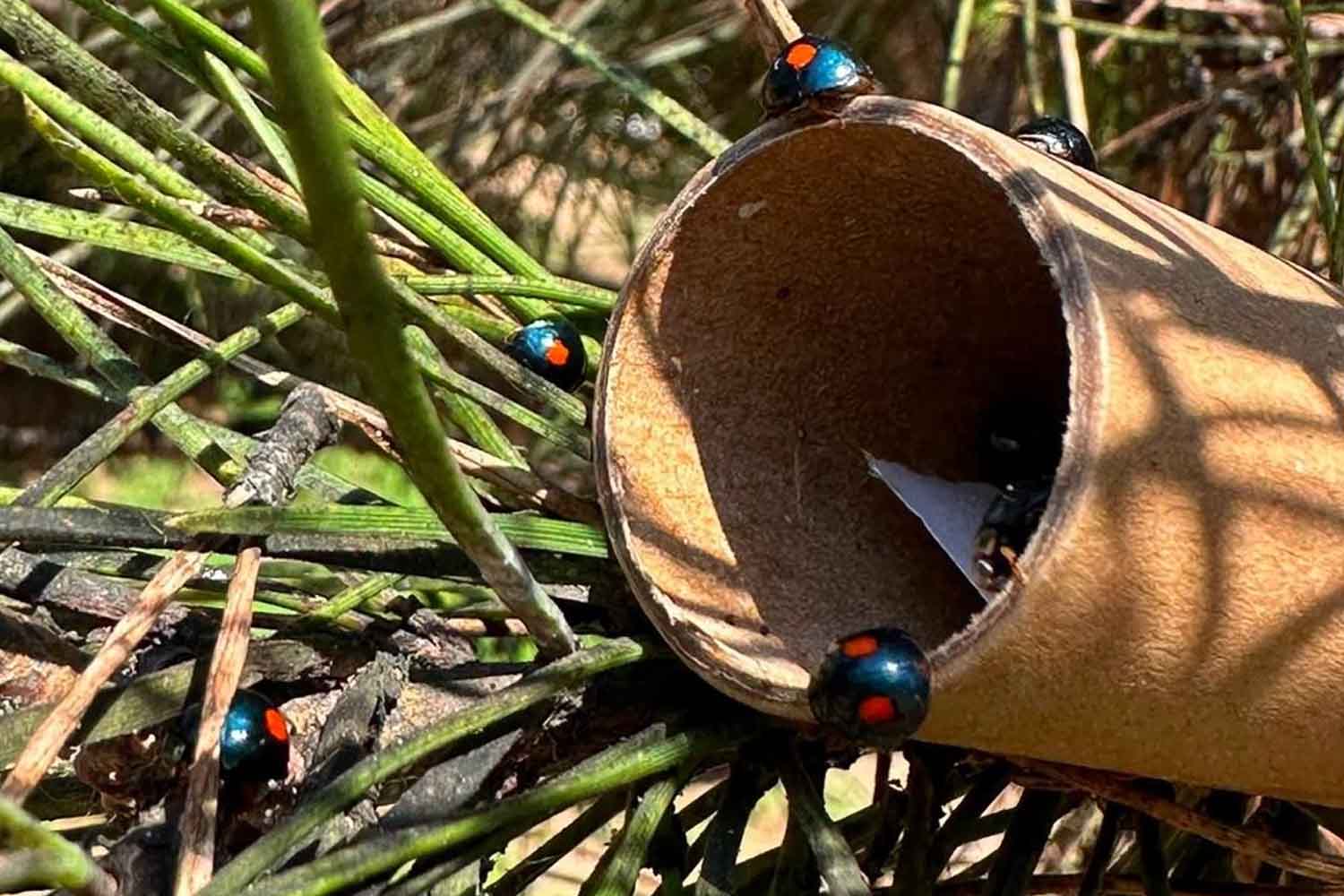
Now another ladybug has arrived against the cochineal
On 30 July 2026, in the grove of Varco Marconi at the Mostra d’Oltremare in Naples, CREA released for the first time in the world on an experimental basis Thalassa montezumaea small beetle of the coccinellid family identified as a natural predator of the turtle scale insect. The release was carried out together with the Campania Phytosanitary Service and the Federico II University, after authorization from the Ministry of the Environment.
The strategy is called classical biological control: we look for a natural antagonist in the places of origin of the invasive species, we study whether it can control it and, above all, whether it can be introduced without creating a new problem in place of the old one. CREA has been working on the project since 2023 and has identified Thalassa montezumae during searches in the Turks and Caicos Islands. Before the Italian release, predation tests and assessments of the possible impact on other organisms were conducted.
The little ladybug, however, was not released with a superhero cape and soundtrack. The director of CREA Defense and Certification, Stefano Speranza, clarified that this is the start of a long-term strategy. In the coming months, researchers will have to verify whether the predator manages to establish itself and how much it affects the populations of Toumeyella and what effects it produces on the environment before thinking about a possible extension to other territories.
In Fregene, meanwhile, the bill has already arrived. A supply chain built for decades around a tiny seed stopped before an even smaller insect. The search is now trying to buy time for the remaining pine trees.
