
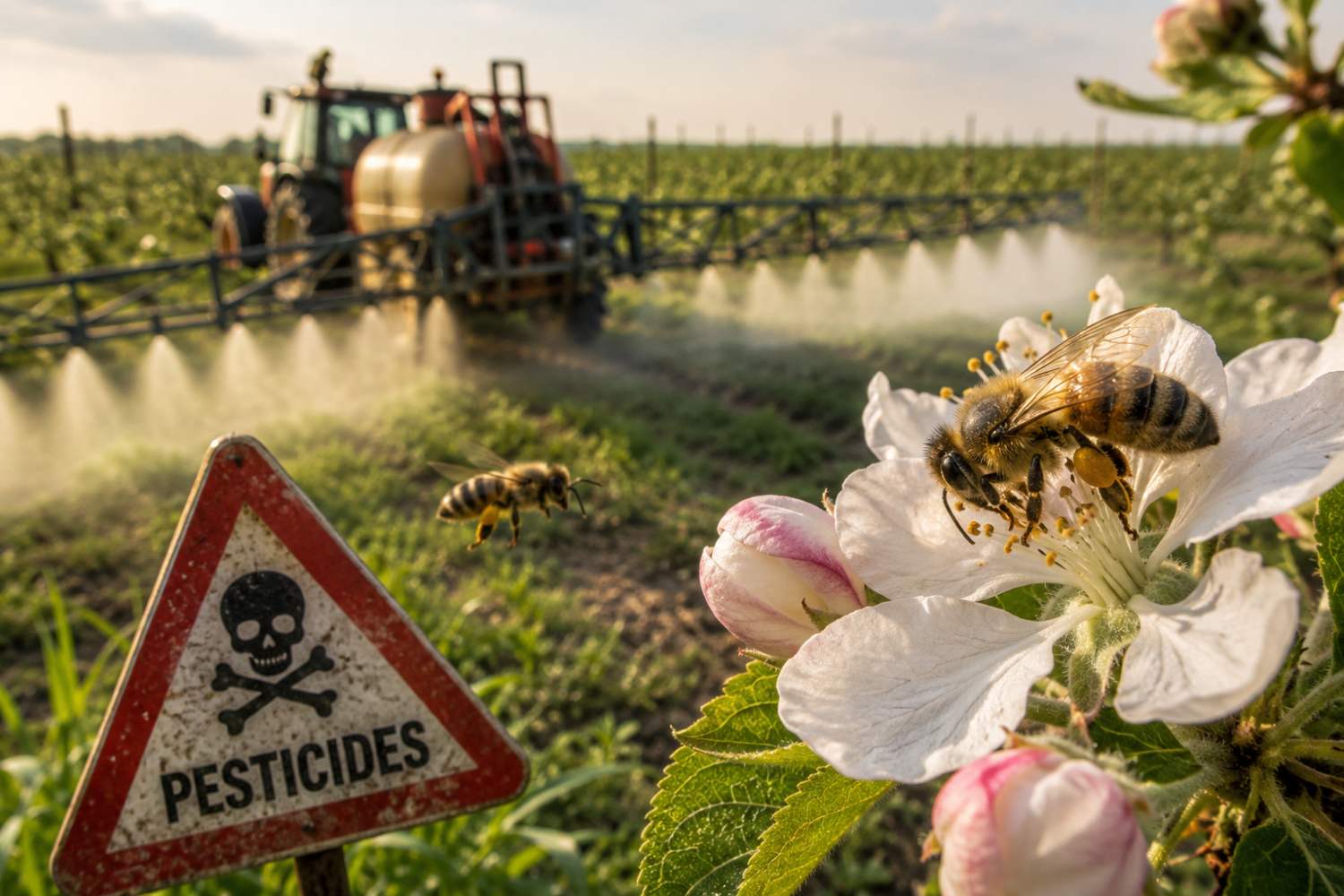
As is now known, pesticides are widely used in agriculture to protect crops from insects, fungi and weeds. The problem, however, is that their use does not only concern the organisms they intend to attack. Some of the substances can in fact reach the soil and water and have consequences on non-target organisms and ecosystems. For this reason, the European Union provides for specific environmental risk assessments before the authorization of plant protection products, also considering the effects on insects, fish, birds, mammals and plants.
Among the most important organisms to be protected are undoubtedly bees, which are fundamental for pollination. In fact, EFSA evaluates the risks of pesticides for honey bees, bumblebees and solitary bees by considering both exposure through contact and through feeding.
And it is precisely in the context of the effects that pesticides can have on non-target organisms that a new study dedicated to glyphosate, now sadly known for being one of the most used herbicides in the world, comes into play. The research, published in Journal of Experimental Biologyanalyzed what happens to honey bees when they are exposed to a sub-lethal dose of the substance.
The study
The authors worked with three small honey bee colonies (Apis mellifera), each composed of a queen, brood and around 5,000 workers. The experiments were conducted under conditions favorable to foraging.
The bees were trained to reach two artificial feeders placed at the same distance from the hive. One contained a sucrose solution without glyphosate, used as a control; the other contained the same solution with 5 mg of glyphosate acid equivalent per liter. According to the authors, this concentration was within the range of glyphosate residues detected in nectar collected by bees a few days after an application carried out according to the maximum specifications reported on the label.
During a 3-hour experimental phase, the researchers recorded how many times each bee returned to its feeder. Subsequently they also observed other behaviors, including the so-called belly dance, through which bees can recruit mates towards a food source, and the persistence in returning to a source that no longer offered food.
The most evident result concerns the foraging activity. During the three hours of the experiment, the 46 bees that collected the solution containing glyphosate made 13.34% fewer visits than the 40 bees in the control group. In absolute terms, the estimated average was 31.76 visits for the bees in the control group versus 27.52 visits for those exposed to glyphosate.
The observed effect therefore did not consist in the immediate death of the bees, but in a modification of their foraging behavior.
What happened in the brains of bees
The second part of the study concerned neurochemistry. On the third day, the researchers recovered 25 bees, 12 belonging to the control group and 13 to the one exposed to glyphosate, and analyzed the brain contents of four substances: tyrosine, tyramine, octopamine and dopamine.
The results show that tyrosine, octopamine and dopamine had no significant differences simply attributable to treatment. However, the situation was different for tyramine, a substance involved in the functioning of the nervous system of bees. The researchers observed that its levels in the brain changed in relation to both exposure to glyphosate and the frequency with which the bees visited the feeder. In particular, bees that visited the contaminated food source more frequently showed higher levels of tyramine.
Another interesting result concerns the relationship between octopamine and its precursors. In bees exposed to glyphosate, brain levels of octopamine showed significant correlations with those of tyrosine and tyramine, whereas these correlations were not observed in the control group.
The authors interpret these results as a possible signal of an alteration of the neurochemical balance and of the biosynthetic pathway involving these substances. Tyrosine is in fact converted into tyramine, which in turn can be converted into octopamine.
However, it is important not to transform this observation into a certainty about the mechanism: the study did not directly demonstrate what the cause of the neurochemical alterations is. The researchers themselves hypothesize, among the possible explanations, an indirect effect on the bee’s intestinal microbiota, but underline the need for further research.
Why these results are important
For a foraging bee, the ability to locate, evaluate and reach a food source is essential. Foraging therefore does not only concern the individual insect, bees can in fact contribute to the recruitment of mates and, more generally, to the supply of the colony.
For this reason, according to the authors, even effects that do not cause the death of the insect may deserve attention. A reduction in foraging frequency could in fact mean a lower influx of nectar to the colony, even in the presence of recruitment that remains substantially unchanged. And, indirectly, a lower supply of nectar could also translate into a lower availability of honey produced by the colony. However, this is a possible downstream consequence of the reduction in foraging, not an effect directly measured by this study. The authors present this possibility as a scenario to be explored in future studies.
The research therefore offers an interesting indication on the sublethal effects of glyphosate on bees, but does not demonstrate that every exposure to the substance causes the same effects in colonies living in the field.
The study was conducted under controlled conditions and on a limited number of bees, so further research will be needed to understand whether the same effects also occur in nature and how long they can last. But one thing is already clear: glyphosate can have effects on bees even without killing them, and this makes it even more important to question the consequences of exposure to this substance in the environment.
