
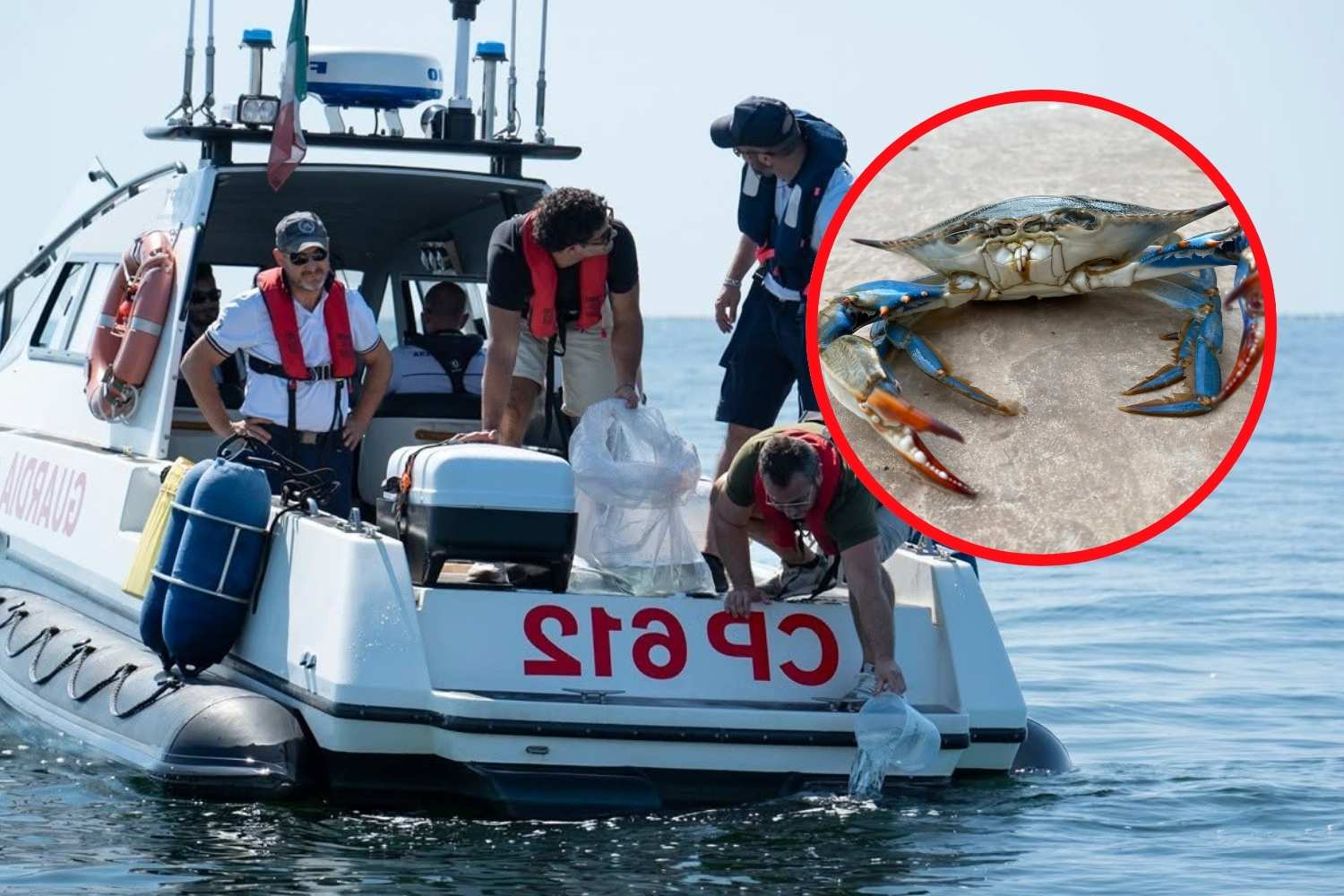
The invasion of the blue crab (Callinectes sapidus) is causing a deep crisis in shellfish farming in the northern Adriatic, where it devastates farms by breaking their shells with its powerful claws. The economic damages amount to 16.8 million euros between Goro and Comacchio according to the Emilia-Romagna Region, while Coldiretti estimates losses of up to 200 million euros across the entire national territory.
To deal with the emergency, the Department of Veterinary Medical Sciences of the University of Bologna has launched the OCTO-BLU research project, funded under the PN FEAMPA 2021-2027. Led by Professor Oliviero Mordenti together with researchers Antonio Casalini and Pietro Emmanuele, the program continues until the end of 2026 to test a biological control system based on the use of the common octopus (Octopus vulgaris), one of the main natural predators of crustaceans in the Mediterranean.
From the pools of Cesenatico to the submerged cliffs
In the university laboratory located in Cesenatico, scientists have managed to reproduce the octopus in a controlled environment and manage the growth of paralarvae, small transparent organisms of a few millimeters which initially lead a planktonic life. Since June, around 80 thousand specimens have been released into the sea, with the aim of doubling the quota to 160 thousand by the end of August. To maximize the chances of survival of young cephalopods, the team placed artificial shelters made of concrete and clay near submerged reefs, creating suitable areas for the settlement of stable nuclei along the coastal strip.
The reproductive response against the expansion of the invader
The containment of the crustacean native to the American Atlantic coasts – which probably arrived decades ago via the ballast water of ships and proliferated due to warming waters – is made complex by its enormous fertility. A single female can lay millions of eggs. Even if only a fraction of them reach maturity, the capture of just one female specimen by an octopus avoids the birth of generations of new invaders. The controlled increase in predators thus aims to destabilize the growth curve of the alien species.
https://www.instagram.com/reels/DHtrf5ettCu/
Environmental limits and future research prospects
The overall effectiveness of the plan must take into account the different ecological preferences of the two species: while the blue crab thrives in the warm, shallow waters of coastal lagoons and sandy pockets rich in clams and mussels, the octopus prefers rocky bottoms and ravines to hide. For this reason, researchers evaluate the integrated action of other natural antagonists, such as eels, capable of feeding on the crustacean’s eggs, and sea bass.
