
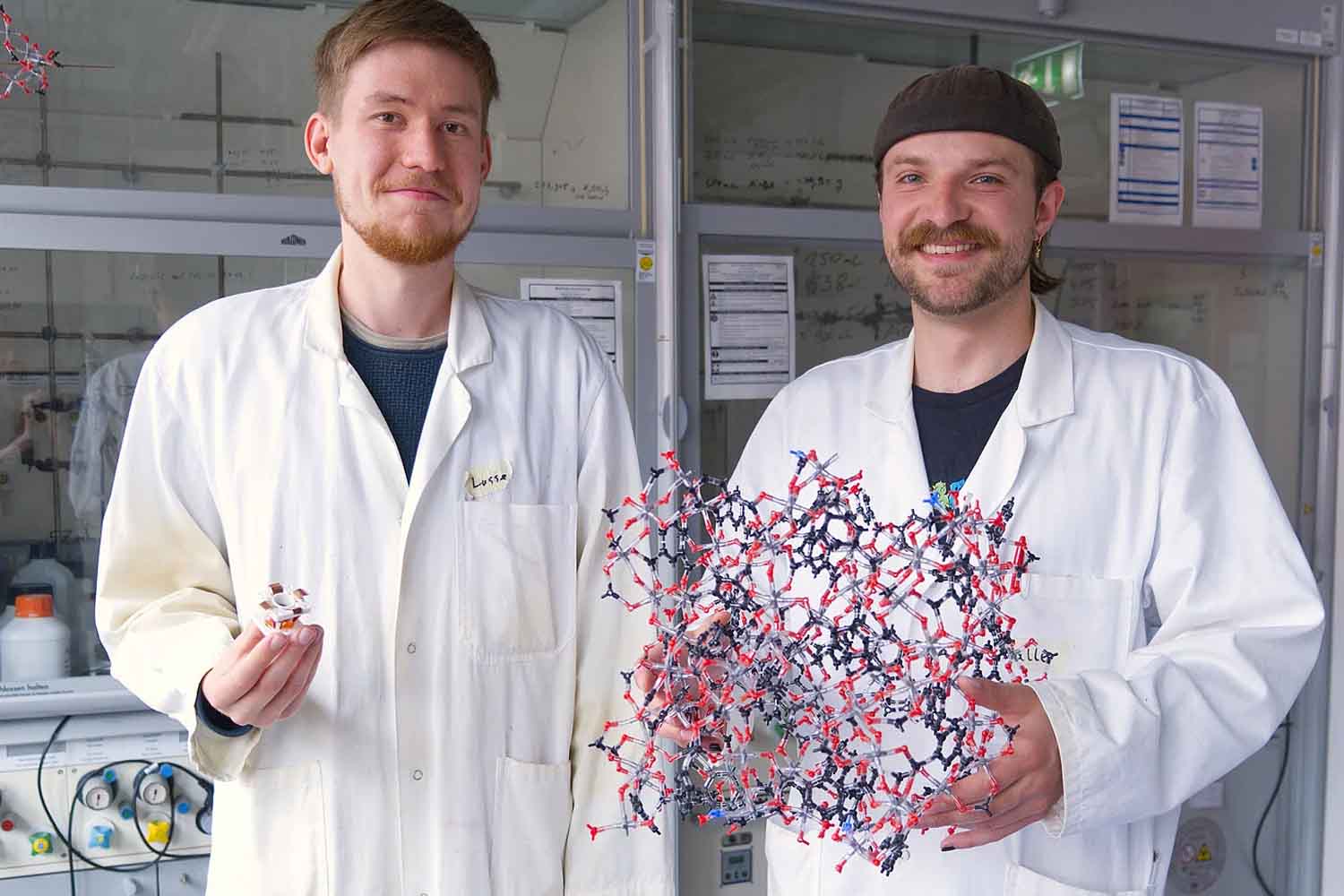
At room temperature it takes water from the air. When heated up to approx 70°Che lets her go. Then it starts again. It’s the small loop that researchers at the University of Kiel, Germany, are working on with a material called CAU-10-H: in tests it can capture water vapor even when the air is rather dry and, in the conditions studied, theoretically produce approximately 1.8 liters of water per day for every kilogram of material.
The important word, however, is “theoretically”. The device used in the experiments weighs approx 100 milligramsabout the size of a small paper clip. The researchers calculated how much water a much larger system could get if it continued to operate with the same efficiency. Before putting a tank underneath and waiting for it to fill, therefore, there are still a few steps left.
How do you get water from something that seems dry
Even in the air that seems dry to us there is water in the form of vapour. The problem is being able to capture those molecules without spending more energy than it’s worth.
CAU-10-H belongs to the family of MOF, i Metal-Organic Frameworks. We can imagine them as solids crossed by an enormous quantity of microscopic tunnels. They have so much internal surface area that water molecules can stick to the walls of these tiny pores. It’s a bit like having a sponge, except that here the “holes” are on a molecular scale and the water is adsorbedthat is, it sticks to the internal surfaces of the material.
The CAU-10-H studied in Kiel begins to capture water already with a relative humidity around 18%. When heated to around 70°C, the molecules detach and can be recovered. Then the material can be used again.
The group added another piece to the mechanism: a conductive carbon foam. In practice, the MOF is placed on top of a structure that allows air to pass and which can heat up rapidly by passing electric current, thanks to the so-called Joule effect. The same principle, very simplified, by which an electrical resistance becomes hot.
The heat therefore reaches directly into the material instead of having to slowly heat the entire device. In tests this solution reduced the duration of the phase in which the water is released until 51%allowing complete cycles between 46 and 178 minutes. Heating can also occur through light.
How much can he really raise
At 40% relative humidity, the composite with CAU-10-H captured up to 0.17 grams of water per gram of material. By repeating the cycle several times during the day, the authors calculate a potential production of approximately for this material 1.83 liters per kilogram per day. With 20% relative humidity it drops to around 1.05 litres.
Two other MOFs were also tested in the same study. Considering the different composites, at a humidity of 40% the theoretical production with active heating is overall between 1.5 and 2.2 liters per kilogram per day. The best among those tested was MOF-303, with approximately 2.18 liters.
It’s a useful distinction because it avoids turning a laboratory result into a portable aqueduct. The same authors write that the transition from 100 milligram devices to large systems is still one projection based on linear scaling. We need to check what happens when size, airflow, condensation and effective water collection increase.
Even the definition of “drinking water” needs to be handled with a little care. The University of Kiel indicates the production of drinking water as the objective of the technology, especially for arid and Mediterranean regions. The published experiments, however, measure above all how much vapor is captured and how quickly it is released. To get to the glass you then need a condensation system and controls on the quality of the water produced.
Now they have produced almost 30 kilos
The other interesting result comes from quantity. CAU-10-H had already been known for about fifteen years, but producing a few grams in the laboratory and making enough to build a car are two quite different sports.
In a second study published in Industrial & Engineering Chemistry Researchthe group led by Kalle Mertin used a 750 liter pilot reactor and obtained 27.5 kilograms of dry CAU-10-Hwith a yield of approximately 88%. It is the first production of the material on this scale.
The researchers then tried to calculate a future factory. In a scenario from 1,000 tons per yearestimate a production cost of around $13.8 per kilogram, using 2022 prices. With a more efficient process and solvent recovery, the estimate drops to around $12.1. These are economic calculations based on a hypothetical system, therefore still far from the price that a commercial product could have.
However, the leap remains notable: the material went from small samples in the laboratory to tens of kilograms. For a technology that is supposed to work by the kilo and ton, it’s the kind of unspectacular detail that matters a lot.
And while it gets water, it can also help in cold weather
CAU-10-H then has a second possible life, apparently disconnected from the first: it can be used in adsorption cooling.
These machines exploit the fact that a material captures and releases water as the temperature varies. The cycle allows heat to be transferred and therefore cooling to be produced. One of the interesting parts is that you can use it to do this heat that would otherwise be wastedfor example that produced by some industrial processes, data centers or even bakery ovens.
In simulations published by the researchers, CAU-10-H achieved cooling performance under some conditions up to three times that of silica gel and approximately double that of SAPO-34, another reference material. The advantage, however, depends on the type of system and operating conditions: it does not mean that any air conditioner built with this MOF would automatically consume a third of the energy.
This is what makes the two studies interesting when placed side by side. On the one hand there is a material that manages to take water molecules scattered in the air and return them when heated. On the other hand, there is finally enough material to start wondering what happens outside a test tube.
For now there is no tap in the desert. They are there though 27.5 kilos of that strange “sponge” where before there were many fewer. And, when trying to bring a technology from the laboratory to the real world, weight also matters.
