
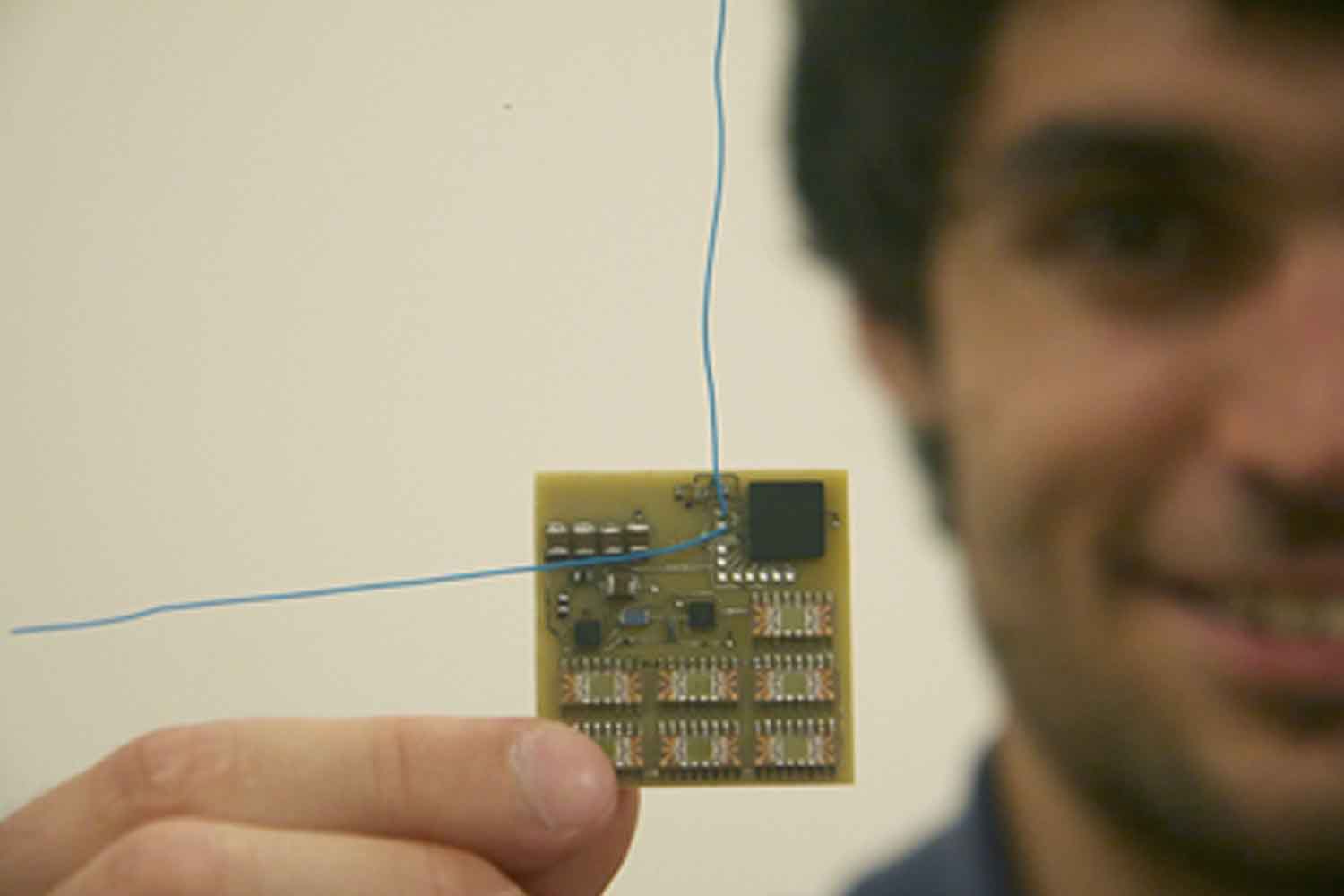
Send 10,000 tiny satellites inside Saturn’s ringsalready knowing that some might be destroyed along the way. NASA has decided to finance the study of the idea proposed by Michael Rubenstein of Northwestern University: a swarm of small vehicles should collect data directly between ice and dust, where a large probe would risk much more. For now there is a project and nine months to understand if it can work. The launch to Saturn is much further away.
The proposal was selected by the program NASA Innovative Advanced Concepts (NIAC), which funds ideas still in the very early stages of development. The technical name of the project is almost as long as the journey: Actively Steerable Femtosat Constellations for In-situ Exploration of Saturn’s Rings, Atmosphere, and Magnetosphere. The much simpler goal is to study closely the rings, atmosphere and magnetic field of Saturn.
Because you really need 10,000 small satellites
©Rebecca Manchester – Cornell University
Saturn’s rings appear almost smooth in photographs. Up close the matter changes: they are made up of an enormous quantity of particles, especially ice, which can hit a spacecraft.
For a large probe, a serious collision can mean losing expensive instruments and, in the worst case, compromising the entire mission. With a swarm of approx 10,000 small satellitesinstead, the risk would be distributed. Some may be lost while others continue to gather information.
This is precisely the unusual part of the proposal: the loss of part of the swarm would be taken into account from the beginning. NASA cites Cassini, the large mission that studied Saturn for years, as a comparison. Pushing a single such vehicle into very dense regions of the rings would have posed too great a risk. Thousands of simpler units could afford a few casualties in the field.
The vehicles are defined femtosati.e. extremely small satellites. The NASA data sheet published so far, however, . These are precisely some of the issues that will need to be addressed in the study phase.
NASA is paying for the study, not building the swarm
Here we need to keep our feet on Earth, at least until the satellites have their own. Rubenstein’s project is one of 18 selected by NIAC for 2026. Overall, NASA awarded 3.2 million dollars; each Phase I project can receive up to $175,000 for nine months.
NASA specifies that the NIAC ideas selected . In this phase, feasibility, technical problems and possible solutions are studied. So no one is building 10,000 satellites and there is no departure date for Saturn.
Difficulties, moreover, are not lacking. Such a swarm would have to be transported to Saturn, released into space, monitored and enabled to carry out useful measurements. Then that data should reach Earth. All with devices small enough to be produced and used by the thousands.
Saturn attracted two projects in the same program
In the NIAC 2026 selection there is also another idea dedicated to planetary rings. It is called PRAXIS and is led by Marco Quadrelli of NASA’s Jet Propulsion Laboratory. This project also aims to directly reach the ring particles, but using a robotic system designed to take samples.
Two different proposals in the same year illustrate how Saturn’s rings still have a lot of information to give to scientists, especially when trying to move from remote observations to measurements carried out directly on site.
For Rubenstein’s swarm the next step is much less cinematic: do the math. If the idea holds up to the nine months of study, he will be able to continue his journey. The 10,000 satellites, meanwhile, can wait. Saturn has been there for a while.
