
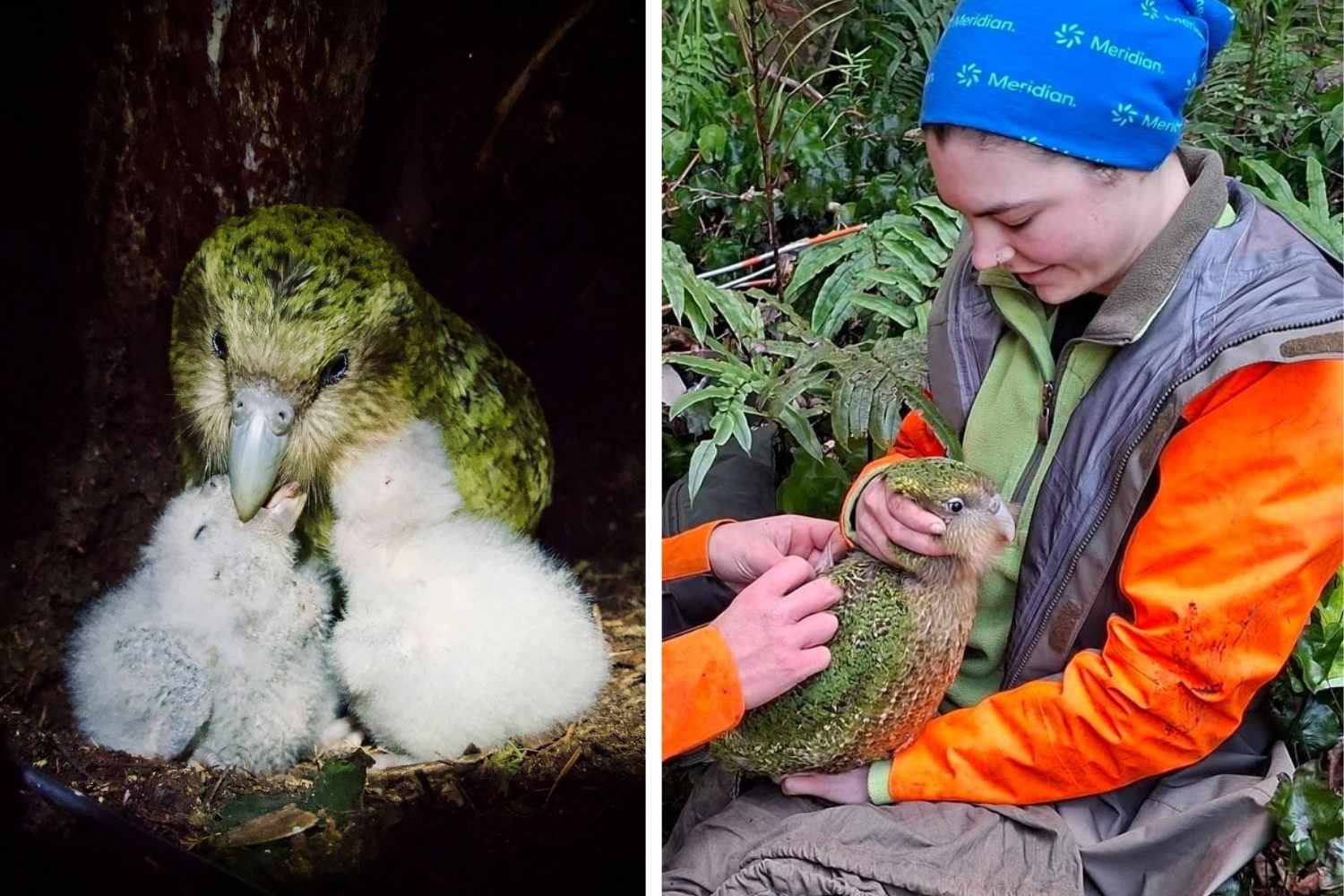
We have reached a historic milestone for global wildlife conservation: the kākāpō population (Strigops habroptilus), the famous New Zealand nocturnal flightless parrot, has reached 325 specimens. This extraordinary achievement was made official after the youngest chick of the season, the female Awarua-A3 born on March 30, turned 150 days old, the age threshold at which chicks complete feathering and become sufficiently independent to enter the official count.
A boom that gives hope
The 2026 breeding season brought a record balance of 90 chicks (38 females and 52 males), marking a numerical milestone that had not been recorded for at least 75 years. The population explosion of this bird, known for its weight which can reach 4 kg and for its characteristic musky aroma, is closely linked to the natural cycles of the forest.
In fact, kākāpō reproduce only in conjunction with the frightening abundance of rimu fruits (Dacrydium cupressinum), a tree endemic to New Zealand whose fruiting occurs at intervals of several years. As explained by Deidre Vercoe, operations manager of the Kākāpō Recovery Program for the Department of Conservation (DOC), the wait for this last season lasted four years, but the fruits have guaranteed the energy resources necessary to allow unprecedented nesting.
From the threshold of extinction to the three refuge islands
The current goal acquires even more value when compared to the dramatic conditions in which the species found itself three decades ago. Launched in 1995, the conservation program coordinated by the DOC together with Te Rūnanga o Ngāi Tahu and supported by national partner Meridian Energy led by CEO Mike Roan, managed a residual population of just 51 individuals (including the famous female Solstice, which disappeared in 2025).
The devastating attacks of predators introduced by man, such as cats and stoats, had eliminated the presence of the bird on the mainland, requiring the transfer of all surviving specimens to three protected sanctuaries free from external threats: Whenua Hou (Codfish Island), Pukenui (Anchor Island) and Te Kāhaku (Chalky Island).
Waiting for the new breeding season in 2028
Through 13 breeding seasons monitored via small backpack radio transmitters, the researchers managed to overcome complex obstacles such as very low genetic diversity, frequent infertility and the risks linked to the imminent threat of avian influenza, for which specific vaccines are already being tested.
As highlighted by Tāne Davis, iwi representative in the Kākāpō Recovery Group, the long-term goal is gradually evolving: the program aims to reduce intensive human interventions, such as supplementary feeding and egg handling, to encourage more natural hatching dynamics. The shared dream remains the complete reclamation of Rakiura (Stewart Island) from predators, the ancestral land from which almost all the founders of the modern population came, with the hope that current projections will be confirmed in a new reproductive season already scheduled for 2028.
View this post on Instagram
