
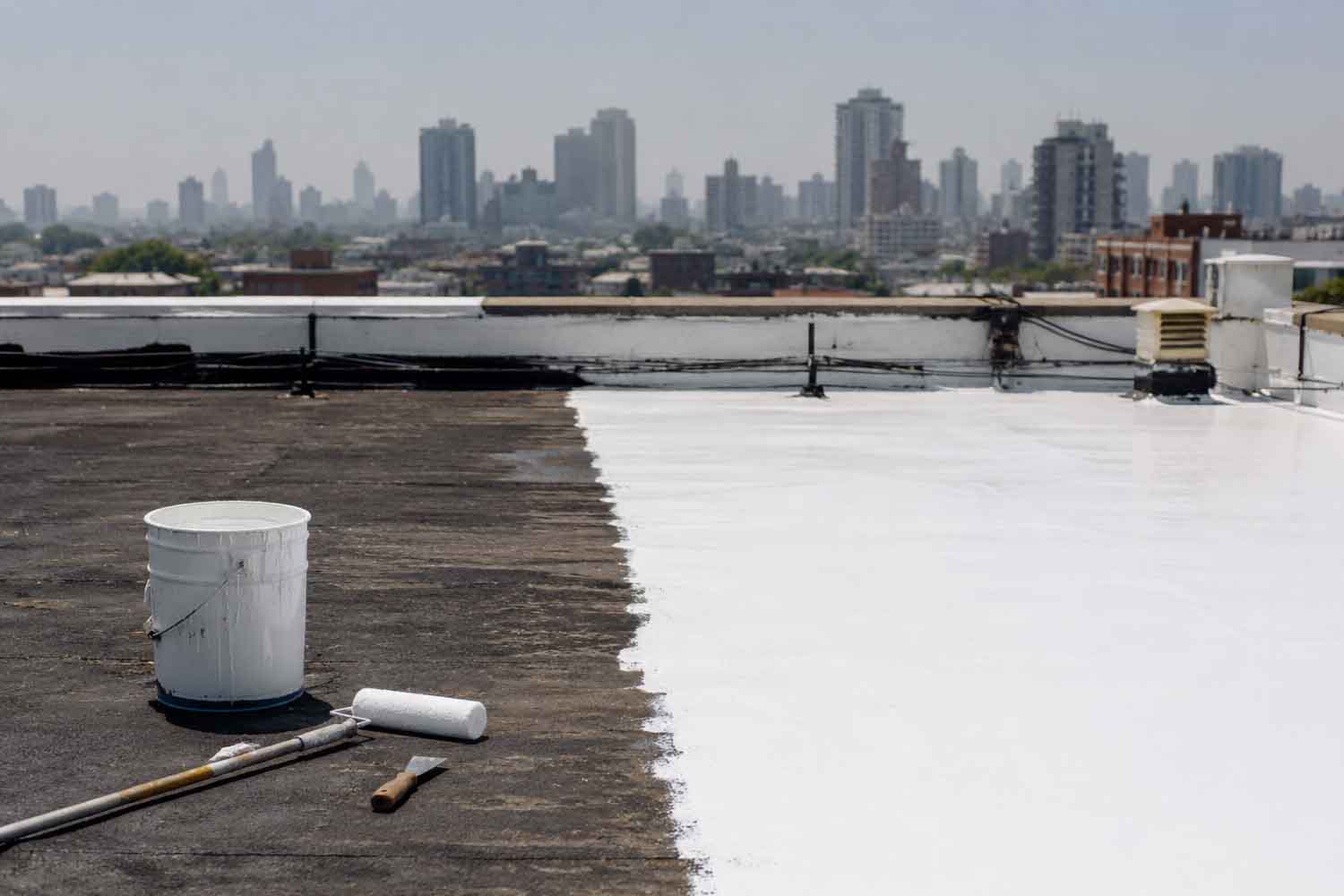
The roof turns white, absorbs less solar radiation and on hot days lets less heat enter the building. So far, so good. Then comes winter, dirt, maintenance and, after a few years, another coat of paint. The French Center Scientifique et Technique du Bâtiment (CSTB) has also put these pieces together and the result significantly downsizes a solution which, seen since August, seems almost irresistible: reflective coatings help against overheating, but on many tertiary buildings the energy savings are not enough to recover costs and maintenance.
The analysis was commissioned by the French construction directorate after the law of 10 March 2023 on renewable energy asked the Government to evaluate the use of reflective materials on the roofs of non-residential buildings. The CSTB report is dated 25 June 2024, was transmitted to Parliament in January 2025 and published on the government portal on 20 May 2026. In short, the research already had a few summers behind it. Now the accounts have also become public.
We had already talked about white roofs, talking about a study by University College London on cool roofs. So the question was different: what intervention would be able to best cool a city during days of extreme heat?
The researchers simulated different strategies in Greater London during the two hottest days of summer 2018. If applied on a large scale, the reflective roofs would have reduced urban air temperatures by around 1.2°C on average, locally reaching close to 2°C. In the modeling comparison they did better, on the cooling of external air, than green roofs, photovoltaic panels and increased street vegetation.
A few months later, another research by the same group published on Nature Cities had extended the simulation to the entire London summer of 2018: with a widespread diffusion of cool roofs, the temperature would have decreased on average by around 0.8 °C and the authors had estimated up to 249 potentially avoidable heat-related deaths.
The French results now on the table do not make those grades disappear. They simply add the question that was then left out of the frame: how much does it cost to get that cooling on the individual building and for how long?
White cools. The roof, however, belongs to a building
The physical principle remains the same: a surface with high reflectance sends a greater portion of solar radiation outwards and heats up less than a dark covering. The effect grows in hot climates, on very exposed roofs and when the roof itself represents an important part of the building’s heat exchange.
The dimensions, however, change the result a lot. The cladding works on the roof and the benefit is concentrated above all in the rooms immediately below. In the CSTB results also reported in a document from the Assemblée nationale, on a three-storey building the reduction in the cooling requirement of the top level is around 5%; considering the entire building it falls below 2%.
A low warehouse with thousands of square meters of coverage and a tall building can therefore have the same sun overhead and decidedly different accounts.
White gets dirty and sooner or later has to be redone
Then there is a rather stubborn characteristic of reflective paint: it continues to reflect even in January. In the cold months, part of the solar radiation can contribute to heating the building; rejecting it can increase energy needs. How much you weigh depends on the climate, insulation and characteristics of the building.
Then comes the real life of the roof. Dust, pollution and atmospheric agents reduce the performance of surfaces over time. Cleaning, maintenance and renewal of the covering are needed. In July 2026, discussing the study in the French Senate, Minister Vincent Jeanbrun recalled that these paints get dirty and must be reapplied periodically. The white roof of promotional photography, evidently, does not remain white by decree.
Carrying the calculations over a 30-year horizon, the CSTB found that for the buildings with average characteristics analyzed the costs greatly exceed the estimated energy savings. Conditions improve with warmer climates, initially very dark roofs, poorly insulated buildings and few glass surfaces, without however transforming reflective paint into an economically successful choice for any roofing.
And here a decidedly less flashy competitor appears: insulation. In existing buildings with poorly insulated roofs, according to the CSTB, insulating the roof produces much greater energy benefits than reflective paint alone. A solution less visible from above, but useful throughout the year.
Where white roofs continue to make sense
The French report concerns reflective paints applied to the roofs of tertiary buildings: offices, shops, schools, warehouses and other non-residential properties. The most favorable results mainly concern low buildings, large dark roofs, hot climates and situations in which summer cooling weighs heavily on consumption.
And this is where the old London study and the French one end up telling two halves of the same story. Thousands of surfaces that store less solar energy can lower a city’s temperature during a heat wave. On the other hand, the price of the intervention, duration, maintenance, insulation, winter heating and geometry of the building enter from the side door on the individual building.
The CSTB also reports a less visible cost: some coatings contain pigments, polymers and other components that, degrading externally, can escape into the environment. Another element to put on the table before imagining kilometers of roofing to paint.
Two years ago we looked at London and saw up to 2°C less. Today France has added prices, maintenance and thirty years of roof life. White continues to repel the sun. With invoices, unfortunately, it reflects much less.
