
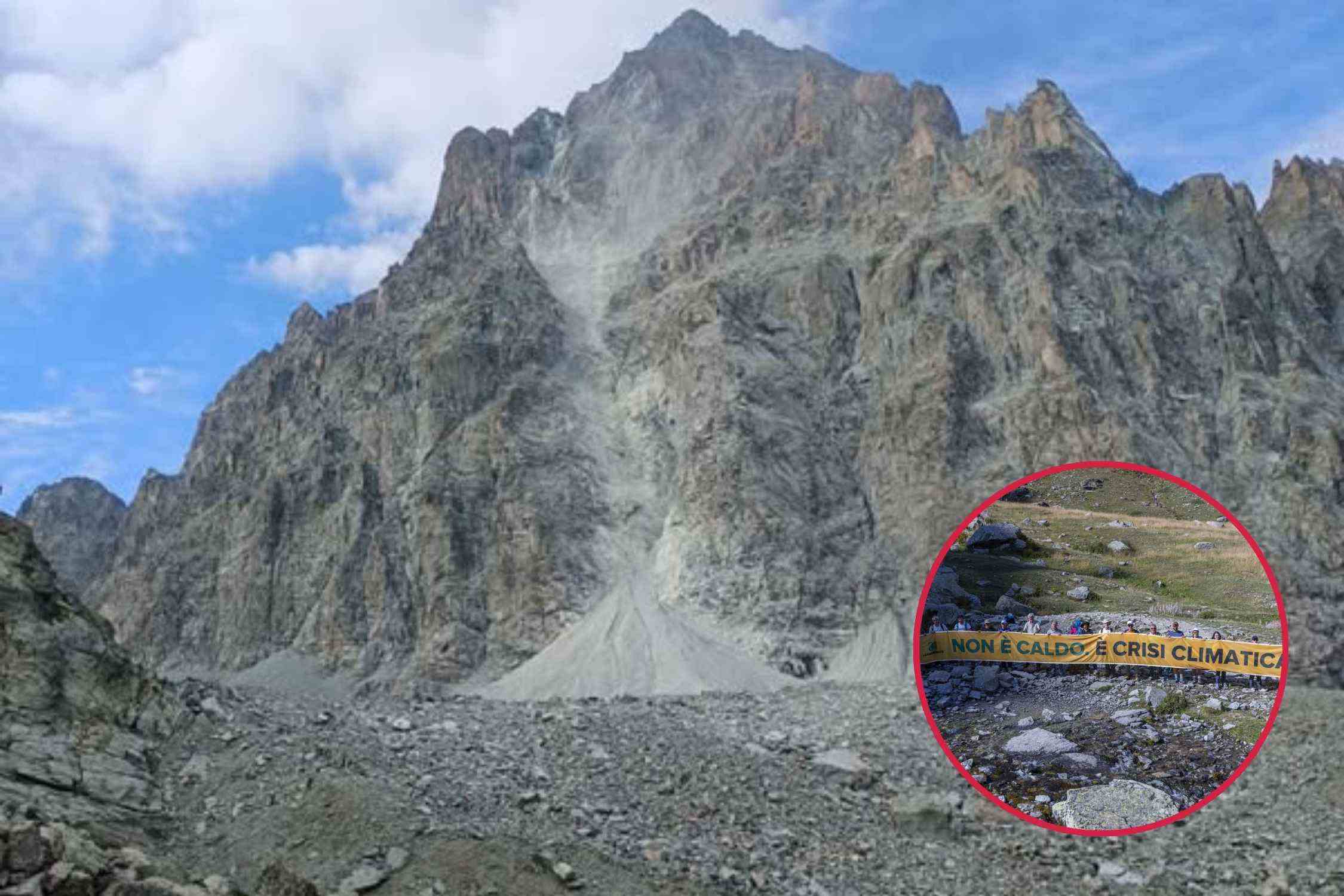
On September 1st, while the technicians of the Legambiente glacier caravan were still busy with inspections on the north-eastern side of Monviso, a portion of rock broke away from the wall, right before their eyes. The episode adds to a long series of failures that have affected the mountain in recent decades, and shows how rapidly the climate crisis is transforming the “King of Stone”.
The expedition promoted by Legambiente, with the support of the Italian Glaciological Foundation and Cipra Italia, closed its Piedmontese stage with an assessment that concerns three distinct levels of the same phenomenon: the altitude, the wall and the plain.
View this post on Instagram
A glacier that can no longer be measured
The Coolidge is the glacier that occupies the north-east face of Monviso, the highest peak in the Cottian Alps with its 3,841 metres: for decades it has been one of the distinctive features of the slope, together with the large rocky walls that surround it. Already downgraded to glacionevato in 2022, today, according to surveys conducted with Arpa Piemonte, its upper portion has been reduced to two isolated plates, measuring 3,500-4,000 and 9,500-10,000 square metres, no more than four or five meters thick. The lower section is almost entirely buried by debris that collapsed from above: only small flaps of ice emerge at the top. The conditions for traditional glaciological monitoring have disappeared: the glacier, strictly speaking, has ceased to exist.
The crumbling wall
The collapse at the beginning of September is part of a sequence that has lasted for decades, and concerns the area once occupied by Coolidge. On July 6, 1989, 200,000 cubic meters of ice and rock broke away from its upper portion. On 26 December 2019, on the Torrione del Sucai, at 3,200 metres, another 60-80 thousand cubic meters collapsed, with blocks of up to 500 cubic metres. The north-east face has a 1,200 meter difference in altitude on fractured rock: the melting of the permafrost, accelerated by the record temperatures of the summer that has just ended, reduces the mountain’s resistance. According to Secondo Barbero, general director of Arpa Piemonte, summer 2026 in the region marked +3.2°C on the historical average, and glaciers remain the most direct indicator of this difference. The Piedmont Region has announced a working table within the Climate Change Observatory, with Arpa, Alpine Rescue, the Province of Cuneo and researchers.
The Po without water and hidden reserves
At Pian del Re, where the Po rises at 2,020 meters on the Monviso side, the altitude crisis is transmitted downstream. At the Isola Sant’Antonio station, Arpa Piemonte recorded an average drop in flow rate of 76% over the summer, with a negative peak of 79% in July; in August the deficit fell to 40% thanks to late rains. In this scenario, rock glaciers, accumulations of rock and ice from periglacial environments, and the Lake Chiaretto basin become central again. According to Marco Giardino, vice president of the Italian Glaciological Foundation, these underground reserves hold water that can be released when the glaciers have disappeared.
Right at Lake Chiaretto the Caravan unfurled a banner calling for European governance of glaciers. Vanda Bonardo, head of the Alps at Legambiente and president of Cipra Italia, summarized the meaning of the stage: mountains and plains share the same water destiny, and European structural adaptation policies are needed, not responses rushed from emergency to emergency.
