

When we buy tuna, we hardly think about what may have happened to the fish before arriving on our tables. Yet, as with many fish species, tuna can also host parasites, organisms that are part of the marine ecosystem and which can be found in different parts of the animal.
Their presence is not necessarily synonymous with a danger for those who consume the fish. However, it becomes an aspect to be observed carefully, especially because some parasites can also affect the edible part of the fish.
It is a phenomenon that can depend on several factors, including the species, the environment in which it lives and its eating habits. For this reason, knowing which parasites may be present and where they tend to concentrate is important for both research and safety along the supply chain.
A new study conducted in Brazil is dedicated to this topic, which focused attention on a species of tuna that is particularly widespread in commercial fishing. The researchers wanted to understand how frequent the presence of parasites was and which parts of the fish were most affected.
The results are quite interesting and show a situation that deserves to be observed more closely.
The study
The study, published in the journal Ocean and Coastal Researchexamined 53 specimens of Katsuwonus pelamis, caught in 2019 and 2021 in the fishing areas indicated as FAO 2.2, 2.3 and 3.1., and subsequently analyzed in the laboratories of the Federal University of Santa Catarina, in Brazil.
The result was unequivocal: 51 of the 53 fish examined, equal to 96%, had parasitic contamination. The researchers identified several types of parasites, including Anisakis, a nematode particularly relevant to human health, as well as parasites belonging to the Trypanorhyncha and Rhadinorhynchus groups.
Most were found in the intestines, stomach and other internal organs. But there is one fact that deserves particular attention: overall, 58.5% of the samples also had parasites in the muscle tissue, i.e. in the part of the fish that is normally consumed.
The researchers explain that some larvae may initially be present in the internal organs and later migrate to the muscles, especially if the fish is not gutted quickly after capture. The timeliness of processing therefore becomes an important step to limit this phenomenon.
Among the organisms identified is Anisakis, a parasite that can cause anisakiasis and allergic reactions in humans when infested fish are consumed raw or insufficiently cooked. The risk, of course, also depends on how the fish is treated before arriving on the plate.
@Ocean Coast. Res
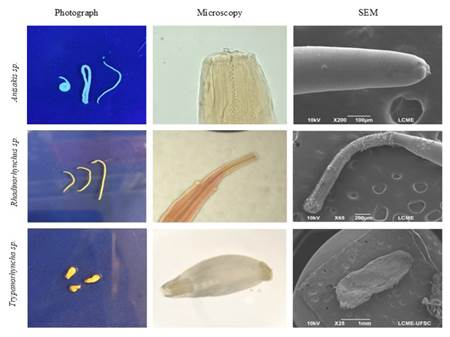
@Ocean Coast. Res
From catch to table: how to reduce risk
To limit the risk of parasites reaching the muscular part of the fish, it is essential to intervene in the early stages after capture. The researchers particularly highlight the importance of rapid evisceration: removing the internal organs promptly can reduce the possibility that the larvae present in the viscera migrate to the muscles.
But subsequent treatments also play an important role. The study reminds us that freezing and cooking can inactivate Anisakis larvae. In particular, the authors cite data according to which freezing at -20 °C for at least 24 hours or a heat treatment above 60 °C for at least 10 minutes are able to inactivate them.
However, there is a clarification that should not be overlooked: inactivating the parasite does not necessarily mean eliminating every possible allergic risk. In fact, some allergens produced by Anisakis can resist both freezing and heat. For sensitized people, therefore, the problem can persist even when the larvae are no longer viable.
But is it the same tuna we eat in Italy?
Yes, from the species’ point of view. The Katsuwonus pelamis it is the skipjack tuna, a commercial species widely used for preserves and which also appears on the labels of products sold in Italy.
However, this does not mean that the tuna analyzed in the study is the one we find in our supermarkets. The researchers examined specimens coming from specific fishing areas, which represent only an extremely marginal part of the areas from which the tuna destined for the Italian market arrives. However, this does not exclude that the presence of parasites could also represent a significant problem in other fishing areas and for other tuna populations, an aspect that would require further studies.
