
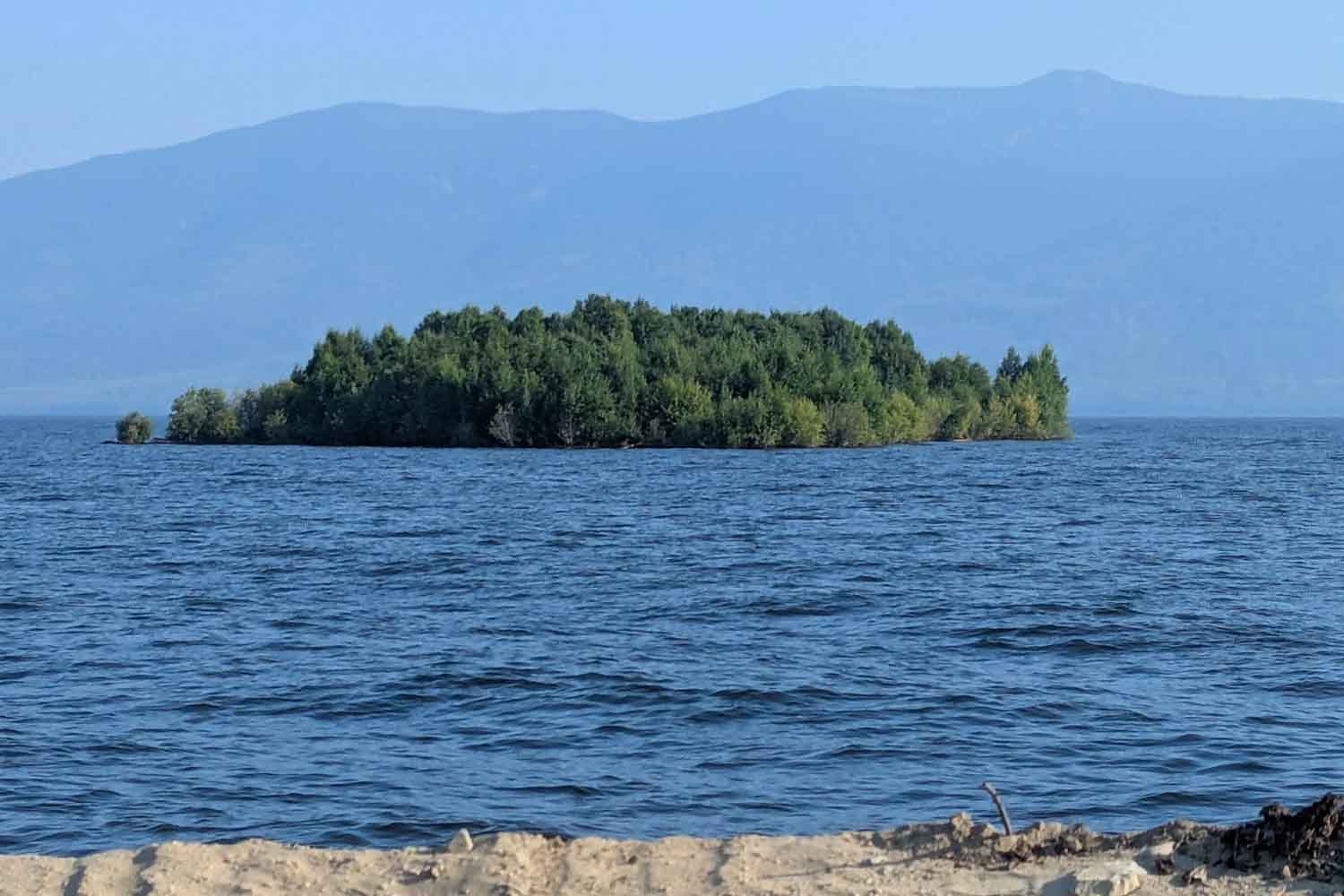
A 140 meter long piece of forest broke away, began to sail in the middle of a Canadian lake and disappeared from satellite images. Then it reappeared about thirty kilometers further away. It happened in Williston Reservoir, a huge reservoir in British Columbia, where in recent weeks a mass covered in trees has done something we usually expect boats to do: move.
The first images were so unlikely that even Bob Gammer, community relations manager for BC Hydro, the company that manages the reservoir, had thought about the possibility of an AI-generated video. After all, we are in 2026 and now seeing a forest that floats requires at least one check.
Control came from space. Images from the European Copernicus Sentinel-2 mission confirmed that on July 21 that thing was indeed there, in the main body of the reservoir, about 100 kilometers west of the WAC Bennett dam. It measured approximately 70 by 140 meters, almost 9,800 square meters. Then, on August 5, it was no longer there.
More than an island, a raft with trees on it
Calling it an “island” gives a good idea when you look at it. From a physical point of view it is probably something less romantic and much more interesting: a gigantic vegetal raft, made up of soil, roots, trunks and organic material compact enough to support plants and trees.
The mechanism hypothesized by BC Hydro starts from the banks. Over the years, logs and debris can pile up in sheltered areas, trap sediment and organic matter and slowly transform into a surface on which vegetation can establish itself. The roots do the rest, binding the material together. Then enough water comes in and the whole block can rise.
A lot of water has arrived this summer. Williston Reservoir reached its highest level in 14 years after a snow-filled winter and persistent summer rain. BC Hydro also used the dam’s spillways to manage the inflow between June and July.
The company explains on its Williston Reservoir page that the reservoir level normally peaks around August, after the snow melts, and can fluctuate as much as 60 feet throughout the year. It also warns sailors of the presence of floating and submerged logs and debris and of the instability of some banks.
In its monitoring of wood in the basin, BC Hydro describes precisely this mechanism: during the lowering of the water, large quantities of woody material remain on the banks and can float again when the level rises in spring and summer. The gigantic mass spotted this year could be the decidedly more ambitious version of the same phenomenon.
The curious detail: BC Hydro had already studied “floating islands”
Due to its size, trees and position in the middle of the basin, the event observed this summer remains an out of the ordinary event. Floating islands, however, are not entirely unknown at Williston Reservoir either.
In the environmental monitoring documents commissioned by BC Hydro itself, a category called Floating Island. In 2014, in the Airport Lagoon area, researchers observed floating masses made up of organic soil and woody debris. A later report describes them as persistent structures composed of organic matter, coarse wood and mineral soil, on which shrubs such as willows had also established themselves over time.
Those formations were much smaller: in monitoring they occupied less than 0.1% of the area analyzed and had progressively reduced until they were no longer visible in 2018. However, they clarify an important detail. A patch of vegetation can actually build its own floating floor, without the need for earthquakes, underwater volcanoes or Photoshop.
Where the island had ended up
After July 21, BC Hydro continued to monitor the basin, but the mass no longer appeared in images available in early August. One of the hypotheses immediately formulated was that the wind had pushed it against a stretch of coast, making it much more difficult to distinguish from above.
That’s basically what happened. Confirmation of the discovery arrived on August 31: the island ended up about 30 kilometers north-west of the last point where it had been located, in the Ospika area, one of the waterways that feed the basin. The mass was still substantially intact.
Wind is the leading candidate to explain travel. In Williston Reservoir it can rise rapidly and generate waves exceeding two metres, so much so that BC Hydro dedicates a substantial portion of its guidance to the risks to vessels. Slowly moving a three-acre raft of roots and lumber seems much more difficult than moving a boat. Just give it a few weeks.
And it is precisely a yachtsman who made it possible to notice his presence. Rocky Avery, a resident of the area, also released the video received from a friend to warn participants of an upcoming fishing competition. He says he has been frequenting that area for about forty years and has never seen anything like it.
The practical problem was less poetic than the wandering forest: a 140-meter-long mass in the middle of a boat’s path is an obstacle, especially in a basin where half-submerged logs and other debris are already a known danger.
Now it’s stopped. The lake, however, continues to move
There are no immediate risks for the WAC Bennett dam. The island is located far from the plants and BC Hydro will continue to follow its movements. It could get stuck along the coast, fragment or, with enough wind and water, get back on its way.
Williston is large enough to make it possible to even lose sight of almost a hectare of vegetation: it has a surface area of approximately 1,770 square kilometers and is one of the largest artificial reservoirs in the world. BC Hydro itself describes it as so vast that it is visible from space.
In the end the mystery lost almost all the supernatural and gained a lot of ecology. The island existed, satellites saw it, the wind moved it and high water may have freed it from the shore. A forest that navigates seems like something invented by AI. This time the AI wasn’t needed.
