
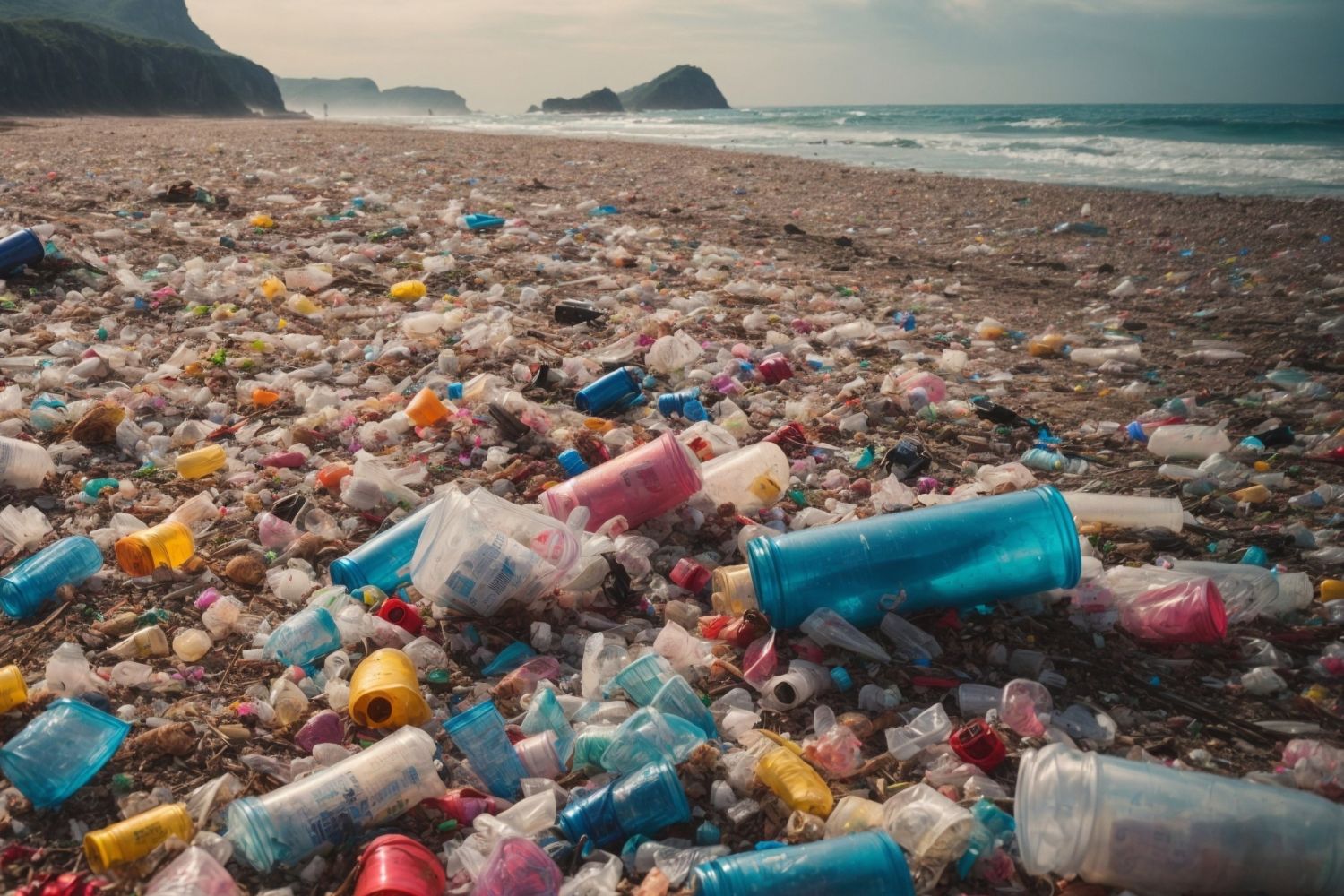
Today is September 6th and we have already exceeded our capacity to manage plastic: September 6th is the Plastic Overshoot Day 2026. Evidently we have not yet learned the many lessons that plastic pollution shows us every day.
Plastic Overshoot Day
The Plastic Overshoot Day marks the moment when the amount of plastic waste generated by single-use packaging, household products and the textile sector exceeds the global capacity to manage it, causing environmental pollution.
Each country has its own, determined by the amount of plastic waste generated and the national capacity to manage it. And we have already achieved it, 4 months before the end of the year.
But this day, in reality, does not provide a complete picture of this complex problem: therefore, to facilitate targeted and effective solutions, five country archetypes have been defined, which allow the real ones to be profiled based on determining factors such as local consumption per capita of plastic, the volumes of import and export of waste and its treatment capacities.
And of course to provide targeted suggestions: these strategies include reducing the consumption and use of plastic, promoting circular economy models such as repair and reuse initiatives, implementing robust waste management policies such as extended producer responsibility (EPR), strengthening local waste management infrastructure and stopping the importation of plastic waste from other countries.
Plastic pollution
Plastic, in reality, was created to reduce the exploitation of natural resources, in particular elephant ivory and turtle carapace. The first plastic was designed in 1862 by the British chemist Alexander Parkes: it was the Parkesinethe first semi-synthetic plastic material.
Eight years later the brothers Hyatt they patented celluloid, designed specifically to replace ivory in combs, handles and billiard balls.
But not only are these resources still exploited today, plastic has also caused enormous damage over the centuries, to the very environment that was wanted to be preserved in some way.
In fact, since those years, the growth of plastic as a material for building practically anything has literally exploded. And at the end of the 90s the “shock” arrived, with the discovery of the Great Pacific Garbage Patch, the large accumulation area in the North Pacific denounced by the navigator Charles Moore.
The world thus discovered that the abandonment of plastic waste was anything but a local problem: plastic always comes back to the surface. And in the middle of the Pacific, between Hawaii and California, there are tiny pieces, rigid boxes, ropes, abandoned fishing nets, fragments that the sun and the waves have slowly crumbled.
The Great Pacific Garbage Patch It currently covers approximately 1.6 million square kilometers and contains, according to the most cited estimates, over 1.8 trillion pieces of plastic for approximately 100,000 tons of floating material.
Not just abandonment of waste
But there is more, and unfortunately we discovered it only after thinking for decades that plastic was the revolution: plastic is not just a problem of waste abandonment. Because plastic contaminates, especially in apparently invisible forms, microplastics, which today are found everywhere.
Recent research has shown, just to cite one example, that, on average, those who only drink tap water ingest between 39,000 and 52,000 microplastic particles per year, while those who regularly consume bottled water can reach around 90,000 more particles. Considering consumption over decades, accumulation in the body can become worrying.
To be fair, the date of Plastic Overshoot Day has progressively moved towards the end of the year from 2021, highlighting an improvement in plastic waste management capacity. But unfortunately production has increased significantly: in the last five years the amount of inadequately managed plastic waste has grown by over 3 million tonnes.
And, if it is true that the search for more sustainable plastic solutions, for example recyclable and biodegradable, such disproportionate production indicates beyond any reasonable doubt that we have not yet learned the many lessons that plastic pollution shows us every day.
