
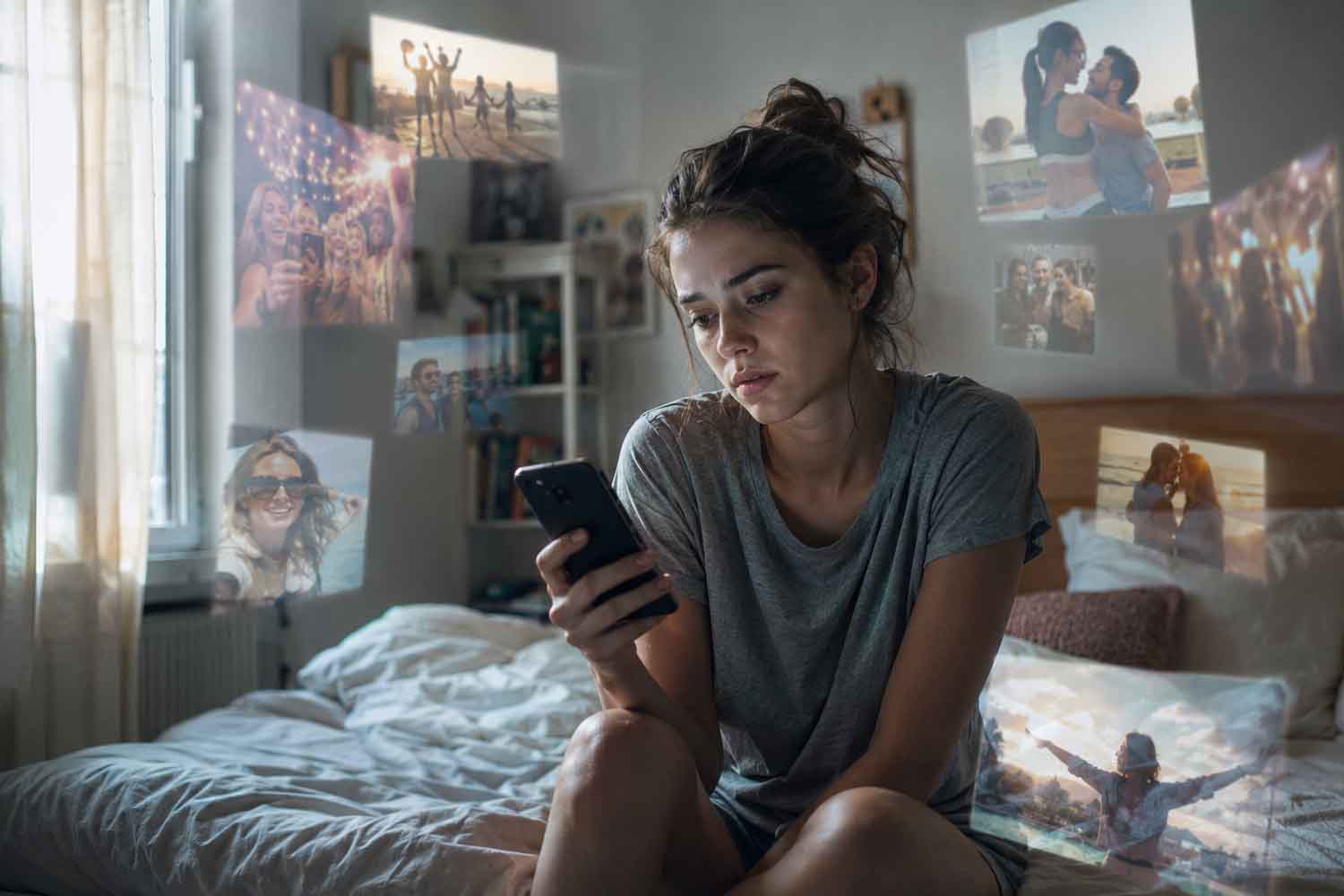
Practically everyone scrolls through other people’s profiles. Between the ages of 18 and 24 the 98.8% look at other people’s profiles or activities at least sometimes without interveningwhile 96.5% scroll through feeds and content without interacting. Then, within that sequence of holidays, bodies, parties, relationships and lives put on display, comes the comparison: the 45.1% of young adults say they feel inferior compared to the life shown by others on social media.
It is one of the most interesting data of theEurispes survey on digital technologies and mental healthpublished on 1 September 2026. The study observes Italians’ relationship with devices, social media, digital automation, well-being and the ability to self-regulate. And in the youngest group analyzed, that of 18-24 year oldsmany percentages rise.
A clarification is needed immediately: Eurispes did not analyze adolescents under 18 years of age. Speaking generically about “kids” would therefore risk broadening the results beyond the sample studied. The data captures young adults and can offer insights to parents and educators, but .
When social media also serves to understand who we are
Among 18-24 year olds, digital occupies a space that goes far beyond entertainment. The 67.5% consider it important to use it to express their identity56.9% to receive approval or positive feedback and 74.4% to meet new people. 70.9% also use it to distract themselves from problems.
Then there is a fact that illustrates the emotional dimension of this relationship well: the 91.9% of 18-24 year olds say they have used social media at least sometimes to relieve negative emotions. The same environment in which one seeks comfort therefore also becomes a space in which one can continually compete with others.
And the judgment weighs. In the overall sample, 60.4% express at least some concern about what others will think when they publish something; 55% fear negative evaluations and 63.6% check the likes received with a certain frequency.
For the younger ones, meanwhile, the screen is on for a very long time. More than half of 18-24 year olds, the 52.4%uses the smartphone for leisure for more than three hours on weekdays. On public holidays the fee reaches 60.5%. It is not surprising then that production and observation coexist without too many problems: 97.7% publish content on social media, but 98.8% also watch what others do without interacting. We talk and look. Very.
45.1% feel inferior to the lives they see online
Comparison does not produce just one type of emotion. And this is probably the least comfortable part of the investigation. Among 18-24 year olds the 53.7% say they feel less alone on social media and 65.8% more free to express themselves and interact. In the same group, however, 74.4% lose track of time, 67% get nervous if they cannot connect, 59.7% feel a continuous need for connection and 46.3% report feeling out of touch with the real world. Then there’s that 45.1% who feel inferior compared to the lives shown by others.
Eurispes does not demonstrate that social media directly causes this feeling. The survey collects behaviours, perceptions and experiences reported by interviewees and highlights how belonging, social comparison, recognition and use of platforms are intertwined, especially among young adults.
After all, social media offers rather special company: it can make us feel less alone while it relentlessly shows us people who seem to be having more fun than us. The two things, in Eurispes data, coexist perfectly.
That 60.5% who feel the platforms get into the mood
Then there is customization. In the overall sample, 71.7% recognize that the platforms show content consistent with their interests and 56.3% believe that they also offer new features capable of stimulating curiosity.
Among 18-24 year olds the percentages rise respectively to 91.9% and 73.3%. But the most delicate fact is another: the 60.5% of young people attribute an influence on their opinions or mood to platformscompared to 29.7% recorded in the entire sample.
Here it is best to use words precisely. Eurispes does not demonstrate that “the algorithm manipulates” young people’s emotions, nor does it experimentally measure the effect of a particular recommendation system. However, it registers a very strong perception: six out of ten young people recognize that what is proposed by the platforms can influence opinions or mood.
In the conclusions of the investigation, the same Eurispes recall the architecture of the platforms: infinite feeds, notifications, personalized recommendations, approval metrics and intermittent reinforcements are built to increase engagement and stickiness. For this reason, according to the Institute, responsibility cannot be placed exclusively on the individual’s ability to self-regulate.
What parents and educators can do, starting from Eurispes data
The survey is not a manual for parents and does not test educational interventions aimed at minors. However, it offers a rather clear indication of the direction: familiarity with technology does not automatically coincide with the ability to govern it.
18-24 year olds are precisely the group that considers themselves most digitally competent: 61.6% rate their skills as good or excellent. At the same time, 86% check notifications as soon as they wake up, 80.3% look for news even when the phone has not reported anything and 58.1% interrupt other activities to check for updates. In short, being great at using a smartphone does not necessarily mean being equally good at deciding when to ignore it.
Some concrete indications come from the self-regulation strategies already experimented by the interviewees. Among those who have tried to reduce or better manage their digital use, the 27.9% have turned off notifications27% use timers or limits for apps, and 16.7% have established device-free spaces or times, such as meals and family time.
And those who have tried give it a predominantly positive evaluation: 36.3% say they have achieved their objectives and another 44.4% at least partially. It is not a clinical trial and does not allow us to decide which method works best, but it tells us something very concrete: making times, automatisms and interruptions visible can help regain at least part of control.
Also because awareness alone does not seem to be enough. 91.9% of young people recognize the personalization of content, 60.5% perceive an influence on opinions or mood and over 40% of 18-34 year olds have already tried to reduce their phone use without success.
Eurispes concludes by calling for greater transparency of algorithms, limits to persuasive practices, stronger protections for minors and vulnerable people and simple control tools. But it also entrusts part of the game to education: cognitive, emotional and relational tools are needed to inhabit the digital world without being dragged by it.
Why that 45.1% who look at the lives of others and feel inferior he already understood one thing: the screen doesn’t always just show something. Sometimes it leaves something even when you turn it off.
