
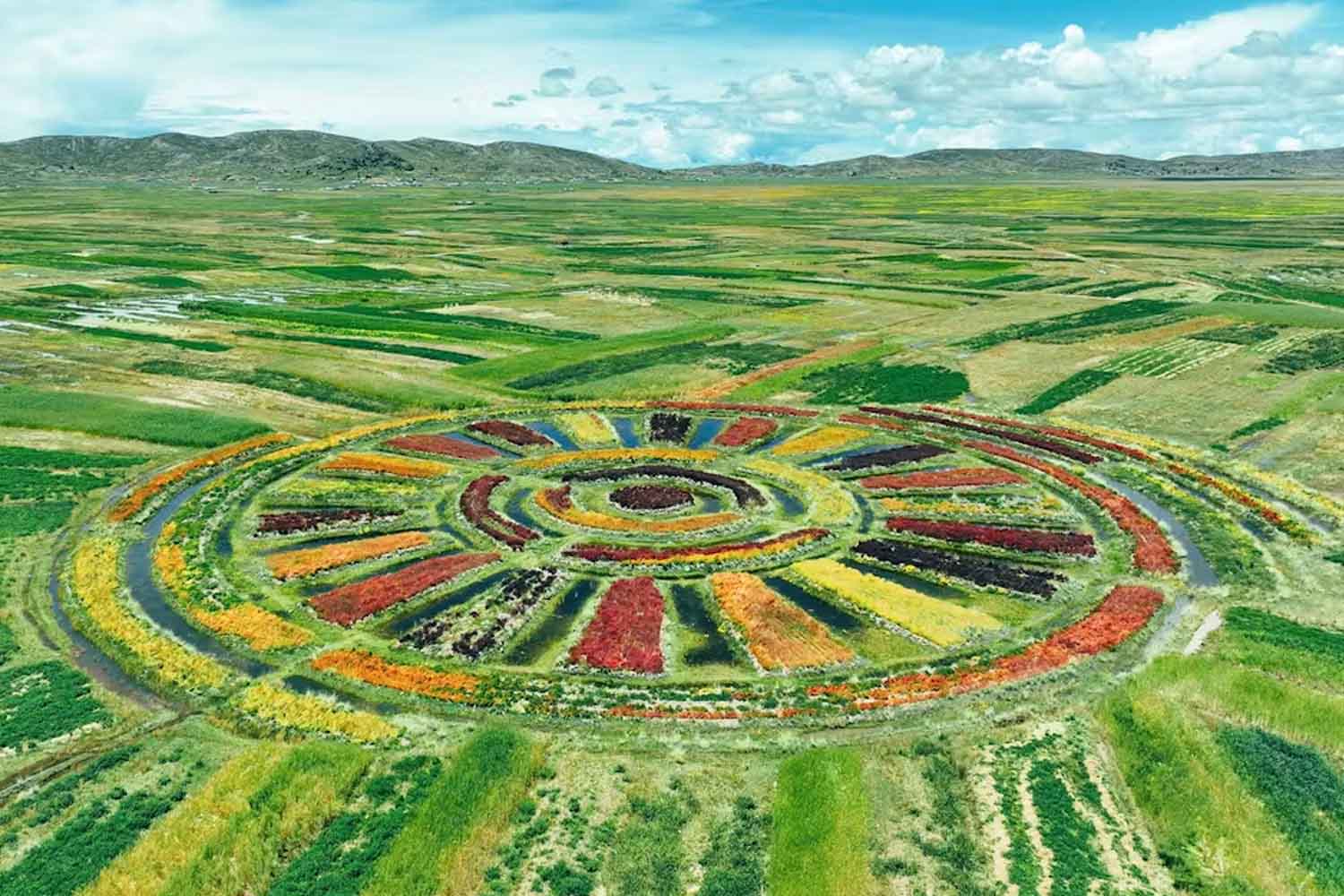
They raised the land, dug the canals again and put the potatoes back where this system had protected them for centuries. In Acora, in the Peruvian department of Puno, on the highland plains surrounding Lake Titicaca, Aymara communities have recovered five waru waru. The first 2025-2026 agricultural campaign has already reached the harvest: native potatoes to eat, save as seed, transform into chuño and tunta and, when they are left over, sell.
The project conducted over the last year by World Monuments Fund Perú together with the Asociación Aymara Suma Yapu has brought back into production an agricultural technology that the FAO dates back to around 3,000 years ago. More than an archaeological find, it is a still perfectly understandable hydraulic system: raised fields, water around, gravity and a very precise knowledge of the local climate.
The field rises, the water remains in the canals
A waru waru resembles a large agricultural bed raised above the surrounding land. Between one platform and another there are channels capable of collecting and distributing the water. A simple geometry which, seen from above, can create spectacular designs and which does a lot of dirty work on the ground: it drains when there is too much water, it conserves humidity when it is lacking and modifies the microclimate around the crops. The municipality of Acora itself describes these fields as a traditional form of adaptation to the Titicaca floodplains.
Then there is a kind of passive heating incorporated into the landscape. During the day the water in the canals absorbs heat; when the temperature drops during the night, it returns some of it, helping to dampen the frost around the plants. It is a mechanism documented by the FAO in Andean agricultural systems. In Acora we are above 3,800 meters above sea level, where drought, frost and strong temperature variations are not exactly marginal inconveniences.
Even mud has its job. Sediment, algae and organic matter accumulate at the bottom of canals and can be recovered and returned to fields as nutrient-rich material. Water, earth and residues thus return to the same production cycle without the need to transform the landscape into a particularly complicated machine. The sophistication here is all about knowing where to dig and how to manage what’s already there.
The harvested potatoes become food, seeds and supplies for the difficult months
During the first cycle of the five recovered waru waru, the communities focused mainly on native potatoes. A part of the harvest remained with the families and a part was saved for subsequent sowing. Other tubers have become chuño and tunta, two traditional preservation systems that exploit the cold of the plateau. Chuño is made by dehydrating potatoes through freezing and drying; the light colored tunta also requires repeated freezing and remaining in running water before drying.
The advantage is very concrete: a part of the harvest can be preserved much longer than fresh potatoes. And what exceeds the needs of families enters the local market, transforming the recovery of waru waru into a small source of income. In late August, approximately four tons of native potatoes grown in the reclaimed fields were brought to Lima by representatives of four Acora communities to be sold, traded and used in tastings.
The work also concerns what risks disappearing long before the fields: the diversity of seeds. The Centro Internacional de la Papa (CIP) and MATER participate in the study of native potato varieties grown by communities, bringing together genetic conservation, agricultural knowledge and food uses. In the Titicaca area, potato diversity is anything but ornamental: it means having varieties with different characteristics in the face of cold, drought, different soils and ripening times.
Climate change has put an ancient system back on the list of useful solutions
In 2025, Puno’s waru waru fields entered the World Monuments Watch, along with 24 other cultural sites considered vulnerable or particularly important to the communities that care for them. The candidacy was presented by Suma Yapu, an association led by indigenous women, together with the decentralized Directorate of Culture of Puno. The Peruvian Ministry of Culture has expressly indicated them as a heritage capable of contributing to resilience and food security in the context of the climate crisis.
The recovery of Acora is then part of the global program Cultivating Resilience by WMF, dedicated precisely to historical landscapes that preserve traditional forms of environmental adaptation. Here the cultural heritage has a rather convenient feature: you can eat it. And it only continues to work as long as someone saves seeds, clears canals, rebuilds platforms, and passes down the correct way to do it.
The waru waru, in fact, can hardly be treated as a technology to be exported in bulk and assembled elsewhere. FAO highlights how these systems require specific knowledge, maintenance and collective work. Their strength comes precisely from adaptation to a specific territory and from generations of field tests, with very little space for the universal instruction manual.
In Acora, however, five of those fields have returned to production. After three thousand years of droughts, frosts, abandonments and returns, the latest agricultural innovation of the Peruvian plateau still has canals full of water and potatoes under the ground. Except it’s a lot older than the word “innovation” suggests.
