
Good news has arrived for Atlantic bluefin tuna in recent years. After a long phase of overfishing and the real risk of collapse of the species, the quotas and controls introduced at an international level have favored the recovery of the stocks. But today a new report from Compassion in World Farming (CIWF) invites us to look more closely at a rapidly expanding sector: that of tuna fattening in large sea cages.
According to the document, over the last twenty years the number of authorized facilities has increased rapidly, going from 13 facilities in 2006 to 123 in 2026. In the same period the number of tuna transferred to cages has grown to nearly one million specimens per year.
More than a real farm, however, it is often a fattening system: the tuna are caught alive in the open sea, especially in the Mediterranean, and subsequently transferred to large offshore cages, where they are fed for several months until they reach the characteristics required by the sushi market.
The hidden cost of tuna farming
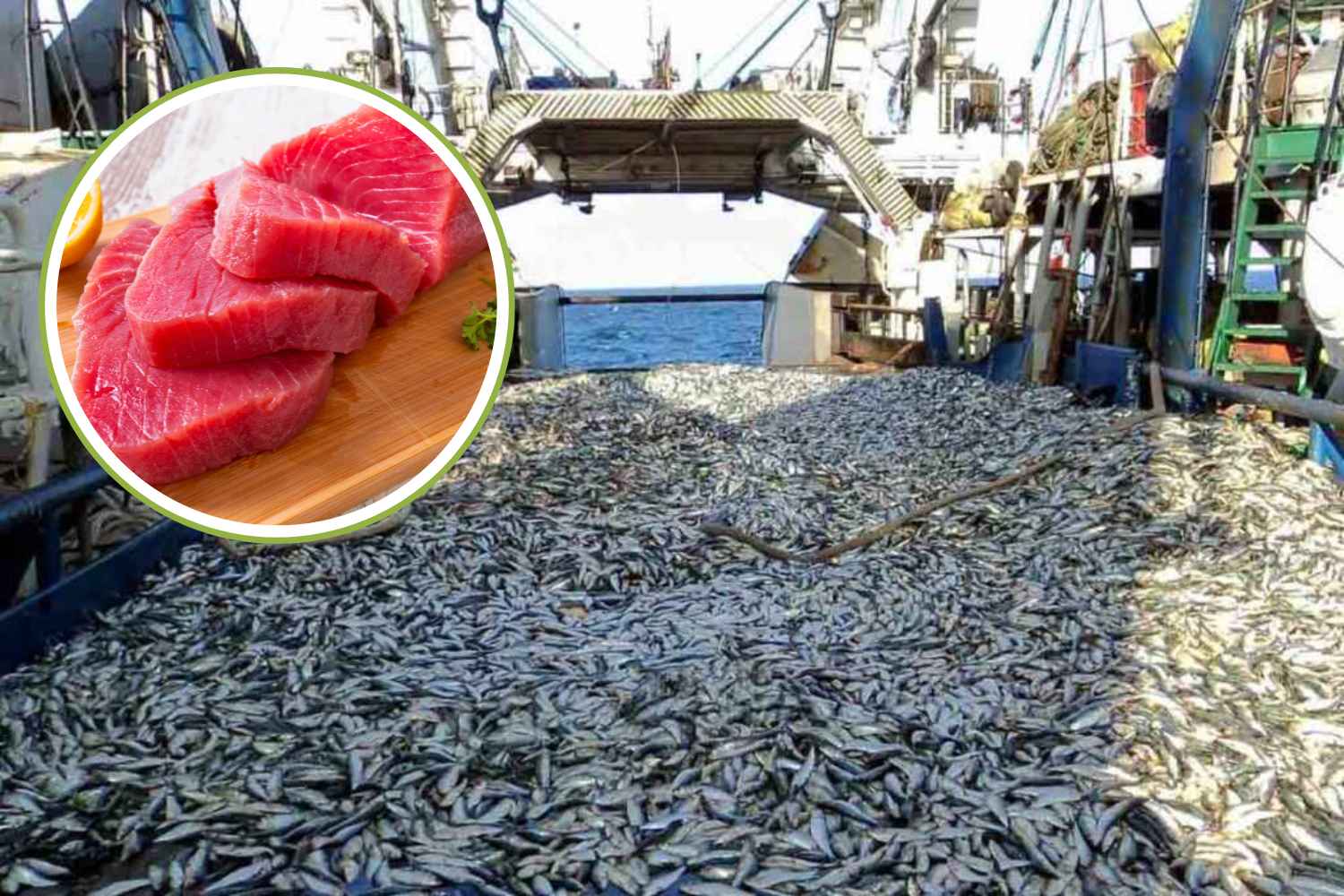
The most controversial point concerns what happens before the tuna arrives on our table: to grow these large predators in marine cages it is in fact necessary to fish large quantities of other fish.
Bluefin tuna is a carnivorous animal and, unlike many farmed species that can be fed plant-based or formulated feed, depends largely on wild-caught whole fish. Sardines, anchovies, mackerel, herring and other small pelagics are used as food during the fattening period.
CIWF analysis estimates that 7 to 16 kilos of wild fish may be needed to obtain one kilo of marketable tuna. The ratio between what enters the cage and what comes out is therefore particularly high: a substantial part of the fished resources is used to feed another animal intended for human consumption.
To get an idea of the quantities involved, CIWF calculates that a single tuna capable of producing around 200 kilos of meat can consume up to 3 tonnes of small fish. An enormous quantity, which according to the report’s estimates corresponds to approximately 33,000 sardines or 166,000 anchovies.
However, the problem does not only concern the number of fish used as feed. Small pelagics play an important role in marine ecosystems: they constitute a source of food for numerous predators and transfer energy from smaller species to those found at higher levels of the food chain. They are also a resource for fishing and feeding many coastal populations, particularly in various areas of Northern and Sub-Saharan Africa.
Here is the paradox highlighted by the report: a system presented as aquaculture continues to depend directly on offshore fishing. The more fattening tuna grows, the greater the demand for wild fish to feed them may become. It is therefore not simply a question of “breeding” a fish, but of transferring part of the pressure exerted on marine ecosystems from one species to another.
How big is this industry really?
Making the situation even more difficult to evaluate is the availability of data. In fact, CIWF reports gaps and discrepancies in information relating to catches, production and trade of farmed bluefin tuna. According to the report, the different databases do not always return coincident numbers, while international trade flows also present elements that make it difficult to precisely reconstruct the actual size of the market.
This lack of transparency is particularly important precisely because it does not allow us to quantify with certainty how many marine resources are allocated overall to tuna fattening. CIWF would therefore need more complete and uniform data on catches, on the origin of the fish used as feed, on production in the plants and on subsequent marketing.
The issue, in other words, is not just how much bluefin tuna the plants produce today, but how many marine resources are necessary to obtain that production. And it is on this relationship between farmed fish and wild caught fish that the tuna fattening model raises great doubts.
The theme of animal welfare
Then there is another aspect that the report highlights: what it means to raise an animal like bluefin tuna in a marine cage.
Atlantic bluefin tuna is one of the largest and most mobile fish on the planet. It is a highly migratory species, capable of traveling up to 10,000 kilometers in a year and, according to CIWF, even swimming 260 kilometers in a single day. It is therefore not an animal adapted to living in confined spaces, in fact in nature it crosses vast areas of the ocean following its own migratory routes.
In the fattening system, however, the tuna are captured and transferred to marine cages, where they generally remain for several months. Here they are intensively fed with large quantities of fish until they reach the weight and above all the fat content required by the market.
The CIWF report also documents physical problems observed in animals confined to cages, including fin damage, skin lesions and even eye loss. Added to these are the risks associated with the different phases of the process: capture at sea, transfer to cages, prolonged confinement and finally slaughter.
Then there is an even more particular issue: the tuna must continue to swim to breathe. Its physiology in fact makes it dependent on the continuous movement of water through the gills. Confining an animal of this size in a delimited space therefore means subjecting it to conditions that are very different from those it would experience in its natural environment.
For CIWF, the problem cannot therefore be assessed only in terms of the quantity of fish used or the sustainability of fishing. There is also the question of whether it is acceptable to capture a large migratory predator in the wild, lock it up for months and intensively feed it to increase the value of its meat.
And this is precisely the paradox of the current bluefin tuna industry: the species has managed to recover after decades of overexploitation, but the currently expanding production model continues to depend on the capture of wild animals and the fishing of enormous quantities of other fish. For this reason, according to the report, the expansion of cage fattening should be accompanied by more rigorous controls, greater transparency and above all by an assessment of the impacts on animal welfare before authorizing new facilities.
