
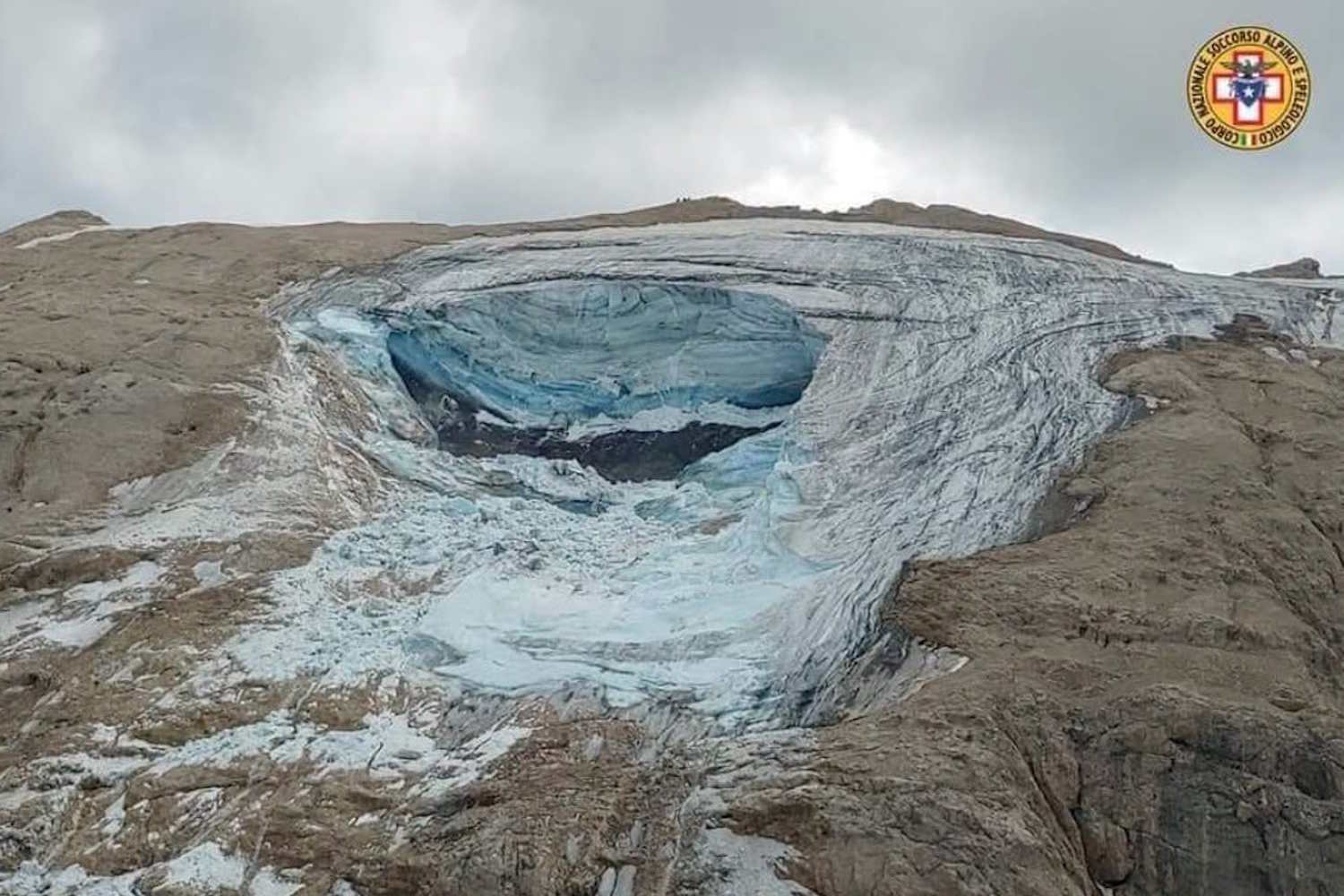
He may only have about ten years to live. This is the perspective that emerges from the latest surveys on the Marmolada glacier, where the summer that is about to end has left another deep scar: 9 hectares of ice disappeared in just one year, an average retreat of the front of 23 meters and, in some places, a retreat that has reached 120 meters in the space of just two years.
What remains of the main glacier of the Dolomites today occupies 83 hectares, compared to 92 in 2025 and around 100 in 2023. Numbers that reflect, perhaps more than any image, the speed with which the Marmolada is changing before our eyes.
The situation is illustrated by the eighth edition of the Participatory Glaciological Campaign on the Marmolada, promoted by the Geography Museum of the University of Padua with the involvement of researchers from the University, ARPAV, the Italian Glaciological Foundation, students and citizen volunteers from four regions. About thirty people, aged 16 to 75, participated in the activities on the glacier.
A record summer at high altitude
2026 was, at high altitude, the hottest summer since 1991. And the effects can now be read directly on the surface of the glacier.
The analyzes of satellite images conducted as part of the campaign show a reduction in surface area comparable only to that recorded in 2022, the year of the tragic collapse of the Marmolada.
We talked about it here: Marmolada: what triggered the collapse and what awaits us in the future, the opinion of scientists who have been studying the glacier for 20 years
According to researchers from the University of Padua, if summers of this intensity were to repeat, the survival of the glacier could be reduced to around ten years. The meteorological data for August are also particularly eloquent. At the ARPAV station in Punta Rocca, at 3,250 meters above sea level, temperatures exceeded the averages for the period by more than 3°C. Only on three days was a minimum temperature below zero recorded, with a lower value of just -0.6 °C, while there was not even a day with a negative average temperature.
The result was the practically uninterrupted continuation of the ablation processes, i.e. the loss of mass of the glacier. No significant snowfall offset the melt even at the highest elevations.
Meanwhile, the degradation of the permafrost also continues: at Piz Boè, according to ARPAV surveys, there is no longer frozen ground at any of the monitored depths.
The crevasses full of water
Then there is a fact that inevitably brings us back to the tragedy of July 3, 2022. In mid-August, the surveys on the Marmolada showed crevasses full of melt water upstream of the detachment niche of the collapse. A particularly delicate condition, because the presence of liquid water inside the fractures had been identified by subsequent studies as one of the determining elements in the dynamics that led to the detachment four years ago.
In short, the glacier is not simply retreating: it is changing in its structure, while increasingly higher temperatures also modify the balance of high altitude environments.
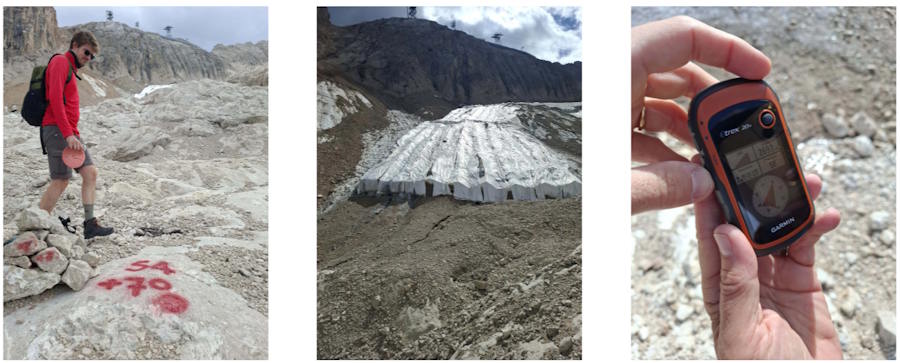
@University of Padua
And as the glacier disappears, the slopes widen
The campaign also put the spotlight on an increasingly evident contradiction in our mountains: while the ice retreats, investments in ski-related infrastructure continue, including expansion of slopes and artificial snow systems.
For Alberto Lanzavecchia of the University of Padua, the problem does not only concern the climate, but also the cultural and economic model with which we continue to imagine the mountains:
The campaign made it possible to observe the impacts of climate change on the ski industry in high altitude areas: the widening of the slopes and the new infrastructures and pipes for the production of artificial snow up to the fronts of the glacier demonstrate that capital investors (public or private) do not want to escape from the “ski trap”. This strategic myopia has a heavy impact on the mountain landscape: an “altar” to the practice of skiing while everything around the glacier is sacrificed to elitist entertainment and our unlimited model of extractivist and dissipative development.
And it is perhaps precisely here that the Marmolada stops being “just” a glacier and becomes the symbol of a broader choice: continue to adapt the mountain at all costs to a model that global warming is making increasingly fragile, or rethink its uses, economies and future.
A negative record that concerns the entire Alps
The Marmolada case, in fact, is not an isolated case. The Italian Glaciological Foundation monitors over 150 glaciers every year, from the western Alps to the Gran Sasso, thanks also to a network of volunteer operators who carry out an observation activity begun in 1911.
2026 is proving to be a record year also on an Alpine scale, with losses of glacial thickness in this sector tripled compared to the average of the last decade and with the winter snow already running out at the end of July, weeks earlier than usual. In mid-August, in Marmolada, surveys showed the crevasses upstream of the 2022 detachment niche filled with melt water, the same condition that our studies had identified at the origin of the collapse. The participatory campaign demonstrates that observing together with citizens is the best way to keep attention alive on what is happening at high altitudes, explains Aldino Bondesan, responsible for the Triveneto area of the Italian Glaciological Foundation.
The Marmolada thus continues to lose pieces, year after year, summer after summer. And if the pace observed in 2026 were to become the new normal, in about ten years we could find ourselves facing a profoundly different mountain.
