
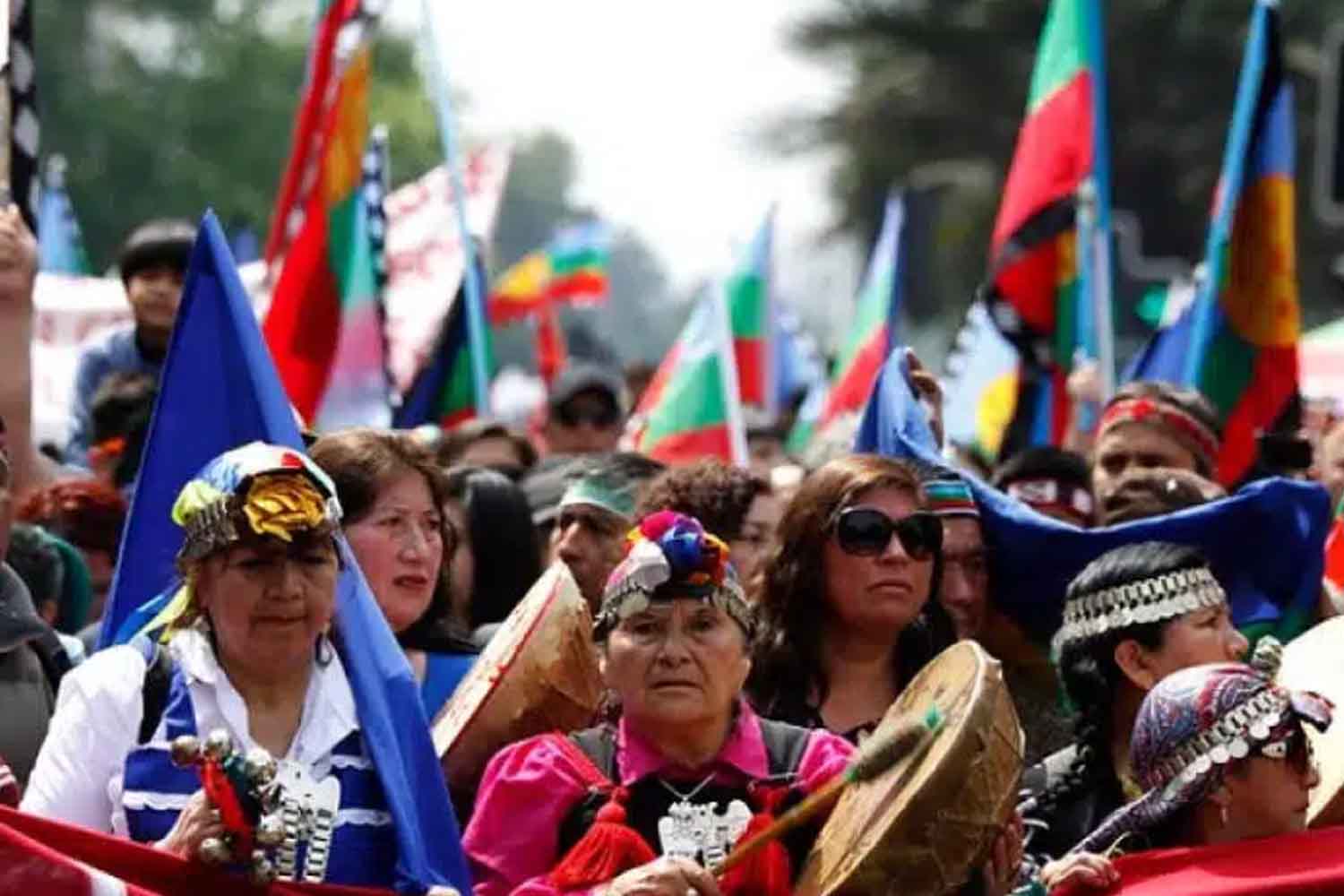
In Pará, Brazil, women play a central role in agriculture and territorial defense. In Nawalparasi district, Nepal, groups of villagers directly manage their community forests. Elsewhere seeds are conserved, agroecology is practiced, lands threatened by resource extraction are defended. Experiences thousands of kilometers apart that should soon end up in the same place: a global map of local solutions for forests, climate and biodiversity.
The Global Forest Coalition, an international coalition of NGOs and Indigenous Peoples’ organizations working on forest-related community rights, announced the project Gender-Just Real Solutions Map for Forests and Communities: the launch is scheduled for November 2026. For now, criteria, methodology and first sheets are being built together with the organizations working in the territories.
Groups from Bangladesh, Brazil, Colombia, Chile, the Democratic Republic of Congo, Honduras, Nepal, Panama and Zambia, together with regional and international networks, are participating in the construction of the map. The work is carried out with the Critical Geography Collective and with the support of Bread for the World and Rosa Luxemburg Foundation.
It won’t be a collection of green dots
The idea is to avoid the classic map where you click on a flag, the name of a project appears and it ends there. Each entry should tell what a community is doing, who is participating, where, for how long, and what conditions allowed that experience to exist. Agroecology practices, forest protection, traditional knowledge, forms of local livelihood and territories protected from extractive activities will be able to enter inside.
During three online meetings held between July and August, the organizations involved established a fairly clear principle: the initiatives must be concrete and rooted in a territory. No packaged recipes to be replicated identically from one continent to another. The terrain, the people, power relations and even obstacles change. The export-ready universal solution can then sit outside your door.
However, there is a caution that avoids transforming the project into something it isn’t yet. The definition of Real Solutions“real solutions”, belongs to the framework adopted by the Global Forest Coalition itself. The inclusion and exclusion criteria are still being validated and the first map entries have not been published. We are therefore not faced with a scientific ranking of the most effective climate policies, but rather with a tool built to document and share practices that the network identifies as community, territorial and respectful of rights.
“Gender-just” also means asking who decides
Perhaps the most interesting part comes before we even talk about trees. To determine whether an experience can be considered truly gender equitable, the group doesn’t want to simply count how many women attend a meeting. It wants to look at who does the work, including domestic and care work, who makes the decisions, who controls land, resources and income.
Jaqueline Santos, of the Brazilian FASE, gave the example of Pará, where women have an important role in agriculture and in the protection of territories, but in rural areas they can encounter enormous difficulties in accessing formal support systems when they suffer violence. For years, FASE itself has been working with groups of producers and agroecological entities in the Brazilian state, linking economic autonomy and women’s organisation.
From Kivu, in the Democratic Republic of Congo, Ariella Kabunga of the PIDP has set another very concrete limit: having laws formally attentive to equality is of little use if women are invited to the tables without being able to influence decisions. Participation, in the logic with which the map is being built, must also include effective power, responsibility and the possibility of guiding the community’s choices.
Even in Nepal this relationship between forests and autonomy passes directly through local organisation. The Federation of Community Forestry Users Nepal, one of the entities involved in the project, has been working with community forest user groups for decades. In some experiences, women directly manage agroforestry activities, participate in decisions and organize production and harvesting. In a community forest in Makawanpur district, for example, a group of forty women started growing turmeric on previously unused land.
The things that cause solutions to fail will also end up on the map
Telling only the successful experiences would have produced a nice showcase. The project instead also wants to record what makes them fragile or prevents them from growing. During the construction of the methodology, extractive projects, land grabbing, patriarchal norms, legislative systems inherited from colonialism, bureaucracy, lack of funding and criminalization of those who defend the environment emerged.
It is an approach that the Global Forest Coalition has been pursuing for some time. In the report From False Solutions to Transformative Changepublished in January 2026, the network had collected cases from Bangladesh, Bolivia, Chile, Morocco, Panama and Zambia precisely to show together community initiatives and the economic and political conditions that can hinder them.
The new map tries to transform that work into a tool that can be consulted and is destined to grow. Organizations and community groups can already propose initiatives to be considered for inclusion and, following the November launch, the database is expected to continue to update.
When it is online, therefore, very different forests, fields, communities, groups of women and territories should appear on the screen. Behind each point, however, there will also be everything that normally disappears from the maps: who owns the land, who works, who decides, who manages to stay and who must defend themselves to continue doing so. Perhaps this is precisely why, before drawing the boundaries, they started with the people.
