
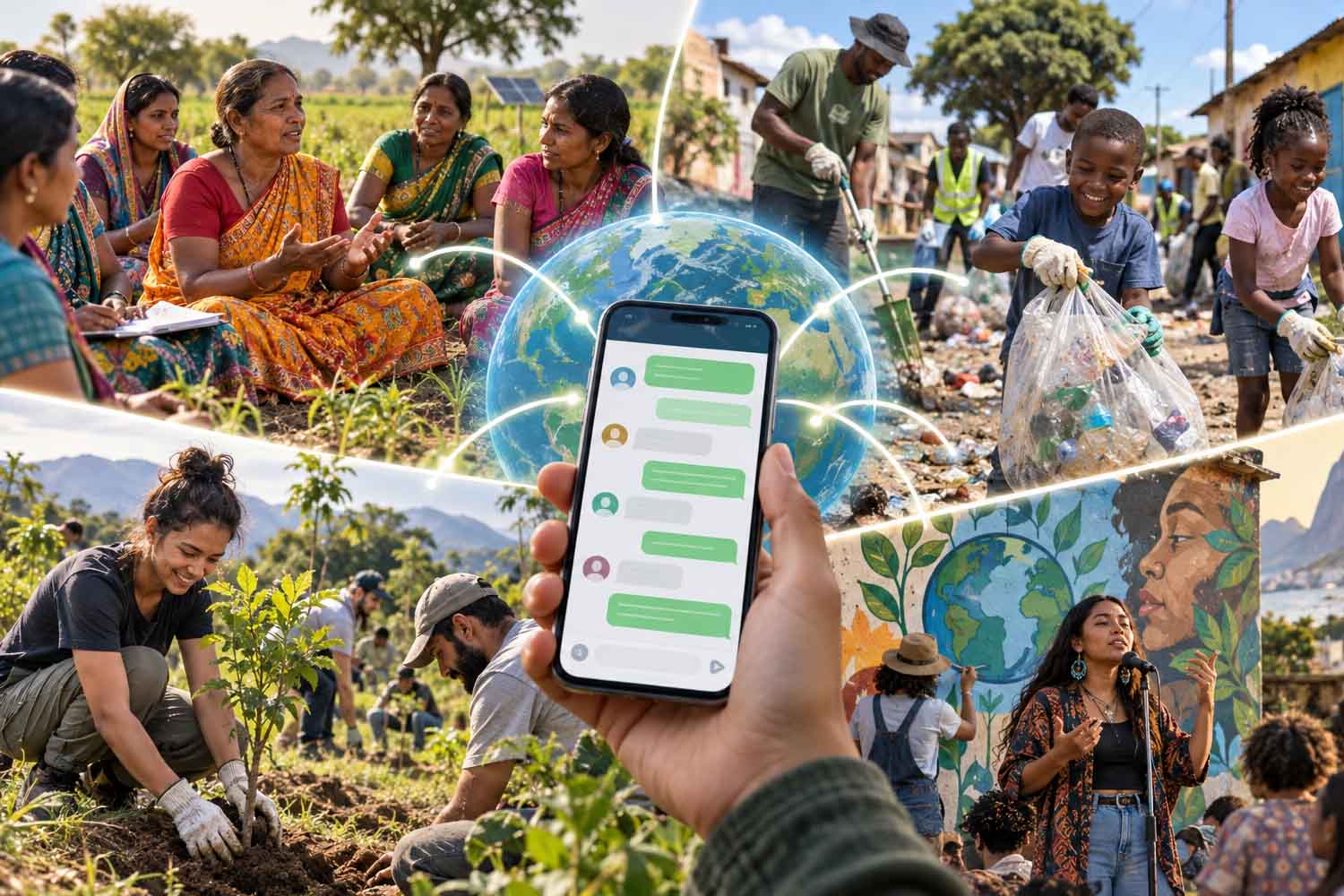
On August 29, 34 women farmers in India sat down to talk about extreme heat and menstrual health, two things that may come together in the fields far more often than they do on climate programs. Not far away, more than 200 people were watching a street show accompanied by ParaiTamil folk music, to talk about water, rain harvesting and waste. On the same day, someone in Burundi addressed climate change with the slam poetry; in Uganda children and adults cleaned up the neighborhood; in Syria the risks linked to the floods of the Euphrates were discussed. Above all, what held all this together was WhatsApp.
The story had begun five months earlier and on a much more manageable scale. In March 2026, three members of the Movement for Community-led Development in Latin America and the Caribbean organized a first regional day, with activities in Colombia and Brazil and an online meeting to discuss. At the same time, other campaigns were emerging in West Africa. The idea began to travel online and someone asked the most obvious question: can we do it too?
The answer came from the telephones. In August, organizations and individuals from 20 countries exchanged proposals for August 29: trees to plant, streets to clean, meetings, courses, shows. MCLD has some ability to circulate messages: it claims over 3,000 local organizations, networks and community groups, along with 30 international NGOs, spread across more than 40 countries. A group chat that got slightly out of hand, in short.
In each place the climate had a different problem
The global day did not include a script to repeat. In Syria, the Salam Humanitarian Foundation has been working on awareness of climate risks and possible flooding of the Euphrates. In Uganda, the Lubaga Social Justice Center and the Fellowship for Community Enlightenment involved residents and children in cleaning the area and installing signs on environmental protection. In Rwanda the Green Development Organization has combined waste training, collection, recycling and monitoring systems managed together with the community.
In India the Sanitation First program makes the idea even better. The organization has been working on water and sanitation for over twenty years and in recent years has also brought climate into these projects. Its activities include watershed reclamation, solar pumps, school training, regenerative agriculture and programs dedicated to people working in extreme temperatures. Hence the meeting with the 34 female farmers: Sanitation First is already working on the relationship between heat stress and the menstrual health of students, agricultural workers, sanitation workers and other people exposed to high temperatures.
The topic still finds little space in Indian climate plans, claims the organization, which would also like to bring it into strategies for preparing for extreme events. On August 29, that work finished along with activities on biochar, water and waste. The climate crisis, seen from an agricultural field in Tamil Nadu, takes quite different forms from those that normally fit into a slide.
Even art has become a tool. In Burundi the Initiative for the Promotion of Art and Culture Group used performance poetry; in Brazil a community combined environmental activities with music, a mural painted together and convivial moments. No obligation to sound like a climate conference to talk about climate.
In Malawi they even needed bicycles
The day of August 29th comes on top of work that had already begun in many countries. One of the stories collected by MCLD in Malawi contains a detail that explains this scale much better than many definitions.
The Chikonde Youth Organization needed to reach distant communities for its awareness and land management activities. With the support of World Bicycle Relief, 100 bicycles were delivered to the volunteers. According to data reported by the organization through MCLD, the project also contributed to the planting of more than 81,250 native and fruit trees in 13 community areas.
In the same country, SAPPHIRE Community Organization reports having trained 619 people in the production of alternative briquettes to coal and wood and 250 farmers in the cultivation of hibiscus, chosen because it is more resistant to drought. They are results declared by the organizations involved, useful above all for understanding what that vague expression called “local climate action” means on the ground. Sometimes it means having enough bikes to get there.
Letting communities decide also means leaving them resources
The freedom to choose which problem to address weighs more than the local color of individual initiatives. In the international debate on adaptation there is a very close approach, the locally led adaptation. The World Resources Institute describes it as a concrete shift of power towards those who directly experience climate impacts: deciding priorities, interventions, implementation methods and criteria with which to evaluate the results.
There is also a second half, which is quite important: money. Among the eight principles collected by the WRI are direct access to resources and predictable, long-term financing. The 2022 work which analyzed 21 experiences across Africa, Asia-Pacific, the Caribbean and Latin America insists precisely on the difference between involving a community and giving it enough power to really guide choices.
According to MCLD, the activities on August 29 were carried out without specific external funding. It is a good indicator of the organizational capacity of the network. It would be much less comforting if it became the economic model of adaptation: congratulations on the initiative, now make do. WRI itself warns against transferring responsibilities to communities without transferring resources and power together.
Just ten days before the MCLD day, at the COP17 of the UN Convention against Desertification, the same issue had ended up at the center of a discussion organized by the IUCN with African institutions and experts. From the meeting came the request to overcome isolated projects and connect land restoration, water, food, biodiversity and livelihoods. Communities, participants argued, must enter processes as knowledge holders and decision-making partners. However, investments, territorial rights, solid local institutions and connections with public policies are also needed.
It’s a distinction that prevents us from romanticizing this story too well. A neighborhood can understand before anyone else where the street is flooding, which crop can no longer stand the drought or why a worker suffers from the heat in the fields. To fix water systems, infrastructures, degraded territories and warning tools, resources are also needed which are difficult to get out of a chat.
The next message already looks to COP31
On September 2, MCLD brought together participants from 12 countries online to talk about what had happened four days earlier. Meanwhile, a new date had already appeared: November 7, when the third day of the called campaign will be held On The Road To COP31. At the time of the balance sheet published on 8 September, 12 countries had already joined.
The day’s report does not measure how many emissions were avoided nor does it allow us to compare the climate effectiveness of individual initiatives. It measures something else much better: the ability of very distant people to recognize different problems, organize themselves and exchange solutions without waiting for someone to prepare the same project for everyone.
In Syria the problem was the Euphrates. In India the heat in the fields. Waste in Rwanda. In Malawi, at one point, there were as many as one hundred bicycles. Then someone took the phone and wrote to the group.
