
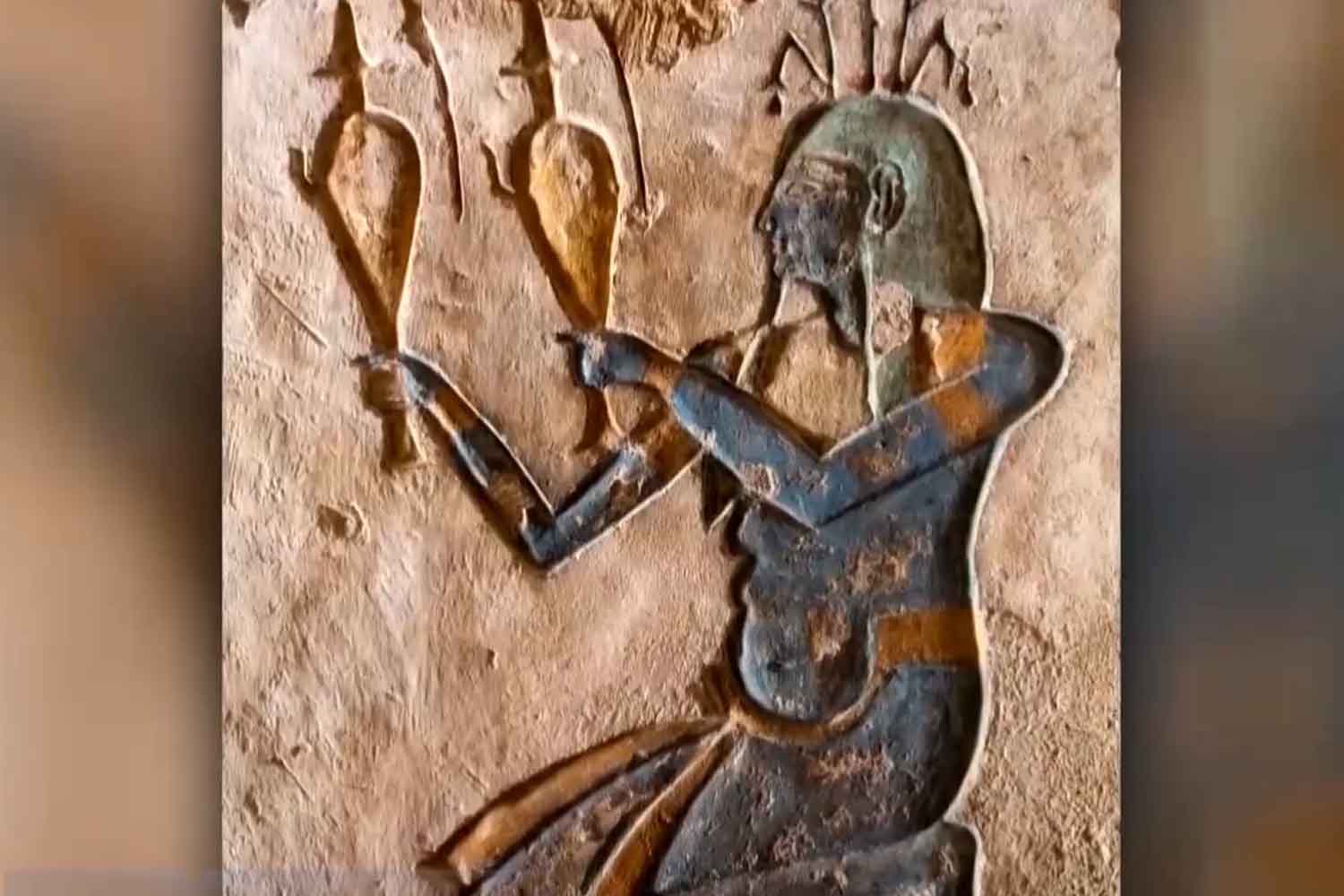
Archaeologists put the collapsed blocks of a wall back together and, piece by piece, they appeared four Hapi with arms full of offerings. Two on one side, two on the other, all facing the entrance to a chapel dedicated to Osiris. The scene had remained dismantled for centuries in the Montu enclosure, inside the enormous temple complex of Karnak, in Luxor. Now it is readable again thanks to the joint archaeological mission of Egypt and China.
The surprise, however, is not only in the age of the survey. The chapel dates back to XXV-XXVI dynastytherefore roughly between the 8th and 6th centuries BC, while the figures seem to look much further back: according to archaeologists they recall artistic characteristics of the Old Kingdom, the era of the great pyramids, approximately 1,500 years. A kind of pharaonic revival, only a few millennia ahead of the vintage trend.
Four Hapi carry offerings towards the temple
The find comes from the fifth of the Osiris chapels studied in the Montu enclosure, in the northern part of Karnak. The Sino-Egyptian mission has been working in the area since 2018 and in recent years has progressively reconstructed the layout of the buildings, documenting inscriptions, decorated fragments and structures that in some cases were only partially known. The Egyptian Ministry of Tourism and Antiquities recalls that Karnak was an entire complex of sanctuaries: in addition to the great enclosure of Amun it included those of Mut and Montu and dozens of chapels built and modified over the centuries.
In the new relief Hapi appears in pairs, with offerings in their hands and looking towards the door. There are also inscriptions left in front of the figures indicating what was brought as a gift. They are described by Wen Jing, researcher at the Institute of World History of the Chinese Academy of Social Sciences and member of the mission, in the report published by the Chinese Academy of Social Sciences.
Hapi is often dismissed as “god of the Nile”, a convenient but somewhat broad formula. It was above all there personification of the flood of the riverthe one that deposited water and sediments on the fields for millennia, making the valley cultivable. For this reason he was represented with a prosperous body, full belly and pronounced breasts: abundance, for once, did not need to be subtle. The Egyptian Ministry of Antiquities describes these traits as symbols of fertility and wealth linked to the flooding of the Nile.
Because a flood god appears in the temple of Osiris
Hapi’s presence in a chapel dedicated to Osiris may seem like an encroachment on divine competence. For the ancient Egyptians it was much less so. Different deities could coexist in the same ritual space and intertwine functions, symbols and myths.
Hapi brought with him the idea of fullness, nourishment and fertility; Osiris was closely associated with death and regeneration. Even the cycle of water and that of rebirth therefore ended up touching. Depictions of Hapi with offerings appear in numerous Templar contexts and continued to be used until the Ptolemaic era. A 26th Dynasty relief in the Walters Art Museum, for example, features Hapi in the same decoration with offerings and scenes dedicated to Osiris and Isis.
The most intriguing thing about Karnak comes from the proportions of the new figures. Wen Jing notes that in 26th Dynasty art Hapi tended to be depicted with more slender forms. These specimens are instead unusually massivecloser to models dating back to the Old Kingdom. The hypothesis put forward by the researcher is that the reference was deliberate: in late Egypt, very far from the political power of the age of the pyramids, recovering an ancient artistic language could serve to reconnect the present to a past perceived as glorious. It is a historical interpretation, therefore, and not something that the survey can declare on its own.
An unknown sacred lake also appeared in the same enclosure
Hapi is not the only piece to resurface from Montu’s enclosure. The mission’s eight years of work also produced inscribed fragments, a female representation linked to the so-called “Divine Adorers” and above all a structure that forced archaeologists to review the plan of the complex: a second sacred lakehitherto unknown.
The southern basin measures approximately 50 square metersreaches an overall estimated depth of about five meters and is covered in large blocks of sandstone. A ladder descends towards the bottom, probably to allow the priests to reach the water even when the level was lower. A northern sacred lake already existed in the enclosure: finding a second in the same sector was unexpected enough to surprise even the Egyptian colleagues, according to the Chinese head of the mission Jia Xiaobing. Part of the basin still remains buried in sediment.
The precise dating of the lake is still open. The materials and construction techniques are not enough to assign it to an exact phase and some blocks show traces belonging to different periods. Here the excavations still have to go down, literally.
For Hapi, however, the wall has already returned a curious story: images carved beyond 2,500 years ago by artists who, while working in their present, seemed to have their eyes turned towards a past another fifteen centuries old. In Karnak even antiquity, evidently, could be nostalgic for antiquity.
